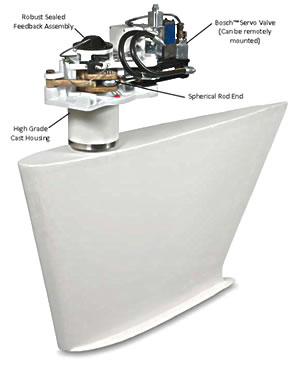
How is Match, after 4 months JFM?

Is pitch an issue? Do the stabs help?
Yes and no. Common sense dictates that two fins stabs can't do anything to reduce pitching, but in practice the dramatic roll reduction makes the boat behaviour feel more stable overall, hence you would probably perceive also a pitch reduction.
Four fins systems are in another league in this respect, but I've not heard of any installation so far in anything less than megayachts.
 
Interested in JFM's experience here. Is pitch an issue? Do the stabs help?

As mapis says, 2-fin stab systems do not do much to eliminate pitch. They can do a little, becuase roll and pitch are linked, but you'd be hard pressed to notice. So, even in a well-stabbed boat, it makes sense to avoid driving into head seas

In all seas other than pure head seas, there is usually roll and the stabs remove that pretty much completely. This makes them very useful in terms of ride quality and eliminating seasickness of guests. I boat that is pitching and lifting/falling is much nicer than one that is doing that and rolling as well.

This is particularly noticeable with a big sea on the quarter. he boat rises and falls but the rolling is eliminated so the corkscrew feel is eliminated. also the elimination of roll means the steering is easier so the a/pilot can keep going much better

I can honestly say that the "feel" of the stabs underway is that they totally eliminate roll. I know that in reality they don't remove it all, but they are so good that it feels pretty much as if they do. You watch big waves come towards your beam with nasty 45degree faces, and you know the boat should roll. But it doesn't. It stays flat. It is a really spooky experience; like riding on a magic carpet

Sleipner have an iPhone app so you can measure the effectiveness. See this screenshot, taken at anchor in a moderately rolly anchorage last week while they were working on the boat. Says it all!

stabsapp.jpg


I have more pics that I will try to find time to put on this thread, maybe tonight
 
Yes and no. Common sense dictates that two fins stabs can't do anything to reduce pitching, but in practice the dramatic roll reduction makes the boat behaviour feel more stable overall, hence you would probably perceive also a pitch reduction.
Yup, agreed
 
but I'm just curious to hear if you see reasons why without them they couldn't work at all.

Oh no, the could work with just a gyro and no computer/fancy algorithm, all agreed

But a fancy algorithm gives you better control. If the boat is still and a big wake comes, the first stroke of the (centred) fins is only half the angular stroke, and the algorithm can make it faster to allow for this. It can soft start the stroke to reduce twitchiness n cases where the fin speed is high, but not when it's slow. It can give different strokes depending on whether the roll is pure or there is some pitch too. It can allow you to do tests by deliberately inducing roll. Lots of things.

It's an 80:20 thing maybe. 80% of the effect can be done the old fashioned way with simple gyro. The other 20% needs the fancy computer
 
It's an 80:20 thing maybe.
Yeah, I guess so.
Actually, for stabilization at rest I wouldn't be surprised if a proper test would show a 70:30 effect, whilst I'd expect something more like 90:10 under way.
Tbh, I sort of agree with you also when you disagreed with my previous comment... :)
In fact, of course I also would go for electronically controlled stabs, these days.
I'm not even aware of any builder who still makes non-computer driven stabs.
My comment was more meant to point out the criteria I'd follow in the choice of such equipment. Something along the lines of...
Stabs=critical equipment=reliability first=go for the most tried and tested.

As an aside, I can also second your comments on pitching.
Interestingly, one condition which you mention (big sea on the quarter) is the most critical for pure D hulls, because they can only play with a limited speed range.
Those are the only conditions where I found myself wishing that my trawler was capable of cruising at a bit more than hull speed. Not a lot more - I'm not talking of a sea which would allow planing speeds anyhow - but sometimes 3 or 5 knots more could have been handy to "tune" with the waves and smoothen the ride pitch-wise.
But even in those conditions, I never had any sort of problem with roll, thanks God. As you said, stabs are unbelievably effective at making it almost disappear.

PS: what about those stabs videos? I for one would be curious to see them.
 
Something along the lines of...
Stabs=critical equipment=reliability first=go for the most tried and tested.

Well yes you can argue for that, but I don't 100% agree. If people only ever buy the "tried and tested", how do innovators find customers? I think it is good to buy the untried and support innovators - not blindly, only where you have checked the product is good. I'm happy to buy (in this case) a new product that I've personally examined the engineering of and personally got happy with, and which I believe is superior to the "tried and tested". Mine have 170 running hours and perhaps 100hrs at anchor, with no problems, which of course is not much but I strongly believe they will prove reliable. In return, Sleipner have given me full dialogue and support, full direct access to the main technical guy (who is a director and major shareholder) and his team. Quite a good deal.

Monday this week we went out to sea with a team from San Lorenzo including the engineering director, Paolo Bertetti . They are used to Tracs and Naiads because they have fitted them to SL88 and above for a few years. It was a f7 westerley with big breaking crested seas south of Cap D'antibes, and certainly the worst seas I have contemplated taking the boat out in voluntarily. The SL group called Sleipner in the morning to ask if the trip would be cancelled "because we assume the owner would not want to take his boat out in that sea?" Sleipner said nope, no cancellation. It's fair to say Paolo was VERY impressed with the performance of the Sleipners and privately told me I had an excellent set up.
 
If people only ever buy the "tried and tested", how do innovators find customers?
Well J, since you asked...
I'm afraid that quite often they just don't.
Particularly when there's no real innovation: you say they're "superior", but the only thing I've heard so far about your stabs which was new to me (though maybe it's available also from their competitors, dunno) is the iPhone app...
In fact, afaik Sleipner is struggling to be even considered by big stuff builders.
And when they are, it's mainly on the basis of better economic conditions which they're forced to offer.
Which is why SL is looking at them, I suppose (btw, isn't possibly Buttiglieri the guy you're talking about? I've never heard of Bestetti at SL).
Otoh, also Princess did evaluate them, but decided to stay with the market leader - and so did S/skr. There must be a reason...
Mind, I'm neither saying that there's anything wrong with the company or their products, nor that they won't find their place in this difficult market.
All I'm saying is that I wouldn't choose them for my own boat, and it's not just a matter of not being innovation-oriented: Raymarine has a much stronger tradition than Garmin for onboard electronics, but I understand the reasons for your choice and I would have probably done the same.
Not so for stabs, though.
All imho, as always.
 
There is much innovation about Sleipner stabs: double cylinder hydraulics not single; complete absence of a mechanical centre; lower mechanism height so they're easier to fit; ability to re-centre on the fly; the only builder who makes the fins in one piece

As for "there must be a reason" why princess haven't switched fully to Sleipner, and your apparent conclusion that Princess's knowledge of stabs counts for anything, I can only deduce that you don't know the real inside story about Princess's problems with stab installations...

Paolo Bertetti is googleable as a senior SL guy. Previously senior in the technical side at Azimut.

I'm happy to disagree on new design stabs versus older ones. I would agree that it's hard to innovate because the basic concept of a stab is already there, so innovation is around the small details only. I wouldn't claim the Sleipners are materially better at eliminating roll than a Najad or a Trac but I would claim that (i) as a matter of engineering a twin cylinder actuator is better than a single cylinder (Naiad and Sleipner use double, Trac uses single); (ii) Naiad's virtual non-use of a winglet just doesn't feel right and Trac's/Sleipner's big winglet feels better; and (iii) Naiad's non floating centre is a major engineering inferiority - they say on their website "Keyless taper allows freedom to install the NAIAD Assembly in any 360° orientation to simplify installation and maximize accessibility, plus allows the fins to be aligned and realigned in any desired position to suit hull flow lines" which is ridiculous because you have to crane the boat to adjust the angle whereas Sleipner (and Trac, maybe, though I'm not sure of the detail) lets you do it on the go. In addition, the Dashews are not particularly pleased with the engineering of their Naiads. Even going beyond the complaints of the Dashews, look at that ridiculously small round hull plate outside the hull through which the shaft passes - it's half the diameter of the Sleipner or Trac plate

I really am very happy with the new kid on the block Sleipners. Their performance is pretty stunning and they tick all the boxes on the engineering front (big winglet, floating centre, double actuator hydraulics) so apart from a sheep mentality of copying everyone else and general risk averseness I cannot see a reason not to choose them :-)

all imho too! :-)
 
Last edited:
Interesting mention of 170 hours/100 at rest for the Sleipners on Match. I would be curious to see how the total hours of stab use compares with engine hours given that these stabs work at rest and not just when making way.

Just to get a picture of how big a proportion of the time a boat spends not tied up in a berth actually running under power.
 
Interesting mention of 170 hours/100 at rest for the Sleipners on Match. I would be curious to see how the total hours of stab use compares with engine hours given that these stabs work at rest and not just when making way.

Just to get a picture of how big a proportion of the time a boat spends not tied up in a berth actually running under power.

I'be been thinking of fitting a maplin-ish hour meter to the 230v at-anchor stab hydraulic pump BJB. Then I could add that to the engine hours to get the stabs total service hours. (Because the stabs are on pretty much all the time except when genset is off eg in the evenings)

I could use the genset hours but I'm mixed as to whether I have a genset on underway or not

My genset hours run at about double the engine hours (in total, not for each genset, and i nearly always run only one at once). Same on this boat as previous boats.
 
the Dashews are not particularly pleased with the engineering of their Naiads.
Interesting link, thanks.
It was funny to read, at the bottom of that webpage, that they actually confirm what I said of my rather old stabs which kept working for 15 years without ever missing a beat: "You could say that having covered in excess of 45,000 miles without incident, including debris strewn waters in British Columbia and Alaska, and then dealing with ice in Greenland and Svalbard, would qualify NAIAD for a pass on this"
Which was my point exactly: call it a sheep mentality if you wish, but for such a critical equipment, that's what I'm really interested in, rather than some sort of theoretical superiority. Also because, even assuming that there is any, as you also say (I wouldn't claim the Sleipners are materially better at eliminating roll...) it doesn't translate in any practical advantage.
Besides, actually I would never even consider fitting fin stabs on anything capable of cruising at more than a dozen knots, and even more so if not fully enclosed in specific watertight compartments.
That's another point where we must agree to disagree, I suppose! :)

PS: I just googled for PB+SL, but couldn't find any reference. Otoh, there are plenty for PB+AZ. Did he move recently?
 
Which was my point exactly: call it a sheep mentality if you wish, but for such a critical equipment, that's what I'm really interested in, rather than some sort of theoretical superiority.
I can't share your non-support of innovation here. Sure, nobody ever got fired for buying IBM I suppose. But to ignore the possiblility of superiority (real not theoretical) in a new product isn't how I'd do a boat. Much of the fun in doing a boat is non-sheeping it.
you also say (I wouldn't claim the Sleipners are materially better at eliminating roll...) it doesn't translate in any practical advantage.
Hang on. I said I wouldn't claim a sleipner will be better at reducing roll, but that doesn't mean it won't be better. Just looking at the current Naiads (pic below) you can see they have quickly stuck a 30mm flange all round the bottom so they can claim to have dealt with the vortexes. Surely you can see MapisM that their winglet is a joke. It's obvious. I would be embarrassed as an engineer to be associated with such a thing. With that "winglet", it is easy to be sure the naiad needs a bigger fin to have the same anti-roll effect as Trac or Sleipner, which have proper winglets. That means more drag underway with Naiad, especially in a P boat. That is a "practical advantage" of Sleipner and Trac compared with Naiad.
Besides, actually I would never even consider fitting fin stabs on anything capable of cruising at more than a dozen knots, and even more so if not fully enclosed in specific watertight compartments.
That's a fair policy to adopt and I wouldn't criticise you for it, even though I'd follow a different policy for a "leisure use" boat.

I don't know how recently PB moved Azimut -> SL. I just googled (.co.uk) "Paolo Bertetti san lorenzo" and he is in all the first 3 entries, all mentioning his SL job.

Naiad's, erm, "winglet", about which they write "Trailing vortices are formed by the communication of high and low-pressure regions across the lifting surfaces over the fin tips. NAIAD tip fences re-distribute the strength of the trailing vortices, effectively reducing the induced drag of the fins". Er right, ok then.
naiad-fin-1.jpg
 
nobody ever got fired for buying IBM I suppose.
LOL, yeah. Funny you mention it: the first big project I dealt with at the beginning of my career was a downsizing from an IBM mainframe.
At that time, I was alone in recommending Sun/Unix, and the steering committee finally went for IBM AS/400.
Just a few years later (I moved elsewhere in the meantime) they abandoned the AS for Unix.
Still with IBM hardware, though - which they're still using nowadays, afaik.

Anyway, each to their own.
You obviously did your homework with this equipment, and I'm neither interested nor willing to make detailed comparisons with any other brands.
All I was saying is that for such critical equipment, which can even sink a boat, I'd rather have someone else testing the new kids on the block, as you called them. And I rest my case, in this respect.
If in 10 years time I'll be considering a new boat, maybe Sleipner will be high on my short list, who knows? Not now, anyway.

As an aside, it's interesting to see how quickly google reacts to searches. Aside from the fact that I'm using the .com rather than the .co.uk, today I'm actually getting different results by the same search!
 
I'be been thinking of fitting a maplin-ish hour meter to the 230v at-anchor stab hydraulic pump BJB. Then I could add that to the engine hours to get the stabs total service hours. (Because the stabs are on pretty much all the time except when genset is off eg in the evenings)

Well, that's really why I thought of the stabs: because you're probably going to run them most of the time you are underway. I don't think you'll uncover the secrets of the universe but it might be interesting, nevertheless. I reckon you'll find the stabs are on maybe three or four times as much as the engines what with overnighting and so on which would bear out MapisM's comment as to their significance being second only to the engine/drivetrain.
 
Well, that's really why I thought of the stabs: because you're probably going to run them most of the time you are underway. I don't think you'll uncover the secrets of the universe but it might be interesting, nevertheless. I reckon you'll find the stabs are on maybe three or four times as much as the engines what with overnighting and so on which would bear out MapisM's comment as to their significance being second only to the engine/drivetrain.
Yup. BTW, I dont plan to overnight with them. If an anchorage is bad enough to need stabs I'd go somewhere else for the night, generally. I hate running gensets all night on this size of boat (on principle, 3.3litres each, and because of the noise which of course becomes apparent at night) and have got all the fridges etc running off inverters and a mastervolt gauge thing that tells me the remaining hours on the house batteries
 
Well, that's really why I thought of the stabs: because you're probably going to run them most of the time you are underway. I don't think you'll uncover the secrets of the universe but it might be interesting, nevertheless. I reckon you'll find the stabs are on maybe three or four times as much as the engines what with overnighting and so on which would bear out MapisM's comment as to their significance being second only to the engine/drivetrain.

However, the consequences of failure are not the same as the powertrain. While Match may be uncomfortable without the stabs, she is not in danger unless there is a chatastrophic failure of the shafts/seals (clouting a stab on something substantial at speed?), whereupon she might take on water. I'm assuming this mode of failure has been properly thought through, and would thereby fail safe, but I'm sure JFM will be on in a while to confirm.

With respect to Luddites versus innovation, while there is always a risk of being the first to market, with a decent supplier behind you, there is the benefit of the extra customer service, as the supplier learns from the application. It appears that John is enjoying this benefit now, having done some due diligence prior to placing the order.
 
. So we ran the boat at 20 knots and it was using 19 litres/mile with the original setting, then Sleipner re-set the centre at 20 knots not 30, and instantly the fuel burn dropped to 17 litres/mile.

mmm that's interesting,

had a full fuel tank on Blue Angel,
refueled 2471 liter after 162nm,
this equals 15,25l /nm

not too bad for a 20yo boat, and +70 Ton weight
when new, on paper dry weight was 64,5T
previous owner told me it is approx 70T, measured on a liftout

cruising speed was 18..20kn

:D I am happy to say that I'm pleased with the fuel consumption of my boat :D
 
I'd be amazed if you get 15.25 l/nm at 19kts and 70t Bart. It kinda defies laws of physics. I'd expect you can get a couple of hundred litres difference on filling up depending on how careful the pump guy is to fill to the brim or just stop when he sees/hears foam. Best to measure it electronically or over several fill ups imho. Still, you must be getting pretty good consumption - good news!
 
I'd be amazed if you get 15.25 l/nm at 19kts and 70t Bart. It kinda defies laws of physics. I'd expect you can get a couple of hundred litres difference on filling up depending on how careful the pump guy is to fill to the brim or just stop when he sees/hears foam. Best to measure it electronically or over several fill ups imho. Still, you must be getting pretty good consumption - good news!

it is what it is John,
I agree about the aproximations,
but all figures I have confirm 300l / 20nm
and this has Alfonzo been using to calculate his fuel range for many years,

haw does this defie laws ?

do you know the influence of the drag of your stab fins on fuel consumption?
must be a complex water flow along them,
but from a certain depth, the flow along them must be in line with the boats cruising direction, so even if you "set" the best angle, there will alway's be
strong forces on the fins = drag and extra fuel
any idea how much ?

after a few hours cruising with nasty beam waves, Elly wants stabilizing fins on Blue Angel :D
 
Top