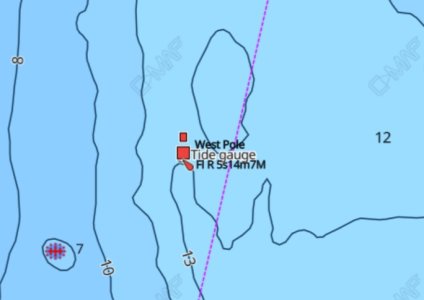
How far away can you spot the West Pole beacon, off Chichester, in daylight?

Greenheart

Well-Known Member
Joined
29 Dec 2010
Messages
10,384
Visit site
I admit it's not a very serious question.

Yesterday I sat on the slipway at Seaview in all the lunchtime heat and hunted around with full zoom for distant features of interest.

Scarcely a clear view, but I was surprised to be able to pick out the West Pole at a clear seven nautical miles.

54645484614_a138af2ce5.jpg


I thought I'd spot Chichester cathedral but it wasn't visible, so I was happy to identify the West Pole with relative ease. If it wasn't so hazy I might have read the name.

I know, different conditions, times of day and possibly elevation would assist clarity of long views. Are there any really good pics of distantly observed marks or features?

Please, for sailing relevance let's keep photos terrestrial and as close to sea level as possible. :sneaky:
.
 
Depends how good your eyes are, and you hight on your vessel avove sea level.

In my case, it is about 4 miles with the naked eye as we have an elevated pilothouse.

Measured when I spotted it by putting the plotter cursor on it and reading the distance.

To be fair, after leaving the Looe Channel, I know EXACTLY where to look, so far easier for me, a regular in the area, than a newcomer.
 
When you say full zoom doesn’t that depend on the device you use? We are somewhat higher in Seaview than the slipway (whichever one you mean they are roughly the same height😀) but never seen the WestP mentioned but I’ve not really looked but curious as to the lense on the camera as I guess some have better clarity than others but photo buff.
 
I saw it yesterday from the outer passage through the submarine barrier, a distance of approx 5 miles. From the cockpit of a 30' sailing boat, so about 2 metres above sea level, with the naked eye.
 
The calculation for distance to the horizon in nm is 1.25 times √(height in feet). You sum the two if both eye and object are elevated.

West Pole is 14m (46 feet) tall. Sq rt of 46 is 6.8 times 1.25 is 8.5 miles. The light is red (harder for eyes to see) so it's calculated as being visible at 7M shown on chart. In daylight, you should see the top of it at 8.5 miles, more of it if your eye elevation is above sea level.

Say you're on deck at 9 feet up, that's another 1.25 times 3, ie 3.75 so you should be able to see the top of it 12 miles away.

You'll notice green and white lights have better visibility range for their height than red on the charts. It's also why brake (and red traffic) lights are the first things to go blurry as your eyesight deteriorates with age.

wpole.jpg
 
Last edited:
When you say full zoom doesn’t that depend on the device you use?
New Nikon bridge camera. I'm no photographer and I'm probably misusing it entirely, but till I learn all its functions and options, I'm enjoying using it as a telescope that takes photos.

I saw it yesterday from a distance of approx 5 miles with the naked eye.
I call that very good eyesight. Although I daresay you knew where to look for it, and were expecting to see it, whereas it popped up in my Nikon's viewfinder unexpectedly, but recognisably. It's a shocking reflection...I don't think I've sailed or motored past the West Pole, this century. 😯
 
I will dust off my small Nikon and see what I can see from the heights of Seaview -the version I have is fairly old but I did get some good pictures sitting at the St Helens Duver of the foiling yacht from the Camber team Ineos a few years ago. You did miss a great red moon from the Seaview front last Thursday
 
There's a moon setting on my P1100. I haven't given it much use yet. I hauled it up to Tennyson's Down today but there was thick mist all around. :ROFLMAO:
 
Top