
How do you use 2 pack epoxy paint?

TiggerToo

Well-Known Member
Joined
23 Aug 2005
Messages
8,409
Location
UK
Visit site
I have never used this; now, I'd like to try some to paint Tigger's lockers. The instructions are not very clear: once you have mixed the two components together, how long does this remain useable? I ask, because I'd like to give a couple of layers: should I mix only a small portion at a time?
 
I have never used this; now, I'd like to try some to paint Tigger's lockers. The instructions are not very clear: once you have mixed the two components together, how long does this remain useable? I ask, because I'd like to give a couple of layers: should I mix only a small portion at a time?

The paint manufacturer's product data sheet should give you this information. q.v.

Pot life will vary with temps. You wont be able to use any mixed for one coat for a subsequent coat! Only mix what you can use within the pot life time
 
I use Jotun Jotamastic and the pot life is usually about an hour and a half. I use cheap brushes from Screwfix and throw them away afterwards. Thinners to wash them is much more expensive than the brushes.
 
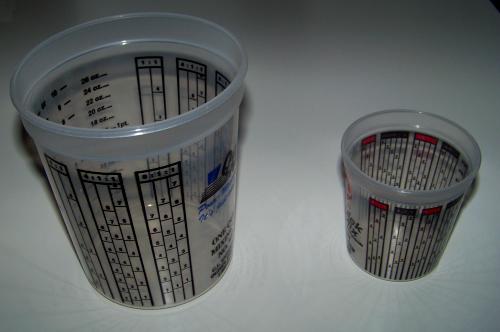
DON'T mix all of the two tins! Buy yourself a plastic mixing cup and it will have markings for different quantities and mixing ratios printed on the side. They are very cheap and are reusable; if you let the paint that remains in the cup cure fully, preferably overnight, you can peel the dried paint off.

They look like these:

mix_cups-2.JPG
 
Read the spec carefully when mixing part pots. The mix ratio given may be for weight and not volume..... my physics is not up to enough tonight to work out if that could be different!!!

Rather them using 2 mixing pots, use a set of scales that will zero after the first lot is measured out.
 
I have never used this; now, I'd like to try some to paint Tigger's lockers. The instructions are not very clear: once you have mixed the two components together, how long does this remain useable? I ask, because I'd like to give a couple of layers: should I mix only a small portion at a time?

Not sure why you would want to use 2 pack for lockers. What are you trying to achieve that easier an cheaper alternatives can provide?
 
Two pack needs priming and good prep, and produces a great hard wearing finish. Whereas locker and bilge paint has loads of pigment, you can slap it on and job's a good 'un. Not quite sure what you keep in your lockers that warrants such exotic surroundings as two pack paint finish? Aso, not all two packs are the same. Some are fussy about what you have on there first and may dissolve incompatibe under layers with interesting cosmetic results.
 
I have to say I wondered why you're using 2 part epoxy for lockers too.

If in doubt mix in small quantities - be sure to get your maths right as you only get one try.

I stick to recommended ratios with mixes for paint or adhesives and am meant to be a reasonably quick worker when people see me do things on my boat or home, but I sometimes end up with the stuff beginning to go off, if it did completely it would be an expensive way to get a small bucket shaped brick even if nicely coloured.
 
Some are fussy about what you have on there first and may dissolve incompatibe under layers with interesting cosmetic results.

That's a fair comment that probably would benefit from a little more explanation.....
Most (if not all) 2 pack paints CAN NOT be painted over any other 'normal' paint. The chemicals in the 2-pack will dissolve the 1-pack leading to 'interesting' results. (epic fail)
 
I have never used this; now, I'd like to try some to paint Tigger's lockers. The instructions are not very clear: once you have mixed the two components together, how long does this remain useable? I ask, because I'd like to give a couple of layers: should I mix only a small portion at a time?
Just done Elkefair's bottom with two different types of two part epoxy and both became unworkable after 25 to 30 minutes despite pouring the mix out of the pot and into a tray. This was at 14 degrees C under a complete tent covering the boat.
If you leave it in a pot it can get hotter and set faster so spreading it out in a thinner layer in the tray kept it cooler.
Don't be tempted to alter the ratio of resin to hardener recommended by the manufacturer especially if the temp is a bit low and you think that adding more hardener will make the mix set quicker.
Good preparation is vital and wash off the first layer with soapy water then rinse before applying a second coat.
 
wash off the first layer with soapy water then rinse before applying a second coat.

This only applies if the first layer has substantially cured, and is generally a precaution against its having developed amine blush. This is a waxy layer which can form during curing, particularly in cool, humid conditions (= UK much of the time). Some epoxies are more prone to it than others, West being possibly the worst.

If the first layer is still tacky, there is no need for such washing. Indeed, this is the best time to overcoat as it ensures the strongest chemical bond.

If the first layer has fully cured, it will need abrading for a 'key', whether amine blush is present or not. Manufacturer's data sheet will give specific info on open time/curing time, etc.
 
Top