How do you mount companionway stairs?

coopec

N/A
Joined
23 Nov 2013
Messages
5,211
Visit site
I picture a 14 stone (90 kg) crew member scrambling up the companion-way stairs when the yacht is on a 45° heel and the stairs give way.:oops:

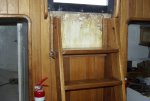
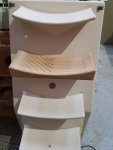
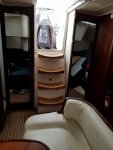
I've done the best I can but is there something further I can do? I hesitate to upload photos as the stairway looks very tatty but for sake of clarity see below..

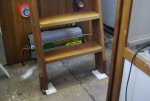
I've used sturdy over center toggle latches to hold the ladder in place between very solidly screwed retaining hardwood timber pieces. The retaining pieces are bolted to the 9mm ply sole with large washers (but I plan to replace the washers with SS plate) I will have to put latches on the floorboards to ensure they can't move.
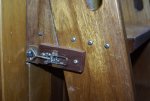
imgonline-com-ua-resize-DPlSRY2n7Q3.jpg
imgonline-com-ua-resize-HFJsHv0dNWscJF.jpg

imgonline-com-ua-resize-sToJ1vUjRJKOx.jpg
 
Ours are a similar design but they have a sort of hook attachment at the top and bolts into the cabin sole at the bottom. I’m over 90kg and well over 6’ and I’ve never worried about their security.

The hook arrangement is two strips of stainless that locate and slide down behind two stainless strips bolted to the companionway threshold. You lift the whole steps vertically a few cm’s to remove them.
 
Thanks for that John.

"and bolts into the cabin sole at the bottom" That's got me.

I used toggle clamps as in an emergency I can discard the ladder quickly and raise the floor to (say) get at the main bilge pump or sort out some electrical problem. With your set -up can you do that?
 
The arrangement on my previous boat sounds similar to John's. The top of the steps hooks under a retainer (a wooden block shaped like a miniature croquet hoop in my case) so that they can't be pulled towards you. The steps can only be removed by swinging the base of the steps outwards and this is locked in place by a barrel bolt on each leg into the floor, or in my case the top of the engine cover. All very neat.

Edit: the hook on the top isn't a hook as such, just a tight fitting block of wood. Provided the base is locked in place you can't pull the top of the stairs towards you due to the angle. Ie they would need to swing up before you can remove them which the block stops them from doing.

In your case ditch the over centre latch and fit a goalpost shaped block of wood over the top of each upright. Remove the blocks on the floor and add a vertically mounted barrel bolt on inside edge of each leg ?

A bit of felt or foam on the underside of the block / hoop where you can't really see it stops the stairs rattling
 
Last edited:
The trouble with the OPs steps - if there is a trouble - is that if any ropes were to drop through the hatch & catch the toggles they could open them without anyone noticing. The steps can then pivot back.
I would prefer a piece of angle each side of the wood stair string & a pin passed through.
You do not need anything more on the feet. One only needs to restrain sideways movement.
However, that may be over thinking it & the system looks secure enough.
From the picture it appears that the top step is small for a big foot & one can only get one's toes on it. If wet it may cause one to slip. If the step was mounted further away from the engine casing it would make the step effectively wider. I assume that there are decent hand holds above. The ones in the step are not high enough for anyone climbing the steps.
 
Last edited:
The companionway is often a wet place on a boat. Not a good location for any exposed electrics, but particularly an inverter producing mains voltage.

I plan to put a cover over the top. An inverter must be in the open to assist cooling and should be mounted close to the battery bank to avoid voltage drop. I did read the manufacturers instructions! :( (but I didn't have a lot of choices)
 
Last edited:
The trouble with the OPs steps - if there is a trouble - is that if any ropes were to drop through the hatch & catch the toggles they could open them without anyone noticing. The steps can then pivot back.
I would prefer a piece of angle each side of the wood stair string & a pin passed through.
You do not need anything more on the feet. One only needs to restrain sideways movement.
However, that may be over thinking it & the system looks secure enough.
From the picture it appears that the top step is small for a big foot & one can only get one's toes on it. If wet it may cause one to slip. If the step was mounted further away from the engine casing it would make the step effectively wider. I assume that there are decent hand holds above. The ones in the step are not high enough for anyone climbing the steps.
I doubt that ropes could undo the toggle latch as they are very firm. (But I will look at it )

I agree with you re the top step: it needs to be wider than the rest of the steps.

If you look at the third photo you will see the bottom of the handhold which goes almost to the cabin roof.
Thanks
 
The arrangement on my previous boat sounds similar to John's. The top of the steps hooks under a retainer (a wooden block shaped like a miniature croquet hoop in my case) so that they can't be pulled towards you. The steps can only be removed by swinging the base of the steps outwards and this is locked in place by a barrel bolt on each leg into the floor, or in my case the top of the engine cover. All very neat.

Edit: the hook on the top isn't a hook as such, just a tight fitting block of wood. Provided the base is locked in place you can't pull the top of the stairs towards you due to the angle. Ie they would need to swing up before you can remove them which the block stops them from doing.

In your case ditch the over centre latch and fit a goalpost shaped block of wood over the top of each upright. Remove the blocks on the floor and add a vertically mounted barrel bolt on inside edge of each leg ?

A bit of felt or foam on the underside of the block / hoop where you can't really see it stops the stairs rattling

I didn't think of using barrel bolts to locate the bottom of the ladder. Maybe these would've been the way to go?

I have to work out how to locate the floor from moving....

Screenshot 2021-12-05 at 19-18-20 Chicken Coop Spring Loaded Latch Barrel Bolt Box Bolt Durabl...png
 
I added self-adhesive non-slip strips to our steps. My wife objected on aesthetic grounds but soon came to realise how much more secure they are, on unvarnished wood.
 
My steps don't secure to the cabin sole, they clip to the front of the engine enclosure.
This means you can have the steps secure while the cabin sole is lifted for cleaning, drying the bilge, or as now, taken home for varnishing.

I remember sailing on one boat, forget what, where the steps were hinged at the top, so could just be lifted to access the engine.
A set of steps doesn't half get in the way when you're working down below, and it's a big heavy thing that will do damage if it falls on other woodwork.
Especially if like mine, it has a 2kg fine extinguisher added to it.
 
My steps don't secure to the cabin sole, they clip to the front of the engine enclosure.
This means you can have the steps secure while the cabin sole is lifted for cleaning, drying the bilge, or as now, taken home for varnishing.

I remember sailing on one boat, forget what, where the steps were hinged at the top, so could just be lifted to access the engine.
A set of steps doesn't half get in the way when you're working down below, and it's a big heavy thing that will do damage if it falls on other woodwork.
Especially if like mine, it has a 2kg fine extinguisher added to it.

Mine is similar to yours. I think... The steps hook into two substantial eyes at the top and I have 4 chubb door locks into the engine cover, 2 each side

Companionway.jpg
 
Island Packet use a female socket, round plates with a protruding short tubes, at the top. The steps have tubes that go inside these and are then secured by cross pins.

At the floor the lowers go into 'U' shaped hardwood guides. These stop sideways movement.

Simple and effective, but require composite, teak and S/S tube companionway steps to work.
 
May be a bit late, but I much prefer steps which are curved upwards at the ends, as these are much easier to use at sea when the boat is heeled.
That makes sense with long runs, as with centre-cockpit boats, but the main thing is that the steps should be enclosed at the ends. I know of two designs where the step ends at the galley sink.
 
Mine is similar to yours. I think... The steps hook into two substantial eyes at the top and I have 4 chubb door locks into the engine cover, 2 each side

View attachment 126867
I know this is thread drift...apologies....
But this photo has answered my search for a design to make a plate and cup rack and for adding a worktop to the left of my cooker...
 
I know these are a different design to yours but I removed vinyl pads and made new treads from blocks of iroko on a cnc. These are bonded to the grp with sikaflex.steps resized.jpgsteps complete resize.jpg
 
I would put two holes in the floor under the step legs and insert a metal peg into the bottom of each leg.
That takes care of the bottom end. You could do the same at the top but with horizontal pegs and holes in the bulkhead. The side latches will keep it in place.
 
Top