How do you get on and off the boat ?

dunkelly

Well-Known Member
Joined
28 Aug 2018
Messages
286
Visit site
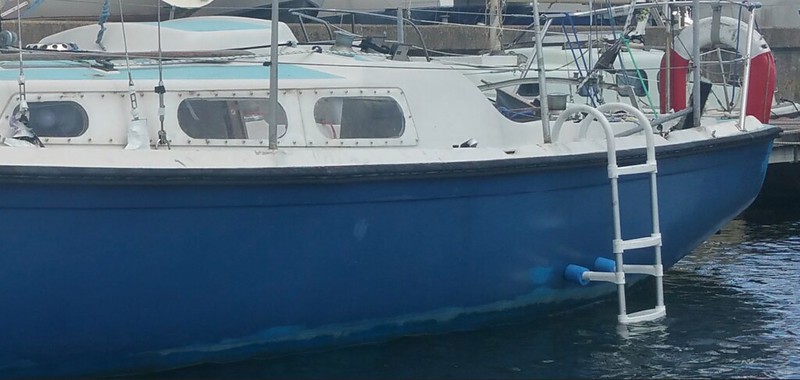
This may at first seem a trivial question , however . We have after a long period abroad cruising returned home and wanted a different sort of sailing experience - to that end we've gone for a bilge Keeler with the intention of taking to the ground as often as possible . We have a small folding boarding ladder which works ok at sea but there's now way my aging partner would ever manage to get on and off when we take to the ground . We've bought one of these collapsible ladders which may be ok but wondered if anyone else was more used to doing this than us and if they have good systems already worked out .
 
This may at first seem a trivial question , however . We have after a long period abroad cruising returned home and wanted a different sort of sailing experience - to that end we've gone for a bilge Keeler with the intention of taking to the ground as often as possible . We have a small folding boarding ladder which works ok at sea but there's now way my aging partner would ever manage to get on and off when we take to the ground . We've bought one of these collapsible ladders which may be ok but wondered if anyone else was more used to doing this than us and if they have good systems already worked out .
Carry an aluminium ladder of the correct length. Lash it to the guardwired when not in use like you would with a fender board
 
Drying out and climbing on and off sounds a great idea but in reality with a decent size boat and a draft of over 3' plus high topsides it becomes less attractive except for the young fit amongst us!. Carrying a ladder is a good idea - any kind of on board ladder is difficult. My first "big" boat was shallow draft with bilge plates and I sail in a location with shallow water and many places to dry out, but in reality in the first 10 years I could count on the fingers of my hands the number of times we actually dried out - even with young children, so I removed the plates and deepened the keel by 9" which improved sailing performance and I never missed the loss. I now have a bigger version of the same boat but doubt I will ever dry out.
 
One of those telescopic ladders surveyors use should fit the bill and not take up too much space in the meantime.

I think surveyors more often use folding ones (happy to be corrected if I'm mistaken), and if you can accommodate the additional width I would think these more suitable than telescopic ones.

I have a telescopic one for accessing my boat deck when ashore. Good for what it is, but surprisingly heavy; will not like sand, grit and salt getting in the sliding or latching mechanisms; and, I suspect, vulnerable to getting stuck open or closed if the telescopic tubes are dented. (And be very careful to keep fingers and thumbs out of the way when when collapsing them - can cause serious pain/damage.)
 
Our Westerly Pageant came with a longer boarding ladder, this made it easier.
Very useful if you fall in the water.

For the Catalac I made a boarding ladder, this is stored tied to the guard rails when not in use.
The boarding ladder is again long enough when dried out but could do vith a few more rungs to be easy and for mob.
 
Should you be on the East Coast, you need to avoid the mud, as it makes drying out somewhat uninviting, that is unless you are the mastodon from Secret Water.
The collapsing aluminium ladders fill up with rain water, which pours out when you collapse them and pick them up. A lightweight fixed ladder of the correct length lashed to the rails would be my choice.
 
With my 1.5 m fin keel I can get to the ground via the boarding ladder and just about get back again, though I would normally use a folding step. As a rule, it is a good idea to have a good boarding ladder, if only for quick recovery of MOBs when not under way, but I can’t say that it s an easy way for the less nimble and agree that some sort of folding ladder might be better for many.
 
We have a folding ladder located midway in the pushpit. It was designed to be a sellable item but attracted no interest.
It performs two functions;- when deployed vertically, the bottom rung is two feet below the water to aid recovery from the water.
When extended horizontally, it acts as a passerelle. It has "flat" rungs to aid this. (We call it a ladderelle).
In the cockpit deep locker, we carry an extension which allows disembarking when aground (bilge Keeler). We also carry four wheels which we can attach to the extension that turns it into a trolley.
 
I bought a fairly inexpensive, very lightweight aluminium boarding ladder for the Achilles 24. I was surprised how much it flexed under my weight, but the freeboard was minimal and I might have been able to board from a swim, without it...I just liked the idea of a swim-ladder.

52738686608_cf8a6e9c5c_c.jpg


When the boat came ashore I was amazed how damned awkward it was to get aboard each time, and I usually borrowed a folding ladder.

Whatever boat I buy next, I'll equip it with a long-enough, sturdy aluminium ladder, and stanchion-supports so the guardwires can be freed while the ladder is in use. I won't buy a boat that can't take the ground, and the idea of that versatility being restricted because it's hard to get aboard or ashore at low tide, is preposterous.

A tough, rectangular-section aluminium ladder may not be pretty but there's beauty in its usefulness and convenience, and it could be a lifesaver. I'll strap one to my pushpit with pride.
.
 
Last edited:
I got a local fabricator to make me a longer folding section for the transom mounted bathing ladder already fitted to my boat. This was intended to improve it's original purpose but it's now long enough to climb aboard when aground. Even chocked up in the boat-yard, no other ladder is required.
 
Slight Fred Drift ere ; I have body strength issues , so need a Hand Hold higher that the Boaring Ladders usuall have , to enable me to reach higher and pull myself up ; as without the higher hand hold I cannot get myself up n off any Boarding Ladder

Its a bgr and of course can be dangerous for me
 
Can only dry out against a wall. Boat came with suitable length alloy ladder. It stows against the guardrails along the foredeck. Nice and simple, out of the way most of the time but very useful when dried out or ashore. I did use it once as a fender board when we had to moor alongside a pier supported by wood piles.
 
We have an old beer bottle crate on a rope we can lower to the ground. Makes a very handy first step after you get to the bottom of the ladder that folds down from the stern, if you have dried out (or in the boat yard). However this is a vertical ascent, manageable for my wife and I. It does require some upper body strength. A proper ladder (extendable or otherwise) of some sort is much easier and works for my son who has a physical disability. And can give a handhold as high as you need according to length. We had a whole season with a wooden ladder lashed to the grabrails.
 
We have an old beer bottle crate on a rope we can lower to the ground. Makes a very handy first step after you get to the bottom of the ladder that folds down from the stern, if you have dried out (or in the boat yard). However this is a vertical ascent, manageable for my wife and I. It does require some upper body strength. A proper ladder (extendable or otherwise) of some sort is much easier and works for my son who has a physical disability. And can give a handhold as high as you need according to length. We had a whole season with a wooden ladder lashed to the grabrails.
Similar for me, but I generally use a folding step or the ship’s bucket if I am drying out. When ashore for the winter I have various ladders that are much higher, a light step-ladder being the easiest, tied to the boarding ladder for safety. We occasionally have similar problems when boarding or alighting from the bow, common in the Baltic and occasionally in the Netherlands. People use various arrangements for the bow, but stepping from the anchor onto folding steps was enough for us until madam’s knee gave out, when the process was accompanied by assorted complaints, usually directed at me.
 
Top