
How do I adjust this furler bottlescrew?

FinesseChris

Well-Known Member
Joined
3 Sep 2001
Messages
282
Location
Emsworth, boat Emsworth YH
Visit site
I would like to shorten my forestay to improve tension. There's a bottlescrew hidden inside the perforated chainplate fitting at the base of this Plastimo 406 furler, presumably to allow just that. But how can you adjust the bottlescrew without distorting the fitting?
Plastimo's how-to instructions are not helpful.
I expect lockdown is making me dimmer than usual, but...
Thanks allFurler adjust.jpeg
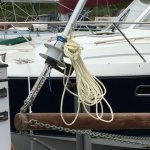
 
I hate it when boat riggers do that. it is just daft. On one boat I had the furler system secured just aft off the bottle screw secure point....I may have made up two small triangles of stainless steel plate..... I can't remember. On another I placed a bolt or longer clevis pin through the top of the furler chain plate and then threw the top of the bottle screw and bent the lower ends outwards so I could always access and monitor the bottle screw. If never going to need the length of furler chain plate, cut it off once secured to top of bottle screw. To me, the furler secure point should be independent of the forestay secure point.
 
These were originally supplied with a pin secured by either a split pin both ends or a pin threaded both ends and nylock nuts in place of the socket cap bolt and nut in the picture. Crude. Often naively replaced by a bolt as is the case here. Revert to a pin as described above.
To adjust remove both split pins or nuts, spring/bend (it is crude) the stainless tangs to release from the pin and slide the whole unit and foil up the stay . Adjust the rigging screw taking care not to disengage the pin (temperay replacing the nuts or split pins is wise) Reassembly is the reverse. The installer who thought they were being clever and used a bolt may also have fitted the top foil section long enabling a longer luff sail while not understanding the purpose of this space, if so you are out of luck and until the issues are resolved out of options as well.
 
Secure mast with halyards forward
Slacken backstay
Undo cap head bolt holding furler and forestay
Slide furler up and tighten bottle screw
Replace cap head pin
Tighten backstay

You could replace the pin and forestay and tighten the backstay to where it was, then tighten the forestay before loosening the backstay again to attatch the furler.
 
I have a plastimo 1012t. to adjust my bottle screw i disconnect the perforated parts at the base, slide the furler up the forestay, tighten/loosen and refit.
 
I would like to shorten my forestay to improve tension. There's a bottlescrew hidden inside the perforated chainplate fitting at the base of this Plastimo 406 furler, presumably to allow just that. But how can you adjust the bottlescrew without distorting the fitting?
Plastimo's how-to instructions are not helpful.
I expect lockdown is making me dimmer than usual, but...
Thanks allView attachment 106965


It's not clear whether or not you have appreciated that the 'perforated chainplate fitting' is attached to the forestay only at the bottom end. The top end, and the whole furling gear, can slide along the forestay. So a changed bottle screw length will not itself distort the chainplate fitting.

The only issue you face is having enough space to grip the bottle screw to turn it to make the adjustment. Others have described above how you address that.
 
I have a plastimo 1012t. to adjust my bottle screw i disconnect the perforated parts at the base, slide the furler up the forestay, tighten/loosen and refit.

The problem is that the OP can't disconnect the perforated parts without disconnecting the entire forestay.

Pete
 
The problem is that the OP can't disconnect the perforated parts without disconnecting the entire forestay.

Pete
Yes, shoddy cheap work. The furler system should be completely separate from the forestay to allow adjustment. Yellow ballad above describes the solution but when reconnecting separate the systems from the single bolt.
 
Yes, shoddy cheap work. The furler system should be completely separate from the forestay to allow adjustment. Yellow ballad above describes the solution but when reconnecting separate the systems from the single bolt.
I thought that if installed as intended the side plates should be secured to the stem head ( bowsprit end) using the bottom holes and that the forestay, or bottle screw in this case, should be secured to the same point ( or to the side plates one or two holes higher. ??)
An M8 setscrew and nut is supplied with the "chain plate" version . An 8mm diameter clevis pin is supplied with the "turnbuckle" version
Its not 100% clear in the photo but the bottle screw appears to be secured to the bottom holes along with a toggle between there and the bowsprit end

It can be adjusted as Yellow Ballad suggests in #5
 
Last edited:
On mine I had a Clevis pin at the bottom. I undid the bolts holding the bracket to the furler on the split pin side ( has captive nuts). Took out the split pin and removed that bracket. You now can tighten the bottle screw. Make sure the split pin does not move. You may want to have a forward halyard secured just in case. Once done reattach bracket and put in new split pin. You can do the same on the nut side of your bolt.
 
I have a similar arrangement, but without the bottle screw. If I want a tighter forestay, I just wind down the backstay.

If that can't or shouldn't be done on that boat for some reason (mast rake?), I'd set up the genny halliard to hold the mast up, slacken the backstay, undo the bottom of the forestay, take up as much as necessary on the bottle screw, put it all back together and adjust the backstay to get the right tension. Before I got a Loos gauge, the right tension was when the head door bolt would just not close...
 
Secure mast with halyards forward
Not sure I would use the word secure here, probably steady would be a better word since a halyard will hold the mast still enough to avoid damage. Halyards are not connected to the top of the mast so it's far from secure, and given the ropes length the mast could still easily be moved if a force were applied in the wrong direction.
 
Top