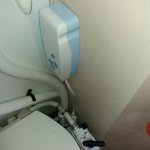
How can I prevent a Scaled Toilet

VicS: If there's is bacteria involved would a bactericide work? You can get a fitting from Purytec that goes on the water in line that takes a bottle of such gel like stuff. See pic attached. Otherwise what could you put in the bottle that might work?
1586002876861.png
 
VicS: If there's is bacteria involved would a bactericide work? You can get a fitting from Purytec that goes on the water in line that takes a bottle of such gel like stuff. See pic attached. Otherwise what could you put in the bottle that might work?
View attachment 87573
I've used one of these religeously as well.as fitting a Seasamate.dosing gadget. It helps with the smell from the raw water flush supply (where the aroebic bacteria die but they make no difference to the scale build.up.
 

Attachments

  • 20200404_150512_resized(1).jpg
    20200404_150512_resized(1).jpg
    388.2 KB · Views: 5
No it won't.

Agreed, unless you plan to leave it for a very long time at rather a high temperature. :D

I stick to peeing in the forward head (no holding tank on that one), flushing 24+ strokes (~2.5m hose), hydrochloric acid every 6 weeks (not a lot and in a controlled manner) and fresh water flush a couple of times during the season (I have a by-pass from basin outlet).

It seems to have worked for the last 10+ years with no sign of build up. No smell either. I usually spend about 6-7 months on-board and that's about 5-6 years full time with 2 people.

I wasn't surprised to see a cracked pump in an earlier post. I once met a very old chap with completely blocked heads. I offered to help as it was a holiday weekend and he was stuck from Friday until Tuesday. He told me the pipe had been replaced about 6 months earlier and couldn't understand why it had blocked. I discovered that he only pumped 2-3 times and had about 6-7m of pipe (longest run I'd ever seen).

I had about 5 litres of hydrochloric acid and knew it would be dodgy but it did still seem to be pumping just a tiny bit. I added the acid VERY slowly with a fair bit of pumping and waiting. You could see a stream of bubbles in the water on the opposite side and it eventually subsided. We had a chat, a few drinks and added a little more acid every 5 minutes or so. The amount of acid used finally increased to about 500mls and the bubbling became fairly vigorous. I told him slowly use the remaining acid, buy another 5 litres, repeat the next day and he'd need to pump about 50 times in future. Re-siting the skin-fitting seemed sensible, no idea why it had to go forward, up and across under the cockpit, along to the stern, over to the hull and forward metre or so to a 90 degree hull fitting. Worst installation I'd ever seen.

Try to force a lot of acid into a well choked system is going to produce a big pressure build-up.
 
Hi all. Thanks for all your tips. I did a test today on 4 descalers/cleaners.
Unfortunately because of the lockdown I could not get hold of normal descaler (Sulfamic Acid I think) but I did try Sodium Hydroxide, Sodium Hypochlorite, Sprit Vinegar and Cider Vinegar. I have made a video of the tests if anyone is interested


The most potent and effective of them all was Sodium Hypochlorite which reduced the deposits to a foam paste. It is used in domestos and is an approved toilet cleaner so I would imagine that it would be safe for the toilet and pipe innards. My main concern is that the bottle had a warning to fish and wildlife on it and I need to look further into this to see just how potent it is.
I think the main lesson I have learnt from your comments is that we need to flush more. I looked at the Jabsco electric pump conversion but at nearly £400 I think that we shall keep pumping.
Other than that we shall do as the French and pee over the side.
As the scale is mainly formed by the reaction of urea in urine with the salt in seawater the answer must be thoroughly flushing the outlet pipework so that no ammonia products remain in the pipework. When I last replaced my Jabsco pump there was recommended number of strokes per metre of outlet pipework. We have always adhered to that number plus an extra couple for luck and experienced few problems. It may be more effective using an electric WC as I would imagine there is a tendency to overcount the number of strokes.
 
The paper (which I can't find now) I read some years ago when I was using it, stated that hydrochloric acid can destroy bronze by attacking the tin. Quick search shows very contradictory answers so I'm no longer sure what's correct:(
A couple of problems with that. Firstly, bronze is not a mixture of copper and tin, it's an alloy comprising alpha plus delta phases. Alpha is copper with about 1% tin at room temperature, delta is Cu31Sn8. There is no separate tin that could be corroded. Pure tin has extremely good resistance to corrosion by almost everything, which is why it is used as the lining for tin cans.

On a more practical level, I have tested a wide variety of metals in hydrochloric acid. Neither brass nor bronze is even stained within about half an hour in the typical domestic concentrations of HCl, i.e. about 6-7% w/w. It may be a different matter with high temperature and concentrated acid but that is not our concern.
 
As the scale is mainly formed by the reaction of urea in urine with the salt in seawater the answer must be thoroughly flushing the outlet pipework so that no ammonia products remain in the pipework. When I last replaced my Jabsco pump there was recommended number of strokes per metre of outlet pipework. We have always adhered to that number plus an extra couple for luck and experienced few problems. It may be more effective using an electric WC as I would imagine there is a tendency to overcount the number of strokes.
The bore of a manual toilet pump is pretty much the same as that of the discharge hose, 1.5 inches. It is only necessary to divide the length of the pump into the upward length of hose, i.e. to the top of the loop, to decide how many pumps it will take. That assumes perfect replacement of the hose contents, which of course does not happen, so a few additional pumps would be worthwhile as a minimum.

Not sure about all electric toilets but the more sophisticated ones, e.g. Jabsco Lite, limit the flush flow to avoid filling holding tanks too quickly. This most definitely leads to outlet pipework contamination and early scaling of the joker valve.
 
the scale is mainly formed by the reaction of urea in urine with the salt in seawater t...................................................

What rubbish.

Explain how you get calcium carbonate scale, CaCO3, from urea , CO(NH2)2, and salt, NaCl
 
Although calcium carbonate forms some of it I believe the majority is magnesium carbonate. Plus small amounts of some other carbonates.
Yes I am sure you are right. The magnesium concentration in seawater is much greater than that of calcium . In fact I did say calcium and magnesium earlier.

You cannot get magnesium carbonate either from urea and salt. ;)

Coming back to the bronze and HCl question

If brass dezincifies by loss of zinc from the β phase why does bronze not lose tin from the δ phase in a similar way ?
 
Yes I am sure you are right. The magnesium concentration in seawater is much greater than that of calcium . In fact I did say calcium and magnesium earlier.

You cannot get magnesium carbonate either from urea and salt. ;)

Coming back to the bronze and HCl question

If brass dezincifies by loss of zinc from the β phase why does bronze not lose tin from the δ phase in a similar way ?
I don't know but maybe the positions of zinc and tin in the galvanic series has something to do with it?
 
I don't know but maybe the positions of zinc and tin in the galvanic series has something to do with it?

It may be that stronger acids take out copper, zinc etc. at a higher rate and don't preferentially remove the scarcer metal at a higher rate.

So you don't get de-zincification at an enhanced rate, just removal or copper, zinc etc. in proportions closer to the amounts in the fitting. Of course the rate is still relatively slow and you aren't exactly dissolving the fitting overnight.:D

Just a guess at a possible mechanism. You certainly get slow dezincification with chloride ions (i.e. seawater) but I haven't heard of rapid de-zincification with strong acid solutions.
 
Top