How can I cure my fear of heeling? Any ideas please?

This is a thread I might have started. Possibly its the coming from river dingy sailing where capsizing is just a bit of fun, putting that on a ton of boat is a whole new idea. Thanks Op and all

 
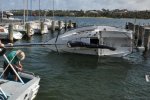
I would vote with those who say go out and try to capsize the boat. Even with water coming into the cockpit I think you will be amazed at how she will recover herself with no problems provided you can hang on. Do make sure you have lots of stout hand holds for your self. It can be dismaying to find you are standing on the side of the cockpit when she is horizontal but she will not need your weight to recover to vertical.
Here is another excercise you might like to try to check horizontal stability. You should need 40kg or more of down pressure at the mast head to hold her down. it will take a lot more than that to pull her down to horizontal but somewhat less to hold it down. This might give you confidence in the self draining cockpit and self righting ability. olewill
DSC_1897.jpg (96.1 KB)
 

Attachments

  • DSC_1897.jpg
    DSC_1897.jpg
    96.1 KB · Views: 2
I don't think your fear can be cured, it can be tamed but never cured. Perhaps taking up model boat sailing would give you the best of both worlds, no healing and you still sail. :D
 
I am introducing my grandchildren to sailing. They "squeak" when the boat tips alongside (getting on and off). I reef right down and even if it's only a F2, we still make progress and once the boat settles on a heading, they soon realise it's not going to fall over,even in gusts. My boat actually goes faster when heeled as its waterline increases, but even this phenomenon has it's limits. When sailing with your wife, reef. Whatever your boat, it will sail more upright and experience will build confidence. Ignore the actions of racing men; they break rigs and destroy sails attempting to squeeze a extra few m/sec.

The other tip I will offer is, initially do short trips. I am fortunate in that, if I get the tides right, I can sail to Cowes in a couple of hours, spend a happy couple of hours ashore relaxing (lunch and a bit of shopping) then a couple of hours back. It's a nice day out. You get to sail from your home port to somewhere else. Even if it blows up on the way home, it doesn't last for ever.
 
I think it's worth asking yourself whether it's the heeling angle or the heeling motion which worries you. I'm perfectly happy sailing a boat at 45o, but I hate the rolling motion needed to get there. Dinghy sailors, in my experience, are general less bothered about the motion, being used to very tender boats, but hate the angle.
 
I think the best idea is, as mentioned by others, is to get used to reefing the sails. There's an old saying something alongs the lines of "if you think you might need a reef, do it now. If you think you can shake a reef out, then have a cup of tea and see if you still think you can shake it out". Reefing will make the boat heel less and answer faster and more easily to the rudder: in time you'll feel easier with a given angle of heel and allow the wind to build further before reefing. Take your time and it'll come.
 
Actually I think you issue is not dinghy sailing per-say. I Dinghy sailed as a youf and thought capsizing was normal as you described. I still dinghy sail and am proud to say in 8 years I've capsized accidentally on my boat twice. Neither were in situations where I was significantly heeled - one was a turn that went messily wrong (sheets got tangled) just as a gust happened and a 40degree wind shift and it went wrong. The other we have no idea what happened. We'd just finished a race and were taking about waiting for the next race to start and then we were in the water! But as a youf I'd capsize because I'd be fighting the boat to control the heel and then a further gust would over do it. Learning that capsizing isn't a necessity in dinghy sailing means you learn not to constantly fight the heel so that there is scope to heel when the gusts hit.

I find on the dinghy that newbies are always a bit twitched about heels. I find the best way to re-assure them is to let them feel what they can control to balance the heel off and how responsive that is. SO - I get the boat on a reach and sheet in to create a false heel. I then let them test each control to see what works and what works quickest. My Genoa actually makes quite a big difference on heel and they have control of that. They learn if they are scared THEY can control the heel almost irrelevant of what I do. I also get them to heel her as far as we can so water is literally coming over the gunwale - so they can see how far she will go without falling over. So I suspect you need to do something similar. Get her heeling and play with all you controls so that you know which you can dump quickly to have the fastest effect of cancelling it. Also use the opportunity to see how far she will heel without filling the cockpit!
 
Nothing stupid at all about irrational fears. You know and others have reinforced the point that your boat will not capsize unless you do something extreme to push it over. I sometimes find that the first heeling moment takes me by surprise and the pulse quickens. Usually this is because I am not properly into sailing mode yet, still thinking about land-based issues like the logistics of getting back in time for crew to get home, or putting my phone somwhere safe for the duration. Your dinghy sailing experience tells you whether you are sailing the boat correctly and that means you are safe, but even lounging in the cockpit the old addage of "one hand for the boat, one hand for you" applies. Get yourself somewhere you can sit comfortably or hold on securely before commiting to a manouvre and make sure your crew do too. Keeping a good lookout and paying attention to your sail trim, course and safety of the crew makes the perception of the angle of heel a minor matter and you'll begin to forget about it. Of course, there are times when the boat is well heeled because it is going too fast to windward for your current situation, like entering a river, channel or port, so slow it down - de-power the rig, reef if you have to or even take the sails down and motor. Above all, have fun the way you want to. Experience and expertise take time to acquire.

Rob.
 
Why is it that, in every sailing book you read, it tells you that your boat will sail quicker when upright so reef early or slide the traveller to leeward, but racing crews, who I presume are interested in boat speed, insist on sailing with excessive amounts of heel.
My advice to the OP is to sign on a race boat. Once you've experienced their amount of heel, you'll either never be worried again or, give up sailing forever. Either way, the problem is solved.
 
I also was a touch concerned about the heeling aspect, in my little tug, with the wife who's more concerned than I am about it - we worked up from light winds to normal winds and then experienced some moderate winds (30kn) this week - suffice to say that we learnt about reefing the Genoa and main, understanding what our weight does (in fairness not a huge lot) and also what happens when you do get that big gust which knocks you over a bit more, heads the boat up and carries on.

I think experiencing it has been far better than reading and worrying about it.
 
I would vote with those who say go out and try to capsize the boat. Even with water coming into the cockpit I think you will be amazed at how she will recover herself with no problems provided you can hang on. Do make sure you have lots of stout hand holds for your self. It can be dismaying to find you are standing on the side of the cockpit when she is horizontal but she will not need your weight to recover to vertical.
Here is another excercise you might like to try to check horizontal stability. You should need 40kg or more of down pressure at the mast head to hold her down. it will take a lot more than that to pull her down to horizontal but somewhat less to hold it down. This might give you confidence in the self draining cockpit and self righting ability. olewill
DSC_1897.jpg (96.1 KB)

Brilliant, you do realise that I have to go and try this sometime? Just have to remember to empty the beer cellar first.
 
Brilliant, you do realise that I have to go and try this sometime? Just have to remember to empty the beer cellar first.

You need to be able to tether the bow and stern to hold the boat in position then have a place (we used a mobo) to stand in to pull halyard down from. We have now tested about 6 (small) boats in this way. The requirements for Oz (and presumably UK is similar) are given in http://www.yachting.org.au/wp-conte...3-16-Special-Regulations-Part-1-Keelboats.pdf look at about page 65. This PDF also has lots of other requirements for racing which would make good sense for cruising. olewill
 
Heeling is normal so you will get used to it in the meatime just ease the main down a bit and the boat will stand up a bit, the more you ease it the less heel there will be but you will sail slower. Keep doing until you are happy with the amount of heel. If it's any help Jane and I sailed 12,000nms and on leaving on every passage we got nervous before casting off. Once cast off it went.

Wise words one and all ... the more you sail the boat the more "normal" it will become... you will also learn what her natural/happiest level of heel is...
 
Apols if this has been mentioned before but I have not read the thread

The way I think about at and the what I say to novice crew is that the keel is the keel is trying to make the boat go back to the horizontal and as the wind increases and the loadings to push the boat over grow so the righting effect is also growing but exponentially so every extra degree of heeling takes more and more effort (no idea if this is correct but it does the trick !)
 
I to have this "fear" of excessive heeling, but it is not as simple as that. Here is my analysis of the situation.

If I crew on someone elses boat, I am happy to sail with the boat on it's ear, toe rail in the water. Not at all so happy if I am sailing my own boat. Why is that?

I think it's all down to responsibility. When crew on another boat, I trust the skipper to know his boat, and it's "his" problem to sort it out if something goes wrong.

Now on my own boat, It's not exactly excessive heel that bothers me, it's what is going to happen next? We get in the situation of a lot of heel because the wind has increased since we set off, and often above what was forecast. So my concern becomes what happens if it carries on increasing? I am certain if I knew the wind was going to remain manageable for the duration of the trip the worries would all go away.
 
Just make sure your engine mountings are in good condition, if you're going to try this.
Good point, cooker mounts too I guess. Although I use an outboard..

One thing though... if it takes 40kg at the mast top to hold it, then some way down the mast it would need all of me, at a bit lower it could be a neat people trebuchet? makes singing from the halyards a bit tame!
 
Top