nimbusgb
Well-Known Member
a little bigger than a number 4 and somewhat smaller than a number 2?
Baboom!
Baboom!

How do you reef it, actually? I would love to have a look if you are coming down in the near future.
You have one major benefit over me in that you dear lady is happy, or at least willing, to sail in those conditions - mine would insist on being surrounded by proper walls and a roof !!!

That, is a Blast ReacherReefing the no 3 is done by having a tack and clew cringe higher up, so you can lower the sail, fix the tack and sheet, and not use the lower section. Done a lot on hanked on sails which is what my no 3 is. Previous boat had a no 3 on the reefing /furling gear, that was a pain to swap.
That, is a Blast Reacher
Sounds like you want a Solent jib

So why is that a #3 Genoa not a #1 Jib?My #3 (as marked on the bag) is 100% of the foretriangle, deck-hugger all in front of the mast - also known as a blade jib and as a Solent.
A Jib is no longer in the foot than the mastA jib has a high clew and angled foot genoa has foot parallel ish to the deck thus low clew.
I use the high cut jib for reaching, wind 50 degrees or more from the bow.
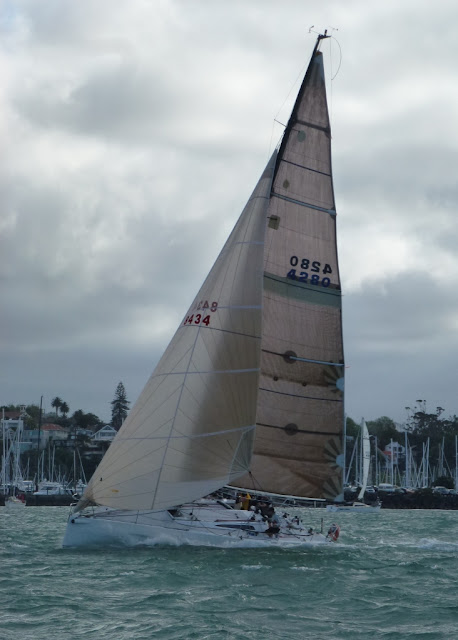

So why is that a #3 Genoa not a #1 Jib?
A Jib is no longer in the foot than the mast
A genoa goes past the mast (ie overlaps)
The height of the clew has nothing to do with it unless the sail is a Yankee
I guess your sailmaker used the wrong sail bag thenNot in the case of my #3 genoa. Which also need an entirely different sheeting angle to the overlapping genoas.
I guess your sailmaker used the wrong sail bag then
PleasureBefore suggesting one of the UK's foremost sailmakers was in error, perhaps you could give an independent printed authority to justify your opinion?
It is, of course, possible that the term is so loosely applied as to be meaningless.
Pleasure
Genoa (sail)
From Wikipedia, the free encyclopedia
Jump to: navigation, search
SC70 RETRO's genoa overlaps the main sail and the mast
The genoa or genny was originally referred to as an 'overlapping jib' and later as a Genoa jib, being named after the city of Genoa as explained below. It is a type of large jib or staysail that overlaps the main sail, sometimes eliminating it. It is used on single-masted sloops and twin-masted boats such as yawls and ketches. Its larger surface area increases the speed of the craft in light to moderate winds; in high wind conditions a smaller jib is usually substituted, and downwind a spinnaker may be used. The feature that distinguishes a genoa from a working jib is that the former extends past the mast, overlapping the mainsail when viewed from the side.[1]
Quite so the sail "Overlaps" by 15% dunnit GovObviously the entry is in need of amendment - if you look here - http://www.secondwindsails.com/measurement.php
you will find that in sailmakers' terms a #3 genoa is 115% of the foretriangle area.
As has already been stated in the thread at least once.
