wingcommander
Well-Known Member
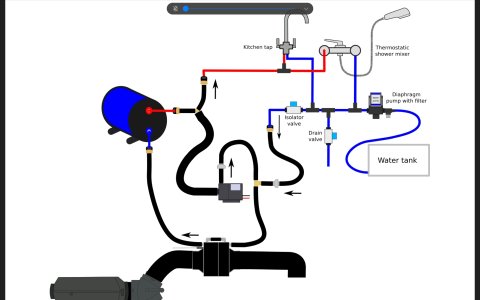
My temporary ( now three years) installation to see if it produces sufficient volumes of hot water.How does a hot air heater help warm the water?
I will eventually get a round tuit.

My temporary ( now three years) installation to see if it produces sufficient volumes of hot water.How does a hot air heater help warm the water?


My boat came with a calorifier and seawater cooled engine. When about 15 years old I replaced the calorifier for one with an electric immersion heater. The copper tubes in the old one were perfectly OK when I cut them open.Also, if you pass warm brine into your calorifier, you may well have an opportunity to replace it with one with multiple immersion heater ports relatively quickly...
There are thousands of seawater heated calorifiers out there. The 'weak link' is the electric pump with a life of 10 - 15 years. Otherwise they last well.My opinion, I would advise against tapping into the sea water coling loop for hot water for a few reasons:
1. It's the primary cooling circuit on the engine, if anything goes wrong you have lost all cooling.
2. On indirect cooled engines, the calorifier is tapped into the existing circuit with isolator valves - if there is a failure in the calorifier loop, this can be isolated and the engine continues to run. If you tap into the SW circuit, it would need to flow directly through the calorifier, this will load up the pump and adds extra points of failure
3. Eventually the calorifier will scale up and fail or restrict the SW pump flow
There are a few optiuons depending on budget, hassle factor and your appetite for installtion, on our boat we are going with a diesel hydronic heater (diesel water heater). Works the same way as you diesel air heater, just heats water instead or air. The HW can be piped anywhere around the boat - we will use ours to run a HW loop in the heads wet locker and heat the calorifier. Very efficient. Downsides are the installation which is failry easy but not always straightforward. They can be bought as little as £300 now.
I'm not a fan of the gas water heaters as there needs to be a good vent/flue, and i've never found a solution I fully like.
"Thousands" sounds like a dramatisation, I doubt that very much since the vast majority of engines in operation now are fresh water (indirect) cooled.There are thousands of seawater heated calorifiers out there. The 'weak link' is the electric pump with a life of 10 - 15 years. Otherwise they last well.

There are many many thousands of old pre 90s & 80s boats with direct cooling you only have to look at the PBO section to see just how many post on here and they are not even a small fraction of the thousands of Moodies, Westerlies, Sadlers and a myriad of long since forgotten makes."Thousands" sounds like a dramatisation, I doubt that very much since the vast majority of engines in operation now are fresh water (indirect) cooled.
Either way, it's a poor solution.
I don't disagree that some exist, I do disagree the claim that there are "thousands". They simply weren't made in those numbers, and a decent proportion of boats still being used today woud have been repowered by now, most likely to indirect cooling.There are many many thousands of old pre 90s & 80s boats with direct cooling you only have to look at the PBO section to see just how many post on here and they are not even a small fraction of the thousands of Moodies, Westerlies, Sadlers and a myriad of long since forgotten makes.
My temporary ( now three years) installation to see if it produces sufficient volumes of hot water.
I will eventually get a round tuit.
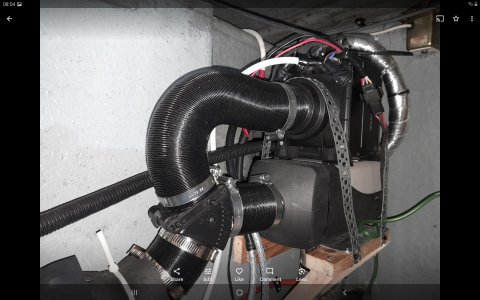
The hot air is diverted via the y section see photo. When heating water its all blown through the matrix ( surprisingly cool exitiing the matrix into my locker) which meansthe efficiency of transfer must be quite high . I never fitted the hubble controller as its easier for me to open locker lid to set to water or heating, or you can even do both simultaneously. Though I would expect to wait a while doing this.Do you have the controller?
Where do you divert the hot air, I'm thinking about the brief summer we sometimes get in the UK. Ideally I wouldn't want a cabin at 40 degrees.

Not in the USA!"Thousands" sounds like a dramatisation, I doubt that very much since the vast majority of engines in operation now are fresh water (indirect) cooled.
Either way, it's a poor solution.
You need an inlet and outlet on the block that won't affect engine flow. It's not a problem. As said, thousands running like this.Thanks for all the responses. Much appreciated.
I don't like the idea of adding a gas boiler. Lots of space taken up and needing to route a flue. The calorifier is already there, so it makes sense to get that working again.
Will I use the engine long enough to warrant it? If my sailing ability is anything to go by, absolutely.
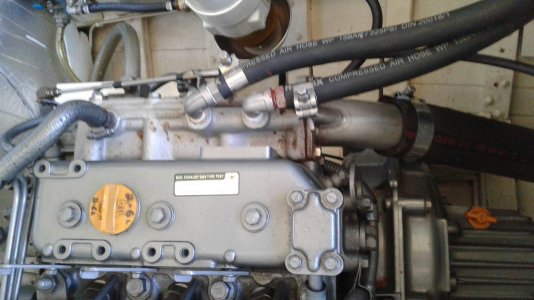
Is the verdict that interrupting the seawater flow at the point highlighted in red on the attachment wouldn't give enough heat to get hot water in the calorifier?
I haven't found a way of doing this on the Yanmar 3gm so far, hence why the common theme for this engine seems to be to revert back to indirect cooling via a kit and connecting it that way.You need an inlet and outlet on the block that won't affect engine flow. It's not a problem. As said, thousands running like this.


Fitting hydronic heating would do the job. Feed the calorifier and radiators/fan coil units. 15 mins of 5kw heat output to the calorifier should give you enough water for a couple of showers. I have just switched over from air blown diesel heating to hydronic so we can heat how waterI'm in the process of buying a boat, where the engine has been recently replaced from a yanmar 3gm with indirect cooling to direct cooling.
I only twigged on to this as the calorifier hadn't been reconnected. Seems like a massive oversight to me.
What are some realistic options to get hot water from the engine or other means? I'm pretty annoyed that getting hot water when not in marinas is off the cards at the moment.
Convert the engine to indirect cooling? Fit a (expensive) 3rd party heat exchanger and pump? Electric heating?

And if it's used with LPG (butane or propane), it's a very serious safety issue in a boat.Thanks for all the responses. Much appreciated.
I don't like the idea of adding a gas boiler. Lots of space taken up and needing to route a flue. . . . .
That's what I would do.Fitting hydronic heating would do the job. Feed the calorifier and radiators/fan coil units. 15 mins of 5kw heat output to the calorifier should give you enough water for a couple of showers. I have just switched over from air blown diesel heating to hydronic so we can heat how water