Hose tail reducing

PabloPicasso

Well-Known Member
Joined
12 Feb 2010
Messages
2,945
Visit site
I have an unused through hull fitting of 1 1/2 to 2"inch diameter that I'd like to use as an engine seacock. It is currently capped off. Is there a fitting that would allow me to attach a hose from a 1 1/2" seacock to a 1/4inch I/d hose?
 
You will need to get 1 1/2” reducing socket then use a reducing bush in that to get to probably 1/2” or 3/8”then fit hose tail to suit your hose, 1/4” ID seems a little small, are your sure it’s correct?

All readily available from pipe fitting suppliers
 
It may be bigger, I'm guessing(likely very badly) at the sizes. Next time I'm aboard I'll measure with callipers. It was the reusing from a larger thru hull to a smaller hosetail I was interested in.

The extra size shouldn't add more pressure or anything else I need worry about as long as all pieces are properly fitted?
 
Not sure what you mean by adding more pressure, the hose will be sucking so bigger is better, I suspect your hose will be either 1/2” or 3/4”
 
Whether it's 1/4" ID or 1/4" BSP, it's still bloody small for an engine water inlet.

That was not the point of my post. I wanted to highlight the fact that when buying fittings pipe/tube 1/2 inch may actually mean 3/4 inch!!

How do you measure a tube?
In short: Tube is measured by outside diameter, pipe is measured by inside diameter. There is often confusion as to which size die the customer actually needs - Pipe Size or Tubing Size. Keep in mind that pipe size refers to a nominal - not actual - inside pipe diameter. Schedule refers to the pipe's wall thickness.

So now you know!

I agree 1/4 in intake is bloody small for a motor.
 
That was not the point of my post. I wanted to highlight the fact that when buying fittings pipe/tube 1/2 inch may actually mean 3/4 inch!!

How do you measure a tube?
In short: Tube is measured by outside diameter, pipe is measured by inside diameter. There is often confusion as to which size die the customer actually needs - Pipe Size or Tubing Size. Keep in mind that pipe size refers to a nominal - not actual - inside pipe diameter. Schedule refers to the pipe's wall thickness.

So now you know!

I agree 1/4 in intake is bloody small for a motor.

That is slightly confusing ... because Tube probably does not mean what you think it means. Tube describes metal (usually) round sections that are NOT designed to carry fluids/pressure ... ie they are structural components, 50mm structural tube is 50mm OD.

50mm Pipe is a metal, plastic or rubber tube that IS designed to carry fluids/pressure ... some products can be sold as both! ... lengths of 30mm 5mm wall steel pipe could be sold as 40mm steel tube ...
 
That is slightly confusing ... because Tube probably does not mean what you think it means. Tube describes metal (usually) round sections that are NOT designed to carry fluids/pressure ... ie they are structural components, 50mm structural tube is 50mm OD.

50mm Pipe is a metal, plastic or rubber tube that IS designed to carry fluids/pressure ... some products can be sold as both! ... lengths of 30mm 5mm wall steel pipe could be sold as 40mm steel tube ...


So where does a cardboard roll come in the grand scheme of things & what is that rubber thing inside the tyre on my bicycle?:confused:

(& will the front fall off?)
 
Last edited:
That is slightly confusing ... because Tube probably does not mean what you think it means. Tube describes metal (usually) round sections that are NOT designed to carry fluids/pressure ... ie they are structural components, 50mm structural tube is 50mm OD.

50mm Pipe is a metal, plastic or rubber tube that IS designed to carry fluids/pressure ... some products can be sold as both! ... lengths of 30mm 5mm wall steel pipe could be sold as 40mm steel tube ...

Where did you get those definitions from? Can you quote your source please?

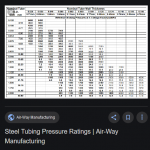
Screenshot_2019-12-05 tube pressure rating calculator - Google Search.png
 
Tube and pipe tend to both be used for hollow metal sections.

Thin wall welded (tube) both round and rectangular tend to be structural in use but can carry liquids and gas. This is measured by o/d and wall thickness

Thick wall tube of schedule tube was solid drawn but now I have seem schedule tube firmed and welded.

This was referred as gas tube as it was used for town gas supply lines.

Our water supply is mostly galvanized schedule 40 steel pipe. these days plastic pipe would be used.

schedule pipe is always specified as nominal bore and schedule fro 10 to 120 or 160.

The o/d is always the same as the outside is threaded BSP and the BSP is also specified by nominal bore.
 
Last edited by a moderator:
Roger

I've given up using measurements. When I want a fitting to screw into (say) a pump I take the pump with me and go through their racks until I find one that fits.
 
Roger

I've given up using measurements. When I want a fitting to screw into (say) a pump I take the pump with me and go through their racks until I find one that fits.

I don't blame you especially when you consider that any any equipment that comes from the US will have NPT threads where the diameters are the same but the thread pitches are different.

Some one will tell me that some sizes NPT and BSP pitch is the same.

The other think about sizes of tube is the even through the dimensions are in milimeters the size id still the original imperial size.

32 mm o/d tube = 1 1/4"
38 mm o/d tube = 1 1/2"
50mm is in fact 50.8 = 2 "

Used to work for a tube makers and tube bending machine makers in the UK.
 
Top