Hitachi LR155 alternator is compensated but how?

fixh1

Member
Joined
2 Jan 2010
Messages
28
Visit site
I have a Yanmar 2GM20 with an hitachi lr155 alternatar that is compensated for a diode bridge.
A wire from the diode block is going into the alternator. Does someone know how such a thing is connected inside the alternator? I think I want to get rid of the diode block but am not sure if I can just skip the wire, or that I have to modify something back in the alternator.

Regards
Hans Fix
 
I have a Yanmar 2GM20 with an hitachi lr155 alternatar that is compensated for a diode bridge.
A wire from the diode block is going into the alternator. Does someone know how such a thing is connected inside the alternator? I think I want to get rid of the diode block but am not sure if I can just skip the wire, or that I have to modify something back in the alternator.

Regards
Hans Fix

That sounds like a voltage sensing wire and should be on one of the battery terminals on the diode, IE measuring voltage after the diode bridge. You just leave it
connected to the same battery and the alternator will regulate to the new condition and reduce its charge to give the same voltage at the battery.
 
That sounds like a voltage sensing wire and should be on one of the battery terminals on the diode, IE measuring voltage after the diode bridge. You just leave it
connected to the same battery and the alternator will regulate to the new condition and reduce its charge to give the same voltage at the battery.

BUT the OP does not say what he is going to do in place of the diode splitter.

OK to do what you say if its the battery is always connected to the alternator eg if its the only battery or if its the prioritised battery in a VSR system.

However not acceptable if the diodes are being replaced by manual switching, such as a 1, 2, both selector, which could leave that sensing wire connected to a battery not being charged.

If a 1, 2, both switch is used the sensing wire can be connected to the common terminal, where the alternator output is also connected.

If volts drop on the wiring between alternator and battery is not likely to be significant it can simply be connected to the alternator output terminal.
 
Currently the wire is connected to the diode splitter (in fact that's a third diode output on the splitter), so, when the engine is not running, there is no connection between the battery and ground, the diode splitter blocks the current.
However, when the sense wire is connected internally in the alternator on a place where it is connecting through a resistor to ground, and I connect this wire as a sense wire directly to the battery, my battery will be flat when I arrive at the boat after 2 or three weeks!

So there is my problem, how is the sense wire internally connected? Can I use it as a sense wire without flatting my battery.
 
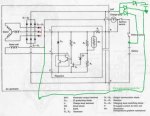
OK, I got it all sorted out, this is the wiring diagram:
Modified alternator.jpg
As you can see, the extra wire also provides the current for the field. So it is not a good idea to connect it as a sense wire to the battery!
The battery will drain, and the field coil will burn.
 
OK, I got it all sorted out, this is the wiring diagram:
View attachment 45181
As you can see, the extra wire also provides the current for the field. So it is not a good idea to connect it as a sense wire to the battery!
The battery will drain, and the field coil will burn.

So to use it without the diode splitter remove all the green stuff and reconnect the field diodes to terminal L on the regulator and the battery positive to BAT
 
Exactly, the only challenge is that the L connection of the diodes to the regulator was cut off.
Probably a winter job.
 
Top