Here we go- New Anchor

Interesting stuff. ?
How does one know what force ones boat pulls at anchor though ? Weight of boat, windage,waves ?
It seems easy to find ratings for anchors but much harder to find what sort of pull a boat can exert?

There are a number of spreadsheets for the windage of a yacht - which a google search will find

I did this testing using our cat (which has the windage off a Bav 45).

Anchor Testing and Rode Loads - Practical Sailor

I was looking for 'worst case scenario'.

Its an aside - but I was using our steel 15kg Excel, but I suspect (or am confident that a 15kg Rocna, or Viking 10 :) , would have been use as good.

When I reached the extremes of snatch load - it was scary - and I stopped testing. It was like running the cat into a brick wall. I was afraid something would break (on the boat). But when I abandoned testing the biggest problem was retrieving the anchor - it was so deeply set.

What is interesting is that the loads, even in the extreme, are below the holding capacity of 'even' a 15kg Delta but that (I suspect, am confident) that a Delta would have broken free and dragged. There is more to 'anchor performance' than hold.

You will see endless pictures of anchors in the seabed - which are interesting - but don't tell enough. If you dive on an anchor when the rode is lifted off the seabed and if you touch your anchor - you will find it twitches. A twitching anchor reduces the shear strength of the seabed in which the anchor is embedded. Good anchors will set more deeply, shallow set anchors might drag.

There are still lots of unknowns. Some people are trying to quantify the unknowns - some are guessing.

Jonathan
 
Sorry - was editing - not sure what I did wrong! :)

There are a number of spreadsheets for the windage of a yacht - which a google search will find

I did this testing using our cat (which has the windage off a Bav 45).

Anchor Testing and Rode Loads - Practical Sailor

I was looking for 'worst case scenario'.

Its an aside - but I was using our steel 15kg Excel, but I suspect (or am confident that a 15kg Rocna, or Viking 10 :) , would have been use as good.

When I reached the extremes of snatch load - it was scary - and I stopped testing. It was like running the cat into a brick wall. I was afraid something would break (on the boat). But when I abandoned testing the biggest problem was retrieving the anchor - it was so deeply set.

What is interesting is that the loads, even in the extreme, are below the holding capacity of 'even' a 15kg Delta but that (I suspect, am confident) that a Delta would have broken free and dragged. There is more to 'anchor performance' than hold.

You will see endless pictures of anchors in the seabed - which are interesting - but don't tell enough. If you dive on an anchor when the rode is lifted off the seabed and if you touch your anchor - you will find it twitches. A twitching anchor reduces the shear strength of the seabed in which the anchor is embedded. Good anchors will set more deeply, shallow set anchors might drag.

There are still lots of unknowns. Some people are trying to quantify the unknowns - some are guessing.

My belief is: Hold is important and currently is the only quantitative measure of performance. Chop, waves (the impact of which is called horsing by some) are a big factor as is veering in terms of an anchor dragging - how to measure the impact of horsing and veering is the issue. In the meantime - hold is all we have.

I'm not sure that measuring hold of small, 5kg, anchors is indicative, or can be scaled - which is why I try to stick to 15kg anchors (or their equivalent). Importanyl if you double weight you do NOT double hold. Think of doubling weight might increase hold by between 70% and 85%. Oil rig anchors increase by a factor of 93%, Fortress 83%, Bruce 70%.. To develop the constant needs a whole batch of anchors being tested the same way - and how do you scale the rode???

Jonathan
 
Interesting stuff. ?
How does one know what force ones boat pulls at anchor though ? Weight of boat, windage,waves ?
It seems easy to find ratings for anchors but much harder to find what sort of pull a boat can exert?

This is one view, there are lots of similar views

Catenary & Scope In Anchor Rode: Anchor Systems For Small Boats

What is interesting is that though there is a focus on tension in the rode and The Smiths were advocates of high hold power (or high holding capacity) feeding heated debate on 'my anchor is better than yours' - this feverish activity has declined and the recent new model, Vulcan, has not been tested independently in comparison with its peers. But then - nor has Mantus.

As I mention - how a customer is meant to assess an anchor in the absence of any hold data is a bit of a mystery.

Jonathan
 
In understand that Knox offer closing up the gap, or they used to.
 
What is/was the purpose of the gap? It looks like a weakness, and could catch things.

I don’t know. Anchors are risky thing when it comes to catching things. I am not sure this is a big increase in catchyness. Back in the 80’s I caught a stone in a Danforth gap which was only noticed on retrieval.
 
What is/was the purpose of the gap? It looks like a weakness, and could catch things.
It undoubtedly does. I tested one in the Aegean for around three months. I cannot say it was great but we never actually dragged. Ultimately I tested it in my worst anchorage (for testing purposes), an enclosed bay north of Amorgos. The seabed is very weedy and seems to have a shallow layer of sand and mud over rock. I tried to set the Knox a total of seven times, every one a fail due to dragging. Each time on recovery the slot was crammed with weed. I gave up after this, changed to the Rocna, which set first time.

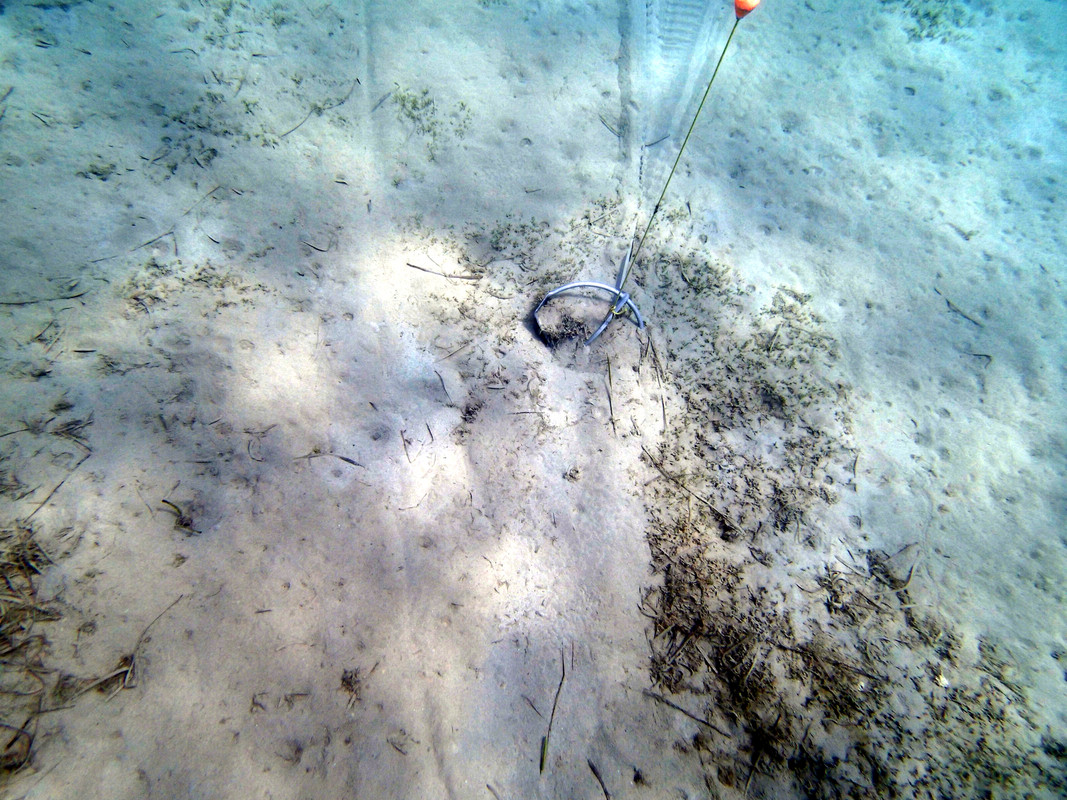
This is a typical shot of the Knox in a good anchorage (Arkangelos) after hauling astern at 2500 revs for 30 seconds or so. Nowhere near as well set as I would like.


And another, in one of the best anchorages we know (Kouloura, Lipsi). The long scar shows it did not set immediately and it is far from well in. Same set method.


For comparison, here is the Rocna after exactly the same set, same location but a different year. This scar is typical, it sets in its own length.
 
The design purpose of the slotted fluke in the Knox Anchor is in order that when the anchor moves in the sand, as most will if there's enough force applied to the rode (by the boat), the bottom material will flow over the anchor and down through the gap. According to John Knox (inventor), this is more useful in clayey bottoms or mud that's sticky. If it sticks to the upper surface of the flukes, it in effect changes the shape of the flukes from convex to concave if a lump sticks on the upper surface as a mound. This in turn changes the resistance to pull that the anchor is there to provide, reducing it. This was first discovered when testing other anchor types of a similar shaped fluke (before the development of the Knox anchor) that John was so well known for. He was determined that this was one improvement to be made - to find a way to reduce this shape changing effect that sticky sands had. And so the divided fluke.
A down side is that on some occasions weed sticks in there. I myself have had this, and these times have been the only times I've had any trouble, and usually in kelp. But its only once in hundreds of anchorings for me personally, but is likely to have been the case for some others. In saying that I don't think there's any perfect anchor that doesn't attract some criticism from someone. Given the number of variables involved in this aspect of our great hobby and leisure activity. Bottom types are variable, practices and methods, wave motions, weed presence, rocks, obstacles, wind shifts, the list is long and each is a variable some with extremes in each direction. If it were not so then we'd all have the same experience, and we'd have to post and comment so vigorously on some other topic! So this topic of anchors and anchoring will give fodder for this and other forums for many years I think!

Disclaimer: I sell Knox Anchors.
 
I have a Knox anchor. TBH I don't consider it my best decision ever. I had to have a new roller system built, which hasn't been totally snag free. The anchor, when it sets, grabs hard, but has been known to break out, if the scope is on the short side. However, the biggest issue I have is that long weed can catch in the gap and render a set impossible. Sometimes, huge weed fronds... Very frustrating. My old CQR did better on weedy conditions...
 
The design purpose of the slotted fluke in the Knox Anchor is in order that when the anchor moves in the sand, as most will if there's enough force applied to the rode (by the boat), the bottom material will flow over the anchor and down through the gap. According to John Knox (inventor), this is more useful in clayey bottoms or mud that's sticky. If it sticks to the upper surface of the flukes, it in effect changes the shape of the flukes from convex to concave if a lump sticks on the upper surface as a mound. This in turn changes the resistance to pull that the anchor is there to provide, reducing it. This was first discovered when testing other anchor types of a similar shaped fluke (before the development of the Knox anchor) that John was so well known for. He was determined that this was one improvement to be made - to find a way to reduce this shape changing effect that sticky sands had. And so the divided fluke.
A down side is that on some occasions weed sticks in there. I myself have had this, and these times have been the only times I've had any trouble, and usually in kelp. But its only once in hundreds of anchorings for me personally, but is likely to have been the case for some others. In saying that I don't think there's any perfect anchor that doesn't attract some criticism from someone. Given the number of variables involved in this aspect of our great hobby and leisure activity. Bottom types are variable, practices and methods, wave motions, weed presence, rocks, obstacles, wind shifts, the list is long and each is a variable some with extremes in each direction. If it were not so then we'd all have the same experience, and we'd have to post and comment so vigorously on some other topic! So this topic of anchors and anchoring will give fodder for this and other forums for many years I think!

Disclaimer: I sell Knox Anchors.

That's why concave anchors work so well:

They are convex anchors in disguise!

Why The Professor did not simply build a convex anchor in the first place (given that concave do work and do carry compressed seabed) is thus a mystery.

I'd still close the gap of the Knox at the toe - leaving the slot to allow any sediment to flow out but not catch weed, stones, the chain, sticks etc in the slot.
 
I want to ask this in a polite way, what credentials do you have to say what's good and bad as I've no idea who you are ?

I can tell you with some confidence that he's a Scots-trained engineer of the old school..... :cool:

.....a man of superior technical and engineering skill, experience and ingenuity. Despite his superior talents as an engineer, he is often the source of comic relief due to his sometimes unrestrained use of the Scots Language....

You'll find them around the world, holding together repair and maintenance yards, running production facilities large and small, training locally-produced engineers to contribute to their communities.

And..... if a Scots-trained chief engineer is good enough for the USS Enterprise, that's good enough for me!
 
Last edited:
I can tell you with some confidence that he's a Scots-trained engineer of the old school....
Brilliant. It's quite easy to read a convincing test of an anchor and even better when more knowlegable people share their own research ?
 
I am surprised that nobody has asked you yet about your One Tonner, so I will - I vaguely remember seeing a boat like this advertised in a Caribbean broker not so long ago. Is she one of the varnished timber hull prototypes?
Can you post a photo or two of her please?
(You could include the anchor on the bow to keep it on topic :) )

Richard, I am still hoping that you will tell us a bit more about your beautiful One Tonner............ ideally with some photos as well please?
 
Top