Hempel Silic One Cote d'Azur

jmnapier

Well-Known Member
Joined
29 Jun 2007
Messages
196
Visit site
I thought it would be useful to others to post about Hempel Silic One, specifically on the Cote d’Azur.
The boat is a Hunton 37 thoroughbred based in la Rague. She is flat out at 47 knots(prop adjustment needed!)but we tend to cruise at about 30 due to guest comfort. We saw no change in top speed after launch.
We had the coating professionally applied in June, launching on July 1st, so now have approximately 6 weeks of use. The good news is that any green tinge seen at the berth is gone by arrival time at the Islands. The bad news is that it is very susceptible to ‘crustacea’. This comes off with a sponge and is limited to waterline areas. The problem will be, come winter, when it is no longer removed once a week and starts to build. I have read elsewhere that it grips in to paint and will therefore damage the Silic One eventually. There is also some degradation at the location of the supports where the paint has been ‘patched’. I saw this patching done and it was done carefully.
The paint has a ‘sticky’ feel, just like the surface of a silicon hose. It is very slippery at the transom steps built in to the hull, care has to be taken when climbing out of the water.
The prop/sterngear coating was a total waste of time. A large amount came off on the first run and most is now gone. Anyone got any better ideas for sterngear??
Interested in any one else’s experiences with Silic One, particularly reference the crustaceans!!
All the best
Jonathan
 
The prop/sterngear coating was a total waste of time. A large amount came off on the first run and most is now gone. Anyone got any better ideas for sterngear??
Interested in any one else’s experiences with Silic One, particularly reference the crustaceans!!
If anybody can find an effective and durable antifoul treatment for the sterngear on planing boats in the Med, they would make a fortune. AFAIK such a product doesnt exist. FWIW I have tried a very expensive Propspeed treatment in the past and it was a waste of money because it was peeling of the prop blades within weeks. Hull antifouling isnt such an issue because local paints as well as international brands of antifoul paint tend to work well. Personally I always take the advice of the yard who doing the painting on my hull as to what paint they recommend. Local knowledge tends to know best
 
If anybody can find an effective and durable antifoul treatment for the sterngear on planing boats in the Med, they would make a fortune. AFAIK such a product doesnt exist. FWIW I have tried a very expensive Propspeed treatment in the past and it was a waste of money because it was peeling of the prop blades within weeks. Hull antifouling isnt such an issue because local paints as well as international brands of antifoul paint tend to work well. Personally I always take the advice of the yard who doing the painting on my hull as to what paint they recommend. Local knowledge tends to know best

+1 to all this .
I,ve stopped worrying about the stern gear have as above wasted time / money on “ wonder cures “ , over the past 14 years next door in La Napoule.
Takes about 30 mins with a snorkel or 20 with by dive bottle to hand scrape .
The yard at La Rague use an Italian brand “ in -“ something antifoul, which is ok .This season I switched to
International micron 350 seems to work better for us on the hull and we cruise at around 30 knots .

The wind In the afternoon can cut up the bay of Cannes on the run back pretty bad , you’ve probably found this out :)and taken a bit of gratitude from running in a Hunton back home .:encouragement:
 
I applied Silic one to my 7 metre sports cruiser in the spring. I followed all the instructions particularly the timing of overcoating and temp/ humidity. 4 coats in all over existing sound AF.

The sides do get a bit slimy but a quick 20 knots blast with hard turns soon rubs it off!

Quite impressed so far, time will no doubt tell.

A recent YBW article from a boat on the Hamble indicated that a service life of 3 years may be possible. Based on that I shall recoup the extra cost of the materials as I will only have a lift and hold to change oils on the verado.

Saving of around £130 annually plus about £75 on AF.

Slight increase in speed noticed as well. 35 knots before now around 37.

In 3 years time I hope to get away with a single top up coat as set out in their blurb somewhere.

I understand that Superheat6k of this parish is considering applying it should it go well with me.

I do feel as if I am slightly ahead of the curve as traditional AF hasn't been banned or diluted to the point of ineffectiveness.

That day is rapidly approaching though!!!
 
Yes, the Hunton is a very smooth ride. The faster you go the better but unfortunately passenger preference usually gets in the way of this course of action!
HP, where are you based? Any problem with Crustacea/barnacles?
Cheers Jonathan
 
Yes, the Hunton is a very smooth ride. The faster you go the better but unfortunately passenger preference usually gets in the way of this course of action!
HP, where are you based? Any problem with Crustacea/barnacles?
Cheers Jonathan

Hamble and no problems that I am aware of.....
 
no experience with Hempel Silic One, but I do have some good news on metal stern gear in the Med, bear with me.

After various (unsuccessful) attempts, flaking off in the first 10nm... I was about to do the same last year when a guy working on my friend's P45 (doing some grp work) saw me and mentioned that if I want anything to stay on the shafts/props/et al, I have to make sure I apply it in spray form.
So took my v.bloody expensive Velox primer and white a/f to the guy I buy paints from and asked him to put them into aerosol cans (pregassed cans which take around 100ml of the thing)
Sanded/roughened the bronze props with a 60grit paper and applied 4 spray coats from 20cm on a flat calm evening.
Left it and next day did the same with approx 3coats of the a/f again from 20cm.

Primer wouldn't even turn the metal greenish (that's it's colour), a/f did eventual turn the props and shafts white (easier to spot where material is missing)

300nm later and a full winter, spring till late June, going to the boatyard (ok 1nm away...) was easy with good control and decent speed. Previous times, I had to rev it a lot to get the boat over 5kn...
On inspection, props were free from all marinelife, just a tiny bit of crustation...

This year, I got one of these sponge padded sandpaper thingies (I think 80grit this time) and softly passed all the metal again to clean the crustation (less than an hour for both props and shafts).
Boatyard had jetwashed the boat already.
Used only one can of primer, on a few small (say 2eurocoin size) areas that a/f had gone and a haze on the rest (just in case).
FWIW, I didn't even bother buying the Velox primer, but chose a galvanised steel primer (as in primer good enough for galvanised steel), seems to be holding just fine.
I used a can of white Velux a/f.

Diving under the boat, last week and after two weeks on board and 200nm props are clean and are still white no bits missing :D

Mind I'm exclusively on D speeds and up to 10kn with just 2mins at 19kn for the season :rolleyes:

cheers

V.
 
I was going to ask how it has worked so far ?

Not good reports of its performance on stern gear though.

It seems to be working for me Trev. The best advantage of an outboard is that the important bits live out of salt water when not in use and are freshwater flushed internally before putting to bed. This, coupled with the Silic one appears to be a good solution for sports boats that are not drystacked.

Getting anything to stick to a prop is a technical challenge at the best of times. I do think that trim tabs would benefit as they are subject to similar forces as hull. Ditto rudders. So that just leaves the props to sort....

A highly polished prop will aid efficiency and reduce fouling for a time but regular use will also help. Not sure if phosphor bronze can achieve this as well as stainless?

Next time I bump into you on the pontoon I'll update you!
 
Last edited:
Maybe I'm being a bit too suspicious but is it a bit of a coincidence that the first letter in this month's MBY is also about this product?
 
Sterngear as in outdrives here. I found no AF kept barnacles off above the cavitation plate and my outdrives would be absolutely saturated with barnacles within the period June to end of July. With nothing to loose I covered the area over new AF with water proof (whatever they mean by that) white grease simply painted on as a test. The grease stayed on (Boat launched in beginning of April, now August) and no barnacles whatsoever. Not one. There has been some very fine filament weed growth on the anodes which were not painted over with grease and diatoms, which has no negative effect, on the grease. Personally I thought the grease would go within a couple journeys considering my berth also sits in a 3knt tidal current, but it has persisted. I couldn't be more delighted. Note though that when on the plane all the areas above the cavitation plate are out of the water flow so I cannot say if grease permanently under the waterline will enjoy any longevity. Certainly though next year I will be painting my water intake vents with grease and monitor how that goes.
 
I think if it was a conspiracy theory I wouldn’t have mentioned the barnacle/Crustacea issue....??
Plus, I did mention there was no increase in speed so not really a ringing endorsement.
Will give it time and see where we are in a year’s time. If we have to pay a diver, say, 2 or 3 times over winter to do the waterline and sterngear but the bottom otherwise remains clean then perhaps we can declare a success.
Thanks for all the sterngear suggestions, will have to try some of them.
Cheers
Jonathan
 
Last edited:
Hi Everyone
One year since applying Hempel Silic One it’s time for an update.....
The boat has not been used since about January what with the lockdown and commitments in February etc.
We went out on May 12th expecting poor performance, specifically due to sterngear crustacea and although we could get on the plane it was pretty sluggish.
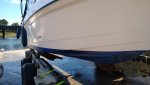
The boat was lifted out on the 28th May and cleaned. We were in the slings for two and a half hours over lunch break. The yard pressure washed and then applied acid to the sterngear, as is usual in this area, leaving it clean and smooth. Inspection of the Hempel Silic One on the hull showed thin coin size pieces of crustacea which pushed off with a finger but otherwise clean. We firmly sponged the whole hull in about an hour and hosed off leaving it exactly as it was when first applied a year ago. Success!
The patchy areas where the supports had been during application were no worse than before so were left again. My fears about the hard worms of crustacea we were seeing at the end of last year did not materialise any further. Perhaps the colder winter water temps removed them/prevented more? When launched we went for a run and saw 49 knots and very briefly 50 so slightly more than previously(no tide here to affect).
Overall I would call it a success in terms of hull antifouling. It has not been damaged by usage or lifting in slings. Obviously it didn’t work on stern gear but if we Brillo pad it through the summer and lift, say, twice through the winter at €250 a pop the performance can be protected.
There we are. Will report again in 2021.....
 
Time for my update too. I applied Silic about a year ago and 2 weeks ago did a lift and hold to service my engine.

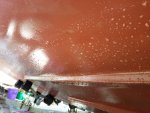
Overall the fouling was minimal, especially as I hadn't run the boat for 3 months. I touched up an area where it had worn through, this was because I left a fender rubbing on it...

I touched up areas which were not treated first time round, after scraping off the barnacles.

When pressure washed the hull came up like new.

Overall I'm impressed and saved £100 by lifting and holding Vs being "chocked off". Best bit is no scrabbling around with a paint brush!! I'll update this post with hull pics as she came out shortly..
 

Attachments

  • IMG_20200514_161439284.jpg
    IMG_20200514_161439284.jpg
    949.4 KB · Views: 20
  • IMG_20200514_093408006.jpg
    IMG_20200514_093408006.jpg
    446.5 KB · Views: 18
Hi I have seen several yachts with silic one and it seems that on the hull if the prep is good then it is fine.
On that basis I decided to do my stern gear with silic one prop paint. First year was a disaster and I was infomed the primer I had been told to use was wrong. So the second year I did it again with the new primer and again it was totally stripped on all the surfaces when lifted a year later.
The only answer to stern gear that appers to work is Prop speed but it is really expensive and can only be applied by approved installers I believe.
 
The prep for application over old antifoul is minimal - just remove loose paint as you would if you were using antifoul.

I agree that the initial application of 4 coats is a bit of a faff, but in subsequent years (hopefully 3) then all that is needed is a single coat which has its appeal!
 
I'm on my 6th season with the same Aquacote silicon foul release application (I applied it in May 2015). It's very similar but not quite as good performance as Silic One (according to the MBY test a few years ago). A bit of a pain having to keep it clean but usually i just wipe around the waterline every so often and give the underside a wipe every few months when swimming. Don't bother much at all over winter.

A quick light jet wash when it's on the trailer in the the spring and it's back to looking as good as the day i applied it. See photo. Only thing I've had to do is touch up small areas which have been scuffed.

No good if you want to ground your boat though as the silicone top coat scuffs easily.

p.s. Aquacote is no longer available after the parent company went bust.
 

Attachments

  • hull may 2020 small.jpg
    hull may 2020 small.jpg
    278.5 KB · Views: 10
Last edited:

Other threads that may be of interest

Top