Help with running main halyard Swift 18

Advent3207

Member
Joined
3 Aug 2022
Messages
27
Visit site
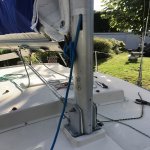
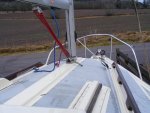
My main halyard runs inside the mast. Where it comes out it seems as though there should be another pulley or something to stop it rubbing the mast (Red Arrow in Picture) Does anyone know what I should have here? Im unsure on what to buy. Also, what thickness would this halyard normally be?

Thanks
Chris.Image1.jpgImage2.jpg
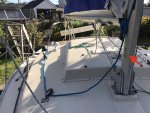
 
I would suggest the main thing is to have a cover to the edges of the aperture - that chafing area is more likely to be damaging the halyard.
Perhaps the mast is not the original but a reduced one to permit fitting of the tabernacle. You could still fit a turning block using the rivetted holes drilled out to fit one.
 
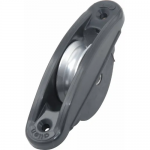
You need a block (pulley) at the bottom of the mast so the halyard runs straight down and then across to the one on deck. Halyard size, I have 6mm on mine.

images
 
Last edited:
That looks so neat! What boat do you have? My halyard is approx 12mm, I feel it is way too big.
That's not my boat just an example.
I have a micro cupper 5.5m so similar to the swift. 12mm is too big and will add friction by being too big to fit in the sheeves on the mast.

On my boat at the mast foot there was already the ability to add blocks, but you could also use the Barton mast base organiser... Barton Mast Base Organiser | Force 4 Chandlery
 
That's not my boat just an example.
I have a micro cupper 5.5m so similar to the swift. 12mm is too big and will add friction by being too big to fit in the sheeves on the mast.

On my boat at the mast foot there was already the ability to add blocks, but you could also use the Barton mast base organiser... Barton Mast Base Organiser | Force 4 Chandlery
Yes, it is the biggest line/sheet on the boat, I thought it looked out of place.

Oh my, the mast base organiser looks a thing of beauty!
 
This is the firs

And this is what may be missing from the two holes in the picture where the arrow is pointed?
I'm remembering back nearly 30 years to when I had a Swift 18 as my first 'big' boat and recall that the Main Halyard exited the mast as yours does, the rectangular exit hole had a hard plastic insert lining the hole that provided a smooth edge to the hole and the two screw/rivet holes below in your picture were the fastening points for a cleat. Mine was thus fitted and the main halyard was cleated off at the mast on the cleat just below the exit.
Your picture shows a later modification to take the lines back to the cockpit and is a bit of a bodge without a turning block at the bottom of the mast. Halyard on mine was 8mm from memory, 12mm is far to thick imho.
 
I'm remembering back nearly 30 years to when I had a Swift 18 as my first 'big' boat and recall that the Main Halyard exited the mast as yours does, the rectangular exit hole had a hard plastic insert lining the hole that provided a smooth edge to the hole and the two screw/rivet holes below in your picture were the fastening points for a cleat. Mine was thus fitted and the main halyard was cleated off at the mast on the cleat just below the exit.
Your picture shows a later modification to take the lines back to the cockpit and is a bit of a bodge without a turning block at the bottom of the mast. Halyard on mine was 8mm from memory, 12mm is far to thick imho.
A fellow Swifty, I havnt talked to one before. If I ever found you in person I would ply you with beer and extract all you know! I need to add a block at the mast like You and Northwind have suggested, and change the halyard to 8mm.
 
As suggested that is a mod from the original and although a bit of a bodge will work OK with an 8mm halyard with no chafe problems as the lead is going to the block and then back to the jammer. You would need some protection if you reverted to the original cleat on the mast or had the turning block close to the mast foot then back to an organiser. Try it as it is before making changes.
 
The answer is that as said you need a turning sheave (block) as close to the mast as possible at the base. 8mm halyard should be fine especially if it is in dyneema (polyester cover). (less stretch) The slot in the mast should be fine. You could take a round file and smooth off the inside of the top and outside of the bottom where the halyard will rub. You do not need a plastic cover and certainly not a sheave box. If you are happy hoisting lowering main sail from the mast then all you need is another horn cleat fitted into those holes in the mast. However there is much to be said for taking halyards back to cockpit so you can let go the halyard and pull main sail down from standing in the cabin.
On my 21fter I have similar exit slots for halyards. The main halyard has wire spliced to polyester rope the wire exits at the slot when main is up. The wire has over years cut the mast slot upwards. But I stopped this with a palte of stainless steel across the top of the slot. No concerns re chafe of halyard after 35 years. Enjoy your little boat. ol'will
 
This is what I did on a similar sized boat I used to own.

1660034260588.jpeg

Where the halyard exited the mast it already had a block set in a sheave / box or whatever the description is. I added the block on the cabin roof to run the halyard to the cockpit.

This is where I got the idea of the block built into the mast exit and for some reason thought that was normal practice. It is certainly something you could do but if you can't find a sheave / box the right size you might have to enlarge the hole in the mast a bit.
 
Most of the open recesses in the mast have had a pulley in them, however. you could try a piece of clear plastic tubing, about
1/2" diameter and slit it on one side. and fit into the recess. might need a couple of tries for the exact length , and join at the top,
Then fit the turning block etc as suggested.
 
Top