
Help with navigation theory

MikeFloutier

Member
Joined
25 May 2014
Messages
34
Visit site
Hi,

I'm just learning navigation theory and I'm grappling with Magnetic Variation.

I had thought I'd got it; ie add a west variation to a true course to get a magnetic course etc..

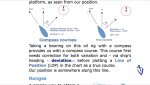
Now having read another resource, to bone up on position annotations, I came across this (see pic) which seems to say the reverse.

Could someone please put me right 
 

Attachments

  • image.jpg
    image.jpg
    74.9 KB · Views: 0
Hi,

I'm just learning navigation theory and I'm grappling with Magnetic Variation.

I had thought I'd got it; ie add a west variation to a true course to get a magnetic course etc..

Now having read another resource, to bone up on position annotations, I came across this (see pic) which seems to say the reverse.

Could someone please put me right 
You are right


Diagram confusing ... dont get it at all ... ignore
 
The diagram is describing both deviation and variation, so it is important not to confuse them.

There are numerous ways of sorting variation out, such as "west is best etc" so I think it is up to each of us to find the way that suits us. Personally, I like to think of a diagram such as the one shown, but that is because I normally think visually, but other people will differ.
 
Like others I have always used True Virgins Make Dull Company, normally arranged vertically as below, where going down West is best and East is least (reversed coming up):

T - 290
V - 7W
M - 297
D - 3W
C - 300

Very simple to scribble down even when wet, cold and knackered.
 
When I learnt my instructor told us to think of our wet weather gear. Assuming the chart is down below and the compass in the cockpit. You put it on going up and take it off going down. So if you want to steer 000 on your chart add as you go up and steer that on the compass 003. Of course that is just the start of it and works in UK waters! :cool:
 
Hi,

I'm just learning navigation theory and I'm grappling with Magnetic Variation.

I had thought I'd got it; ie add a west variation to a true course to get a magnetic course etc..

Now having read another resource, to bone up on position annotations, I came across this (see pic) which seems to say the reverse.

Could someone please put me right 
A little detail, the example you posted is about going from compass to magnetic to true - exactly the opposite of what you are talking about (true -> magnetic -> compass)
 
I had thought I'd got it; ie add a west variation to a true course to get a magnetic course etc..

Now having read another resource, to bone up on position annotations, I came across this (see pic) which seems to say the reverse.

Is the confusion that they've used "+3" rather than 3E, so they're adding to magnetic to get true?

I'm sure mnemonics were hilarious for "chaps" in the 50s but I've never been able to remember them. I have to take the slightly longer route of visualising the "magnetic north" pointer on the compass rose. With west variation of 2 degrees, 0 magnetic is the same as 358 (or "-2") true, so I have to add 2 to true to get magnetic (and subtract from magnetic to get true)

and no matter how often you do it there's still the ...hang on...did I get that the right way round....?
 
Last edited:
My fault, I took the example diagram out of context. It was being used to illustrate plotting a position from bearings on fixed objects.

It didn't mention whether the Var was E or W, I just assumed it was West - doh!

Anyway thanks for all comments, it all helps me to think it through and settle it down in my mind.
 
The diagram you posted confuses a "course" and a "position line." These terms mean entirely different things but the author interchanges these terms freely.

As the bearing of the oil rig has probably been taken using a hand bearing compass there is no deviation correction to apply either, however the diagram has applied the same deviation to both the ships compass and the second compass, (unless he has used the ships compass to take a bearing at about 80 degrees to his heading).
 
Last edited:
Top