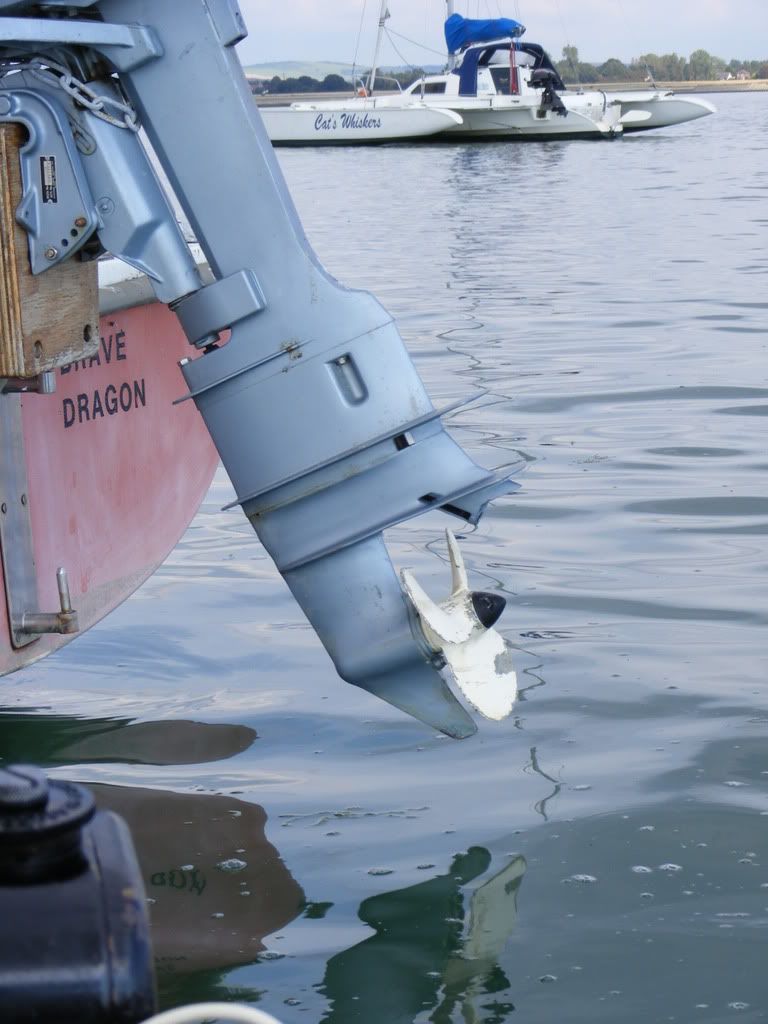
Help With An Outboard

lawrence567

New Member
Joined
21 Jun 2011
Messages
22
Visit site
Afternoon Guys,

I recently purchased an old 6hp Johnson from a marine enginner shop.
It was sold as seen (without warranty), but had just had the points replaced, plugs & a service etc.
The shop owner was a very nice chap & said he's been using it as a small motor to zip up and down the river.
He demo'd it to me & all was fine. (Saturday just gone)
I went out with a friend last night (we put it on my inflatable), got it going no problem, we were zipping about on it, when it suddenly just went to half throttle, the throttle positon was till fully open but it seemd like we'd lost half power (1 cylinder).
We had a mess around, opening & closing the throttle & it seemed to spring back into life, was fine for about 25 mins then almost went into "limp mode" again.
It was starting to get dark by then so we called it a day.
My friend has had boats since he was quite small & he suggested giving it a once over as he's quite handy with a spanner, i was u just looking for things to possibly check out?
It has brand new fuel in it, the mix is correct & it's from a brand new fuel line & tank which the old owner sold the engine with, it's also very clean under the cowl.
Any pointers greatly appreciated.
(I'm unsure of the year, it's got a green body & white cowling, i'd imagine 70's?)

Lawrence
 
Did you notice a pee stream of cooling water? (Not certain on than model if it's a proper pee stream or a mist from the little square bit on the back of the leg.)
My bet is overheating.
It may be the impellor, but may more likely be the rubber grommet at the top of the water tube in the leg. They swell up and close off the flow.
With it running slow for a bit it will have cooled enough to run properly again until it overheated again.

Watertubegrommet2.jpg


Watertubegrommet.jpg
 
Last edited:
Those of us who own OMC engines of a certain age range know all about the grommet in LS's pictures, PITA, but it's all different on older engines.

But please tell us some details. Pretty old to be that colour scheme. Pre 1970s I suspect
More importantly what is the model number? Should be on a plate on the LHS transom clamp .

as is visbible in this pic of a 6hp 'rude


It may be a model and serial number combined into one

Generally check plugs, sparks, points and coils .

Plugs almost certainly should be gapped at 30 thou but type will depend on model
50:1 fuel mix if 1964 or later. More oil if earlier

Tell me the model details and I will tell you the currently recommended plugs and correct fuel mix.

Some tricks to know about in removing the gear case to get at the water pump on some older engines.
 
It's a 50:1 fuel mix.
I'll have a look at the serial number etc later on, there was plenty of cooling water, as this was my first thought.
Apart from that i can't really be of anymore help until i get home from work!
 
I looked through some of the old Johnson catalogues but cannot find that livery.
Pre 1977 though if it has points ignition but not as old as I originally thought it might be.

It may not have the "correct" cover. It could have a later cover and decals. That would confuse things.
The model number, which may also be stamped on a core plug on the side of the engine block will tell all.

Model numbers are up to and including 1979 are:

Year Model-Nr.
1965 CD-CDL-22
1966 CD-CDL-23
1967 CD-CDL-24
1968 CD-CDL-25
1969 6R69-6RL69
1970 6R70-6RL70
1971 6R71-6RL71
1972 6R72-6RL72
1973 6R73-6RL73
1974 6R74-6RL74
1975 6R75-6RL75
1976 6R76-6RL76
1977 6R77-6RL77
1978 6R78-6RL78
1979 6R79-6RL79

Belgium made ones may have a letter B included
 
Ok i'll have a quick look when i get home.
The chap i bought it off seemed very genuine, he said he could'nt find out what year it was & even thought it might have been an Army model due to the green colour of it (but apparently it was'nt).

I'll report back later on with model/serial.
 
Not familiar with that model, but I've always found that an overheateing outboard tends to steam, somewhat! My money would be on the sparkplug or ignition system. It may be that this particular engine likes only one brand of plug or maybe the plug in it is incorrect. Either can cause oiling of the plug with either the symptoms you describe or complete failure. I know some engines run fine on Champion plugs but not on the equivalent NGK.

Rob.
 
Not familiar with that model, but I've always found that an overheateing outboard tends to steam, somewhat! My money would be on the sparkplug or ignition system. It may be that this particular engine likes only one brand of plug or maybe the plug in it is incorrect. Either can cause oiling of the plug with either the symptoms you describe or complete failure. I know some engines run fine on Champion plugs but not on the equivalent NGK.

Rob.

Only Champion plugs are currently recommended! ( except for recent rebadged 4 stroke engines)

However go back in time and you find several alternatives originally listed for older engines. Never NGK though. American brands only

There is a problem with OMC CD ignition systems for which resistor plugs are not suitable. They require the inductively suppressed Champion Q series (although NGK do now offer some inductively suppressed plugs) Put the common NGK resistor plugs in an OMC engine with the old OMC CD system and you are very likely to have trouble.
Not relevant to the current question though because that apprently has points ignition.

The recommeded plugs for this one (assuming info so far is correct) will be Champion J6C gapped at 0.030". I see no reason why NGK B6S should not be used


I agree about the steaming. My 6hp rude steamed like a good-un when I had trouble with the afore mentioned watertube grommet.
 
Last edited:
Then it is a 1974 model. I cannot find any colour pictures of that year to confirm that it has the correct cover but the design of the decal matches a black and white diagram for the year

Recommended plugs J6C gapped 0.030" ( NGK equivs B6S)

It would be wise to check the plugs even though they are new, allegedly. Even consider replacing them.

Check the sparks. You should be able to draw a good fat blue spark from each lead that jumps at least 1/4".

If not look at the Ht leads, check that one of them is not shorting onto something.. Then I suppose look at the coils and points but that involves removing the flywheel.
The Ht leads are plain copper cored... with no suppressors.

Before pulling the flywheel check the fuel system through. Even a new tank could have some debris in it. Check the fuel line for possible air in-leaks esp the connector.
Check the fuel filter, check the tank breather.

If its not been cleaned lately maybe do a carb clean.

Gut feeling is though that its an ignition problem and as you suspect failing on one cylinder.

There is no separate pee stream on the cooling system but if its pumping Ok you should get a fair amount of water blown out of the outlet on the back of the leg. You can see that in one of the pictures


Water pump overhaul when one day that comes due.

There is a join in the shift rod that can only be accessed after dropping the gearcase a little. Only remove one bolt from the clamp and ensure when reassembling that the two parts are properly positioned before replacing the bolt. ( I think you have to remove a bolt but maybe only slacken it)

There are half a dozen bits and pieces at the top of the drive shaft that make up a seal. They are supported by a pin through the drive shaft. In order to withdraw the shaft from the crank shaft you have to rotate it until that pin lines up with a slot in the housing.

Take care not to remove the pivot pin ( Philips type head) from the starboard side of the lower part of the gear case in mistake for the oil drain/fill plug. If you take it out bits of the selector mechanism will come a drift inside!
Drain/fill and level plugs are identical with broad slotted heads on the port side
 
Last edited:
One simple check which takes no time at all, is to check the continuity of the spark plug leads. Old leads can suffer from corrosion build-up around the connectors, which can cause an intermittent fault. If there are suppressors in the leads, these can go open circuit due to age.

Also, check the carb bowl for gunge, which can cause fuel starvation.
 
Ok thanks guys, we'll have a check of all of those.
It was just weird, it had a brand new tank (nothing in it, i checked) & the fuel line is air tight.
I'll have a check of the above & get back to you in a few days time!
Thanks all :)
 
In case it is of interest/useful Joe Reeves' instructions for adjusting the slow speed needle

( the knob should pull off , to allow adjustment with a screwdriver, refit knob in the middle of it range)

(Carburetor Adjustment - Single S/S Adjustable Needle Valve)
(J. Reeves)

Initial setting is: Slow speed = seat gently, then open 1-1/2 turns.

Start engine and set the rpms to where it just stays running. In segments of 1/8 turns, start to turn the S/S needle valve in. Wait a few seconds for the engine to respond. As you turn the valve in, the rpms will increase. Lower the rpms again to where the engine will just stay running.

Eventually you'll hit the point where the engine wants to die out or it will spit back (sounds like a mild backfire). At that point, back out the valve 1/4 turn. Within that 1/4 turn, you'll find the smoothest slow speed setting.

Note: As a final double check setting of the slow speed valve(s), if the engine has more than one carburetor, do not attempt to gradually adjust all of the valves/carburetors at the same time. Do one at a time until you hit the above response (die out or spit back), then go on to the next valve/carburetor. It may be necessary to back out "all" of the slow speed adjustable needle valves 1/8 turn before doing this final adjustment due to the fact that one of the valves might be initially set ever so slightly lean.

When you have finished the above adjustment, you will have no reason to move them again unless the carburetor fouls/gums up from sitting, in which case you would be required to remove, clean, and rebuild the carburetor anyway.​
 
Johnson OB

If you find it does the dying trick again stop the engine (before it recovers itself) and remove each spark plug. If you have an ignition problem the bad cylinder plug will be very wet with fuel and oil while the good one will be dry and grey with soot. If both are dry then you havee a fuel problem.
Usually one dead cylinder has different sound to the same engine at low throttle setting. ie full power on one cylinder is rough like a single cylinder ob while low power or revs on 2 cylinders is quite smooth.

Regarding the grommet at the top of the water I think I have that problem with my old Johnson 6. (not as old as yours) The job to remove the power head from the main tube is just too daunting given corroded screws etc. It does show signs of sealing over but usually responds to shoving a piece of 3/16 trigging wire up the tube. (with bottom end removed) A simple test is to apply the garden hose to the end of the water tube. when clear I get a good flow from the tell tale and back down the exhaust tube.

Right now (winter refit)I need to drag the engine out to check run it but it seems easier to put it off. I haven't used it in anger for a few years. But for all that I seem to be very attached to the engine type. perhaps because I know it well. olewill
 
I've spoken to a marine engineer & he seems fairly confident it's the spark plugs, i'll try those first as they're cheapest & work my way from there.

I'll keep you all updated!
 
Top