Help trying to moor my boat

zambant

Well-Known Member
Joined
25 Jan 2010
Messages
430
Visit site
I have a Moody 346 center cockpit and sail short handed with my 9 year old.

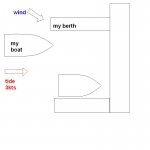
As you can hopefully see from the attached image when I come into my berth I often have a 3 kt tide up my stern and a crosswind trying to stuff me into my neighbour.....

Anyone got a bright idea how the heck I can control this and get tied up safely please?

Changing berths is not an option :-)

Thanks

myberth.JPG
 
In all honesty, i would put her in stern first, which way does the prop kick take effect?

Going stern first mean you can use a burst of power over the rudder to turn the bow/stern in/out inwhich ever direction you want whilst keeping the speed down, using lines to the pontoon then to control her in reverse.
 
I suppose the obvious answer would be to turn into the tide at the last minute and come in backwards. If you are stemming three knots of tide you will still be able to steer effectively even if you are going backwards relative to the pontoon. 'Ferry gliding' and the you should be able to stop easily using engine power. You could also consider using a midship forespring once along side - once its one the jetty motor forward until its taught, wind the wheel hard to port to keep the stern in and then nip ashore to put the other lines before stopping the motor - bowing to the amazed onlookers and then going for a well deserved beer/whisky/gin of your choice.
 
Perhaps wait for the tide to change or just get chummy with your neighbour fender up well and plan to just come to rest along side him ?
I have absolutely no issue if some comes along side so long as the fenders are in place.
 
Berthing 101. Whenever possible, park uptide and upwind. Where the two are opposed, tide is generally king.

In this case, going in astern will do the same job. Just motor at less than three knots, and drop back into your berth, ferry gliding for steerage.
 
Last edited:
You'd certainly be mad to go in forwards and slam into reverse to stop. The wind from the port quarter makes it all the worse, as the prop wash and windage as you slow will rotate you wildly clockwise.

The obvious one is to go in backwards. Head uptide (that's the general golden rule in all cases) and ferry glide across to your berth. With anything like a 3 knot tide this is easy and will give you really good control. (If your idle speed is slower than the tide rate, use a proportional on-off pattern on the throttle: 5 seconds on, 10 off gives you a third of the headway of constantly on.) Then use an increasingly sparse use of throttle to drop back into your berth. Gives you time to lasso the end cleat when it's amidships, from either your bow or midships cleat.

But you can go in forwards if you prefer. You just need to be reversing against the tide before you begin. Ferry-gliding works just as well in reverse as ahead (beware of getting at too great an angle to the tide in reverse, or the prop wash when you engage reverse again can twist you parallel to the tide). So position yourself at the top left of your picture, facing towards the right and reversing against the tide; ferry-glide to the position you've shown, taking your time; and gradually reduce the reverse throttle (or time proportion of using reverse throttle) until you're in position.

Your picture shows the other boat bows-in. Perhaps this is what he did.

Good luck.
 
Now if you were a Turkish Gilet (?) you would charge towards your berth and drop the anchor . When it bit it would spin the boat around and you could reverse into your brth under control. Can't be that difficult...they do it all the time!!!!
 
Had a similar berth in the past. Only trouble with going in astern, especially if strong winds, or tide easing is the the bow can get blown off if you have a shallow forefoot.

If she will handle ok in astern, ferry glide in bow first, take some time in the main channel to get her balanced whe you have some space and watch out for the tide flow changing as you get out of the channel.
 
I used to do a lot of sailing with a 9 year old and her Teddy.

Enjoy it while you can its over all to quick.

To all intents and purpose you are single handing. But they are agile and some times keen to help and on rare occasions even listen. I also sailed with an 11 year old. Some times the additional crewmember was a help often if they are related it’s a hindrance. We used to enjoy it though.
She is now a 15yr old with a 17yr old brother. Teddy still comes sailing occasionally but they often leave me to go it alone or take their Mum.

Trying to teach 9 year olds and 11 year olds how to sail tie knots or cooperate and communicate with each other as a effective crew is an exercise in futility. Especially if you are related to them.

When I stopped trying to teach them and realised they just wanted to enjoy sailing for a while until there attention was drawn to some thing else and the they would come back to it. They learn quickly if its fun and they want to participate.

I used to get them to help me set up my lines and fenders on both sides well ahead. Knots took a while but figure 8s on a cleat there were on top of real fast.
I’d cleat the lines bow and stern. And tie a spring to my shrouds (no mishap cleat)
Lead the lines fore and aft outside every thing until mishaps at shrouds.
Put in charge of one line bow or mid ship.
Id keep stern line for my self.

My wife laughs at me if I scratch the boat.

So far I don’t know exactly what the reaction to returning one of our little darlings in anything other than perfect condition is it varies the angry mother tiger or grizzly would be similar.. Even slight damage never gets forgotten or forgiven.

The hard bit to get across to the 9yr old and 11yr old

Getting them to wear life jackets a constant reminder.
The hard bit teaching kids the following
Don’t jump. on to dock while boat is moving.
Don’t try to fend boat with feet .
Wait until I get the boat where I want it then you can take the line.

Let the boat crash. It can be fixed. Even other boats can be fixed.

As for your dock. My first though is don’t back down wind.. But in this case it as others have suggested stern first might be the best way even though bow may blow off.

Id do it different. To most
Depending on the 9yr old Id plan to do it all my self and let the 9yr old help with any of the steps once I was sure they knew the process having seen me do it. First time id rather break the boat than the 9yr old.

Id use a long bow line at least boat length
A long stern line also good idea.
Set up both at the shrouds.
Give 9 yr old an additional fender to hold.
.
Come in at an angle with bow into wind and current.
Slow down until almost stopped through the water
Let the current set me down on the end of the finger so I land around where the shrouds are preferably at a bit of an angle

Tell 9yr old to position their fender between boat and corner of finger as boat lands(keeps them from trying to jump of and help).9

Motor out of gear don’t need any more.

I step ashore from shrouds with both bow and stern line in hand or just stern line and let 9yr old pass me bow line.

Now Id warp her in. no muss no fuss.

Some body will surly now point out this is impossible in a 34ft boat with a 3 knot current

Many owners of old heavy long keeled 34ft boats will tell you it’s the best way.

I would also consider a more difficult manoeuvre. Also with the log bow and stern lines this time led right back to me in the cockpit.

This time I would turn my bow right into the current and stem the flow and let it set me down into berth until my stern was right at the end of the finger
Now id stop boat over the ground by as hot of power ahead. Drop to idle ahead or out of gear.
Step ashore with both lines and warp her the rest of the way.

The chap who recommended fendering well and going alongside lee boat is a wise man.
 
I agree with all those who say go in stern first, with one other suggestion - fit midship cleats and use a single, measured short line with a large bowline at the pontoon end. Drop it over a cleat as you enter and motor gently against it. You'll find it 'pulls' the boat into the pontoon. Leave the engine ticking over in gear and get off to put the breast lines on. Voila!

Had the current not been quite so strong I also would have suggested approaching the berth astern from downwind - that way the natural 'swing' of the bow as you turn counters the wind pressure on your bows and helps keep you clear of the other boat. In 3kn of tide, however, you wouldn't have enough time to get moving astern before being pinned onto the other boat's transom!
 
Ok call me dumb. What the heck is a Ferry glide. Which would be pretty funny if you knew me.

If you motor into the tide at the same boat speed as the tide itself you will be stationary relative to a fixed object such as a jetty or buoy. Gentle helm movements will make the boat effectively slide sideways much to the amazement of the watching throng and your ego!!. So for example you approach a pontoon stemming the tide and come to a stop relative to it several feet out but are still motoring into moving water you then 'glide' sideways onto it.
 
Here are the images from Bill Johnson's excellent book on manoeuvring at close quarters under power for the scenario that the OP indicated. Dependent on the strength of the tide, ahead or astern are suggested.

View attachment 28257
View attachment 28258

In addition I am a firm believer in midship line assisted berthing. Approach the finger upwind and pin the fendered boat on the corner. Attach the midship line to the outer pontoon cleat and use the line to guide the boat in forward gear gently to the right position, adjusting the line as necessary. This video (a demo of the full version at $10) demonstrates the use of lines although he doesn't demonstrate in any harsh conditions.

Above all, practice, practice, practice. I usually spend at least a day a year doing nothing else than pontoon bashing. It's remarkable how much confidence it brings eventually.
 
It may not be an option - but - what's opposite you? Are you in a fairway with pontoons behind you? If so - is it possible to get a line around a cleat uptide & upwind? If it's a looped line then you can pay it out (through fairlead then onto winch) then de-rig it without leaving your boat (assuming it doesn't tangle!).
I think this would only be suitable if it's really blowing and full tidal flow - but it could be a Get Out of Jail card.
I'd still fender up well, and assume you're going to touch your neighbour ...
 
In addition I am a firm believer in midship line assisted berthing. Approach the finger upwind and pin the fendered boat on the corner. Attach the midship line to the outer pontoon cleat and use the line to guide the boat in forward gear gently to the right position, adjusting the line as necessary. This video (a demo of the full version at $10) demonstrates the use of lines although he doesn't demonstrate in any harsh conditions.
.
I too am a fan of the midships line approach and not just for arriving but leaving too - you can hold the boat securely on the one line having got all the others off in your own time, and then if needs be, reverse the helm and spring out at an angle. If the wind is blowing you on hard - put the spring on the bow and a fender to protect it and you can get the boat out at almost 90 degrees and simply reverse out.
BUT beware the helper on the jetty who ALWAYS knows better. He will take the line and then put it on the wrong cleat and screw you up. I remember once on the fuel jetty in Guadeloupe almost begging the knowall to do as I requested but he was certain he knew better. Once we had resolved thjings I showed him what I actually wanted him to do and he was amazed, mind you the Dartmouth Harbour master wasn't much better...........
 
I too am a fan of the midships line approach...

mind you the Dartmouth Harbour master wasn't much better...........

... and the well-meaning old hand at the Beaulieu petrol berth is a right one for yanking hard on any line he can get his mitts on, particularly if you ask him to leave you to it!

I found the video excellent. Interesting twist on the midships cleat trick there: he lays a line from his midships cleat and back over the rail to a cockpit winch, and it's the bight, not a single loop, that he casts over the end cleat of the pontoon. Would it work equally well if you tried this on a larger boat, or would the greater distance between the two onboard ends of the line (presumably the aft one coming in through the quarter fairlead) be too great?
 
Top