Help, radio's, AIS, chart plotter and wiring!!!

the griff

Well-Known Member
Joined
19 Oct 2015
Messages
98
Visit site
First of all, I am new to the forum, although I have been lurking for a while this is my first "HELP!" post.

I have a 24" falcon cabin cruiser with a volvo KAD32. I have had it moored on the Ouse at York for the last 7 years and have this year brought it closer to home to the river Tees where I plan to use it out at sea next year.

I have just passed my DSC VHF radio course on Saturday and am now wanting to upgrade to a DSC radio. I have recently bought myself a Simrad Go7 chartplotter and the navionics card for it.

I have read a lot about different DSC Radio's and the one that seems to stand out is the Standard Horizon GX2200E. With the river Tees entrance being a really busy shipping port the AIS feature on this radio would be a real bonus.

What is confusing me is;

Would the GX2200E radio's AIS feature work on my Simrad GO7 chartplotter?

Do I need some sort of magic box or accessory to make them work together or can this be done with just a lead, is there a plug in lead I can get or will it need wires joining?

I currently have an old fixed radio with a recently fitted new aerial, will this aerial be ok?

If I bought the GX2200E radio, as well as the GO7 plotter and presuming my existing aerial is ok, is there any other equipment I would need to make them work together?

Would the Standard horizon GX2200E be a good choice or is there something else that may be better suited?


Thanks in advance for any help or advice.
 
The GX2200 is an excellent radio, I have the predecessor model (GX2100) and am very happy with it.

Usually a DSC radio will connect directly to a plotter, but unfortunately, a quick skim of the manual for the GO7 shows that it only has an NMEA 2000 input, and the radio only has NMEA 0183 output. So you would need a converter, and they aren't pennies.

The alternative would be to find a radio with NMEA 2000 output. I'm not sure what to suggest, I haven't kept up with the state of the art since buying mine. The majority of radios are still 0183-only, but this is slowly changing.

The existing aerial should be fine.

Pete
 
Thanks for the reply,
I have just rang lowrance uk, they have told me I need a backbone kit to make it work with a lowrance link 8 radio through the NMEA2000, the part number of the "backbone kit" is 000-124-69. Would this info be correct and would this also be ok with the GX2200E.
The backbone kit is about £60

Thanks again
 
Likewise, I have a GX2100E - basically the same as the GX2200E but without the built-in GPS.

Wiring is, as mentioned above, via NMEA 0183 but an added complication is that the receiving device has to be able to accept high speed NMEA inputs (38,400 baud), not the standard 4,800 baud. Check Standard Horizon's webiste, as they have online manuals to download, that will show you the wiring options. I think I am right in saying that all comms on the GX2200E are via a single high speed NMEA port but, again, check the manual. The older GX2100E required two NMEA ports, one high speed for AIS data and one low speed for GPS input / DSC output.

With regard to your antenna, you will just need to ensure that the cable, plugs, soldered joints and the antenna itself are all of good quality and in good condition. Any weak links can lead to dropouts in the AIS data received.
 
I have just rang lowrance uk, they have told me I need a backbone kit to make it work with a lowrance link 8 radio through the NMEA2000, the part number of the "backbone kit" is 000-124-69. Would this info be correct

Yes, it's correct. This looks like a kit for making simple NMEA 2000 connections, and the Lowrance Link 8 presumably has NMEA 2000 or they wouldn't suggest it.

There should be other NMEA 2000 radios out there as well, if you don't like the look of the Link 8.

and would this also be ok with the GX2200E.

No, because the GX2200 doesn't have NMEA 2000, as I already said.

Pete
 
Last edited:
Thanks again, I am sort of getting things worked out in my head.
So to clarify, my Go7 plotter is NMEA200 and if I was to buy the backbone kit and an extra "t" piece for it I could connect the lowrance link 8 radio to it and have a fully operational DSC radio with AIS displayed on my plotter from the radio with only my standard VHF radio aerial plugged into it.
I am now thinking the lowrance link 8 maybe a better option due to it being made by the same company as my Simrad plotter, the plugs and everything should all be the same connections and you would think it will be easier to set up.
The link 8 radio looks ok and I think it will do what I need it to do.

Thanks again for all your help.
 
image.jpg

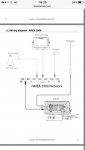
Just found this diagram, the link 8 radio doesn't have an internal gps like the GX2200E, would I need to add an external gps antenna as per diagram or would it automatically use the built in antenna that's inside the GO7 plotter if I replaced the multifunction display that's in the diagram with my GO7.

Thanks again
 
Last edited:
View attachment 54818

Just found this diagram, the link 8 radio doesn't have an internal gps like the GX2200E, would I need to add an external gps antenna as per diagram or would it automatically use the built in antenna that's inside the GO7 plotter if I replaced the multifunction display that's in the diagram with my GO7.

Thanks again

99.9% the radio will get the signal as it's broadcast on the NMEA2K network from the plotter. Should do, will be very impressed if it doesn't!
That's the whole idea of the NMEA2K network.
Saves you some money from buying a radio with a gps antenna in it.

cheers

V.
 
Be wary of the Lowrance / Simrad stuff. The HDS range of plotters only had one port so were great for either VHF comms at low baud or AIS comms at high baud, but I could not have both (NMEA0183). This was not what their advertised specification suggested, and I ended up returning it all to Force 4 to exchange for Garmin, along with a Garmin backbone kit for NMEA2000.

Lowrance Tech support was also poor, as it was my fault their gear didn't work as expected. I would not buy another piece of Simrad / Lowrance also because of my previous experience of Simrad wanting ~ £100 just to press a few buttons to reset the MMSI number on an RD68 DSC VHF.

I installed the Furuno Radio Ocean RO4800 on my last boat but sadly it has been discontinued, but it was an excellent bit of kit at just £200.

There is no colour standard for the wires on NMEA0183 systems so tying these together can be difficult, which is again where pre-wired NMEA2000 scores.

Finally be aware that there are two standards of NMEA2000 - fully compliant such as Garmin, and partially compliant such as Raymarine. Raymarine Seatalk NG is very similar to NMEA2000 but allows install practices not allowed by strict adherence to NMEA2000 protocol, e.g. only one item on a drop down from the backbone. I don't know if Lowarance / Simrad are fully compliant or not.

PM me if you would like the Garmin guide notes to NMEA2000 systems
 
Be wary of the Lowrance / Simrad stuff. The HDS range of plotters only had one port so were great for either VHF comms at low baud or AIS comms at high baud, but I could not have both (NMEA0183). This was not what their advertised specification suggested, and I ended up returning it all to Force 4 to exchange for Garmin, along with a Garmin backbone kit for NMEA2000.

Lowrance Tech support was also poor, as it was my fault their gear didn't work as expected. I would not buy another piece of Simrad / Lowrance also because of my previous experience of Simrad wanting ~ £100 just to press a few buttons to reset the MMSI number on an RD68 DSC VHF.

I installed the Furuno Radio Ocean RO4800 on my last boat but sadly it has been discontinued, but it was an excellent bit of kit at just £200.

There is no colour standard for the wires on NMEA0183 systems so tying these together can be difficult, which is again where pre-wired NMEA2000 scores.

Finally be aware that there are two standards of NMEA2000 - fully compliant such as Garmin, and partially compliant such as Raymarine. Raymarine Seatalk NG is very similar to NMEA2000 but allows install practices not allowed by strict adherence to NMEA2000 protocol, e.g. only one item on a drop down from the backbone. I don't know if Lowarance / Simrad are fully compliant or not.

PM me if you would like the Garmin guide notes to NMEA2000 systems

Thanks but I am stuck with the Simrad plotter now.
I bought the Simrad go7 a couple of months ago because it ticked all of the box's at the time, it was large enough for what I need, it's touch screen, simple to use and came as a good package for the price with navionics and a transducer with down scan which is ideal for finding wrecks for fishing over.
It's only after doing the DSC course on Saturday and looking at new radio's I have decided to take advantage of the AIS feature if possible. If I can get a new link 8 radio for £250 and a couple of bits to join it all together for under a £100, as long as it all works, for under £1000 in total I will be happy with a 7 inch touch screen chart plotter with overlaid AIS and a DSC radio.......... If it all works!!!!
I was talking to force 4 earlier and am going to get it sent in an email exactly what they recomended, that way if it doesn't work I can send it all back(apart from the plotter).
In hindsight I maybe should of started this thread a couple of months ago before buying the plotter and maybe you knowledgable people could of advised me and maybe planted the seed for later upgrades like AIS.
Thanks again everyone for the advice
 
Just to say a big thank you to everyone that helped me with this.
I have today wired in my new "lowrance link 8" radio, after entering my MMSI Number I got it talking to my "Simrad go7" chart plotter.
The radio is using the GPS signal from the plotter and the plotter is receiving the AIS information from the radio and displaying it on the plotter, all by joining it together with the NMEA 2000 backbone kit, it was so simple just joining the "T" piece's together.

Thanks again for all your help!!!
 
Lifting up this post since I've had issues with my Link 8 - Raymarine MDF since I got it years ago...

First, I had to get an software upgrade for my Link 8, which at the time no Lowrance support could guide me to or provide. I got help from a helpful guy on a Norwegian board - a Simrad Guru, so to speach. After upgrading my Link 8 on his kitchen table, I got back to my boat, hooked up all the expensive NMEA2000 wiring and backbone, and voilá! It worked! For two weeks... Then the Link 8 lost it's GPS positioning from the MDF, and the MDF haven't seen any AIS signal ever since. This was back in 2013. I figured it could be a faulty wire, but all of them are just fine after I've checked them. Yesterday I was in the back of my panel, making some sort of much needed order in all my cables. Since I just recently upgraded the software on my Raymarine MDF, I thought I'd give the NMEA2000 a new try, but nope. Nothing happens. Tried setting Baud in different variants but to no help. Then I found an old NMEA0183 cable for the Link 8, Google'd some colorful wires, so now at least I have a GPS position showing up on the Link 8. The most important thing, since I'm sailing with my kids, if they should ever need to push "the button" on the Link 8...
-But no AIS on my MDF. Not sure if I should just capitulate and try hooking up some more 0183 wires and see if it works. Or get some expert help to look at the NMEA2000 issue again.

In short, I shold have gotten a Raymarine VHF instead of the Lowrance. Mixing brands was obviously not the greatest of ideas...
 
Top