Help needed 13ft Day Boat, where to start?

rob_rs2000

New Member
Joined
16 Jul 2014
Messages
7
Visit site
Hi, my name is Rob.

I have just purchased as a project a 13ft day boat in need of restoration, I have never worked on a wooden boat before and think I am in for a steep learning curve.

Firstly any information that anyone may have on type of boat/construction (I think Carvel Double Diagonal) would be helpful.
Also I think most of the work required is to the inner planks that have rotted and I would appreciate any suggestions on repair methods.

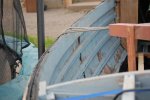
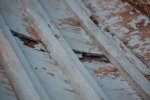
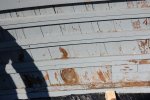
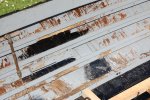
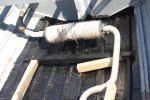
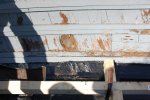
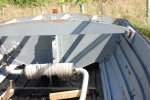
Some photos to show what I've got to work with:

DSC_0179.jpgDSC_0180.jpgDSC_0186.jpgDSC_0183.jpg

Thanks in Advance
Rob.
 
Hi Rob,
My knowledge of this construction is only theoretical, and others with more experience may disagree, but:
Getting at the inside skin will mean removing the outside skin, or removing the stringers while supporting the outside skin to prevent the boat losing shape.
The boat will likely have been built with a calico or similar layer between the skins, bedded in lead paint. The cloth rots over time, and as is what prevents water getting through the two skins into the boat, it needs replacing too.
Unless someone else has a cunning plan, I would think that because of the above points, the boat needs to be disassembled totally, which implies building a set of moulds to allow the parts to go back together in the same shape. Basically the way a new boat would be built, so a lot of quite exacting work.
I would question whether it was all worth it, but that is only my feelings about it.

Good luck anyway

Cheers
Rum Run
 
Rob

my heart bleeds for you.

That boat cannot be repaired with your present level of skills and knowledge, and you really need to sell it on as fast as possible. It is a huge and complex technical challenge to take all those veneers off, remake the frames, and other solid timbers, and then re-plank. At the very least, you will need a set of new internal and external 'planks' plus frames and stringers.

If you are determined to go ahead, take a small hammer, and turn the boat over. Tap every 3 inches over the whole hull; record what percentage of taps are 'bright' (i.e. dry) and what are dull (rotten). If the % of dry to wet is less than 80%, then you really are on to a loser.

Get your money back by selling it, then come back here and ask for more help in choosing a realistic project.
 
Last edited:
I have never worked on a wooden boat before and think I am in for a steep learning curve.
I would echo Sarabande. Even a simple ply dinghy can be disappointing when you realise how extensive the rot is. I have just thrown some rotten wood in the bin from a boat I am working on. It seemed sound enough and had a nice gloss finish to it. However I decided to remove it as it didn't "sound" right when tapped. It fell to bits.

Unless you are a very extraordinary person I can guarantee you will get disheartened and dump it.
 
Agree with the others. Honourable viking funeral required. That method of construction was never intended to be durable. It was used because it required less skill, used short lengths of timber and produced a stiff hull when new, but also created the perfect conditions for rot as you can see.
 
Rob

Welcome to the forum. With your experience, you will not be able to make a decent job of it and preserve the traditional look of the boat. However, if you don't mind perhaps using a lot of epoxy and glass (not cheap) and perhaps painting the inside, all may not be lost.

If the rot isn't extensive, you could chop out all the damaged areas, glass over over the affected areas, fill the low bits with thickened epoxy, replace the longitudinal stringers (which look a bit rotten), and paint it. But if the rot is more than limited local areas, you may be onto a loser.

I have very nearly finished rebuilding a 50 year old keelboat of similar construction, and I found a very bad area of rot in a critical place...the shroud plate. It was worse than your boat...holed all the way through...however I have successfully reinforced and repaired it, and although the boat has not been sailed yet, it takes 400lbs of static rig tension with no problems so far.

See page 8 of this thread...there's no way the boat could ever be varnished on the outside as you'd see all of the repairs, and in the cockpit the offending areas (including glass and carbon fibre reinforcement) are all hidden behind a bulkhead. http://www.ybw.com/forums/showthread.php?330889-Saved-from-the-bonfire-new-project!/page8

Although this is my first wooden boat project, I do have a lot of experience working with epoxy, so I would urge caution with your project, and have lots of practice on spare but of wood first. I'd also say don't even think about it unless you have a dry workshop (I don't...nightmare) and can spare an inordinate amount of time (and double your initial time estimate) to do it.

If it is a knacker, I might be interested, but sadly for buzz saw and bookcase duties only!
 
Thanks for the feedback.

Just to add a little more, the guy that I got the boat from has already removed most of the soft wood, so the photos may make it look worse than it really is.
The majority of the internal wood is sound with the rotten bits already removed.
The previous owner has sealed the inside below the water line with some kind of tanking paint, not sure if this is a good thing, and said that his intention was to use "wood resin" to repair the rest. I am not sure what he means by wood resin or what technique to use.

The boat has already had a lot of work done on the outer skin and engine. I do not intend to fully restore but more of a repair to make the boat useable.

So I guess I really need to assess if it is worth the effort. I would be interested to learn more about possible repair options with the outer skin intact. If the outer skin needs to be removed it's going to be a non starter for me.
 
any wood sealed with 'tanking' paint (possibly chlorinated vinyl ?) will seal in any residual moisture and the mycorrhiza (roots) of any fungus nearby. This sets in motion a process guaranteed to cause rot to spread everywhere.


"Wood resin" sounds like the stuff sold by Ronseal in B&Q for painting over rotten wood in window frames. Not designed for use in boats. It needs totally dry wood to be successful.

The idea of taking out the inner skin requires all the interior frames and stingers and bulkheads to be removed. At which point the boat will collapse as there is nothing to support the outer layer.

The process of using lots of glassfibre (e.g. chopped strand mat or bi-axial cloth) as a liner is also a loser. The weight and complexity of ensuring that the material adheres to the outer skin will render the shell overweight and possibly leading to stresses beyond the design limits.

For the last time. Get rid of it. There may be bits of equipment you can save and sell. Otherwise you will burn money and your enthusiasm for sailing. Be brave.
 
The process of using lots of glassfibre (e.g. chopped strand mat or bi-axial cloth) as a liner is also a loser. The weight and complexity of ensuring that the material adheres to the outer skin will render the shell overweight and possibly leading to stresses beyond the design limits.

Eh? I can't see the extent of the rot from the pictures, but why is a localised repair using quality materials such as west or SP, a couple of layers of 200gsm twill, peel ply and some lightweight filler powder suddenly going to add so much weight the thing folds up? Many old wooden boats have been totally sheathed in glass, and whilst it is a sticking plaster approach, they are OK structurally for the time being...

Not sure if you followed the link but the areas of my F15 that were daylight are now supporting rig loads seem to be managing OK. Unless the only reason I can't see daylight is because my repair is sooooo heavy that the black hole on the port shroud plate is even sucking in light itself to the gravitational vortex?
 
.....For the last time. Get rid of it. There may be bits of equipment you can save and sell. Otherwise you will burn money and your enthusiasm for sailing. Be brave.

I'm not sure that giving up before even starting could be considered "brave".

Why do you think the guy was talking about "wood resin" from B&Q?, I suspect he was talking about repairing with pieces of wood and some kind of epoxy to bond/seal.

I have invested no time or effort into this yet and just thought it was at least worth a little investigation into what is possible repair wise.

I could sell the engine and trailer to recover some cash, but what would I do then? I would be looking for a sub £1000 boat with trailer and engine for weekend use on loch ness and maybe occasional coastal use.
 
Eh? I can't see the extent of the rot from the pictures, but why is a localised repair using quality materials such as west or SP, a couple of layers of 200gsm twill, peel ply and some lightweight filler powder suddenly going to add so much weight the thing folds up? Many old wooden boats have been totally sheathed in glass, and whilst it is a sticking plaster approach, they are OK structurally for the time being...

Not sure if you followed the link but the areas of my F15 that were daylight are now supporting rig loads seem to be managing OK. Unless the only reason I can't see daylight is because my repair is sooooo heavy that the black hole on the port shroud plate is even sucking in light itself to the gravitational vortex?

Iain, you've got an F-15 ? Respect !

Rob,

I think your boat is repairable if you are keen; however if you want to go sailing any time within the next couple of years, bin it as suggested...

It would be helpful to know roughly whereabouts in the country you are, so more help might be forthcoming.
 
Like almost anything, it certainly could be restored, though at what expense is hard to tell from the pics. If just a few inner planks as shown, the stringers could easily be cut, planking replaced and stringer replacements made and fitted. Doubling up stringers would be a good idea. Deep rot beneath the waterline is different though. Wouldn't want to put your foot through the hull would you :). But if below the waterline is reasonably sound (try jumping up and down on it??) a single layer of fibreglass laid over the outside will make it water-tight for a couple of years or so. But don't ever go out without lifejackets etc. But probably I'd scrap it unless you're really determined and prepared for heartache.
 
I'm not sure that giving up before even starting could be considered "brave". Just sensible

Why do you think the guy was talking about "wood resin" from B&Q?, I suspect he was talking about repairing with pieces of wood and some kind of epoxy to bond/seal. I suspect he has never chased rot through a boat, or even repaired a boat
(Wood resin from B&Q will be the Ronseal stuff for filling cobwebby wood on window frames with resin so that you can stick some filler on and paint over it. It doesn't really have a place in repairing boats.)

I have invested no time or effort into this yet and just thought it was at least worth a little investigation into what is possible repair wise.

I could sell the engine and trailer to recover some cash, but what would I do then? I would be looking for a sub £1000 boat with trailer and engine for weekend use on loch ness and maybe occasional coastal use. Can't help you really, the fact you may be out of pocket is a risk you take. However, what is certain is that you will be a lot more out of pocket if you carry on

I think you may have been seduced by the varnished hardwood look of the exterior. Try painting it matt grey and see if the project seems as attractive.

Still, you asked for advice. Whether you take it or not is up to you.
 
Last edited:
OK Rob
If you want some more detailed analysis of the problems you are likely to face, then post a few more pics please.
 
It's the lack of any kind of gunwale that has been the issue. Water will get in and just work it's way down between the strips. I'd be taking an electric planer to that, removing 1/2" or so and epoxy filleting a rainproof hardwood "cap" onto it. An easy job with a router to cut slots into the new gunwale, and it will only cost about £40 in wood, and it will also add a lot of strength. My 15 had a similar issue.

It's still difficult to tell from the pics, but if that's the worst of the rot, I'd be tempted to dig it out, glass it, fill it, paint it and go pottering. OK it might not last forever, but if it gives you a few years, and you are happy with a basic finish, just go for it. I do agree that if the rot is extensive, and the structure compromised, then it might be a lost cause, but I'd certainly not be jumping on the "kill it...kill it with fire" bandwagon just yet. But have a very very good poke around under that black paint and the waterline first.
 
Thanks Iain,

I will start digging about when I get chance and see how much rot, the first job is to get the boat into my shed (still trying to figure out what to do with it to make it easy to work on in the shed).

I like your idea with hardwood cap gunwale, would you bend the wood to the curve of the boat or cut to shape from a lager piece.
 
The combination of a rotting wooden boat and a Stuart Turner is the stuff of nightmares for those familiar with old boats! Patching the rotten bits with glass and resin will work for a while, but as soon as you think you have dealt with one area another will rot. Guess it depends on how good the outer skin is as that is what keeps the water out.

You should be able to bend a capping piece for the gunwhale, although it may need steaming to take the curve at the bow.
 
I don't know too much about the construction of this boat, I understand it is a diagonal laminate construction.
I my be totally wrong and await to be corrected but the one thing that has not been suggested is to laminate a second skin/veneer on the outside of the hull using the same method as the original.
Or using a modern adhesive i.e. one of the wood glues like Balcaton or a two pack, the new layer could be a Mahogany strips of veneer 2/3 mm thick.
the insides then could be locally attacked with graving pieces let in and glued with the same as used for the outer skin.
Which I think would be a better option than just fibre glassing it over.
 
Top