
Help me resolve this VHF antenna mystery

Looks like a J-pole antenna, the shorter section is the tuning circuit, so it doesn't need a tuning coil. Interesting design.

Monopole antennas all have the problem that they either need a ground plane to work against or a tuning circuit, J Poles or Slim Jims are good ways of doing that.
Don't really matter what it's called if it doesn't work; tested on two different radios in two different locations with terrible results in both cases. It was so poor that everyone involved assumed it was broken somehow - turned out it was in perfect condition and exactly how it was meant to be. Still quite shocked by the experience. I mean I've had to deal with some awful products over the years, but really. No really. What sort of performance would you expect if you shorted the ends of the coax? Almost regret throwing it away now; I'd be willing to bet it would have performed much been better if the brass rod was cut between the centre conductor and the shield. Not great, but better.
 
No really. What sort of performance would you expect if you shorted the ends of the coax?

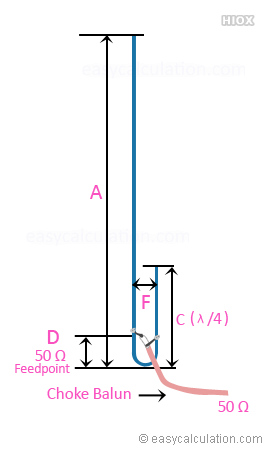
J-Pole antennas are supposed to be shorted so that's not the reason for the poor performance. RF stuff is often counterintuitive, so what is a dead short at DC may not behave that way at RF frequencies. The location of the connections of the centre of the coax and the shield is important though and depends on the intended frequency for impedance matching:

1733442185174.png


Here's an explanation of how a J pole works:
 
Yeah, RF is seriously weird. I have an electrical engineering background, but never got into RF and always regarded it as a dark art. It's difficult to believe that a 30 mm length of 2.5 mm diameter solid brass wire would look like a 50 ohm impedance at any frequency, but ok, RF is weird. I'll accept that a "J-pole" antenna can work, though I'm not convinced the type has any benefits beyond being cheap and easy to make.

Be that as it may, based on the real life performance this particular example must have been poorly designed, since all other controllable parameters were optimal during both tests; cable was good, connector was good, elevation was good, distance to sources of interference was good. The first test was done with the antenna mounted on a wooden mast, on a wooden hull boat, with the antenna base at around 3.5 m above sea level. It was connected to an old but good quality Seafarer dual-watch VHF that previously performed well with a simple whip antenna that was both shorter and mounted at a lower height. No other electronic equipment on the boat was switched on at the time. During this test it was not possible to transmit a legible message to the local marina, whose receiver was located less than 200 m away, with a clear line of sight.

The second test was performed on a boat with a steel hull, with the antenna attached to the side of the wheelhouse and extending above it. The base of the antenna was at approximately 2.5 m above sea level. It was connected to a Sailor RT4822 DSC VHF which normally performs amazingly well with a simple whip antenna. Again no other electronic equipment was switched on during the test. During this test reception was observed to be very bad, with most traffic only coming through as bursts of static, and any transmissions which were legible had severe background interference which made them sound like they were broadcast from a helicopter in flight. No such interference had ever been seen with the original antenna, and it immediately went away when I switched back to it.

Furthermore, upon disassembly no defects of any kind were found inside the antenna. So theory aside, this is how it performed in the real world: very, very, poorly. I'm sure a coat hanger shoved into the PL259 socket would have comfortably beaten it.
 
Last edited:
Yeah, RF is seriously weird. I have an electrical engineering background, but never got into RF and always regarded it as a dark art. It's difficult to believe that a 30 mm length of 2.5 mm diameter solid brass wire would look like a 50 ohm impedance at any frequency, but ok, RF is weird. I'll accept that a "J-pole" antenna can work, though I'm not convinced the type has any benefits beyond being cheap and easy to make.

Be that as it may, based on the real life performance this particular example must have been poorly designed, since all other controllable parameters were optimal during both tests; cable was good, connector was good, elevation was good, distance to sources of interference was good. The first test was done with the antenna mounted on a wooden mast, on a wooden hull boat, with the antenna base at around 3.5 m above sea level. It was connected to an old but good quality Seafarer dual-watch VHF that previously performed well with a simple whip antenna that was both shorter and mounted at a lower height. No other electronic equipment on the boat was switched on at the time. During this test it was not possible to transmit a legible message to the local marina, whose receiver was located less than 200 m away, with a clear line of sight.

The second test was performed on a boat with a steel hull, with the antenna attached to the side of the wheelhouse and extending above it. The base of the antenna was at approximately 2.5 m above sea level. It was connected to a Sailor RT4822 DSC VHF which normally performs amazingly well with a simple whip antenna. Again no other electronic equipment was switched on during the test. During this test reception was observed to be very bad, with most traffic only coming through as bursts of static, and any transmissions which were legible had severe background interference which made them sound like they were broadcast from a helicopter in flight. No such interference had ever been seen with the original antenna, and it immediately went away when I switched back to it.

Furthermore, upon disassembly no defects of any kind were found inside the antenna. So theory aside, this is how it performed in the real world: very, very, poorly. I'm sure a coat hanger shoved into the PL259 socket would have comfortably beaten it.
The breaking up of reception and transmission must indicate a bad connection at some point. Poor solder joint or broken wire. The J antenna has the advantage of not needing a ground plane and should be quite a robust style of construction. I do not believe you can condemn the style of antenna. ol'will
 
Top