Help!!! How can I charge a battery from my outboard?

CLB

Well-Known Member
Joined
18 Jun 2013
Messages
4,959
Visit site
I have a little fishing boat project on the go and it is equipped with a 20hp Evinrude circa 1987. It is manual start but I want to use the engine to charge a battery that will run the boats lights, radio etc etc.

They did make an electric start version of this engine, so there must be a way of getting a charging current out of it.

The big question is, what bits would I need?

This link takes you to a parts diagram with some electrical bits. Its a Johnson but the same motor.
http://tinyurl.com/q6d8j8m

eng model number BE20BFLCUR
 
Last edited:
If your engine does not have the charge coil, No27 in your link, one of those plus a rectifier-regulator unit.
 
If your engine does not have the charge coil, No27 in your link, one of those plus a rectifier-regulator unit.

Thanks that's useful. I do know at least have something to look for. For $25 it would be worth buying one if I don't already have it. Part number 3 is labelled as a rectifier. Would this be the other bit that you refer to?

I wouldn't bother, a cheapo 10W solar panel will keep the battery in much better condition than the occasional low amp charge that is available from an outboard.

I have thought about solar, and I may add one as well, but on this boat, unlike say a sailing boat, the engine will be running all the time so the charge, although only small, will be fairly constant.
 
You might get away with any old 'bridge rectifier'. The output will be fairly low and the battery will damp down any excess volts to some extent.
A lot of small motorbikes used to work like this.
If using a small or sealed battery, regulating the output would be better.
I'd check with a voltmeter to see if overcharging was an issue.
 
I have to admit to not understanding much of that last post. Is number 3 on the diagram a bridge rectifier? If so are you saying that it would be better not getting one of those and adding a regulator instead?

What voltage would I likely see out of the charging coil and will this be AC or DC as I have seen some reference to AC current being produced and the rectifier turns this into DC. Is that correct?
 
Thanks that's useful. I do know at least have something to look for. For $25 it would be worth buying one if I don't already have it. Part number 3 is labelled as a rectifier. Would this be the other bit that you refer to?


I have thought about solar, and I may add one as well, but on this boat, unlike say a sailing boat, the engine will be running all the time so the charge, although only small, will be fairly constant.


Right then #27 is not the coil for battery charging. It is the charge coil for the CD ignition system.

#41 , called the stator coil, is the battery charging coil!


The official parts lists at http://epc.brp.com/Index.aspx?lang=E&s1=60a9c7f1-158e-4459-8c89-cc4a92f3b201 indicate that this coil and the rectifier were only fitted as standard to electric start models.


Sometimes however Belgium made models ( yours is a Belgium made one) are fitted with a lighting coil. If this is so then its output will be taken to a socket on the lower cowling . This socket is shown in the diagrams as #45 although not included in the parts list

It would be possible to connect a rectifier to the lighting socket ...... and a plug-in accessory part number 0582105 was available for this.

While it would be possible to improvise I must make the point that the battery charging and lighting coils have a 3 wire output and a special rectifier, identical with a 3 phase rectifier with a 3 wire input is required! an ordinary bridge rectifier will not do the job.

It would of course be possible to assemble your own rectifier using 6 diodes rather that the usual 4 incorporated into a normal bridge rectifier.


The full battery charging kit, including stator coil, rectifier, terminal strip (#7) and all the associated bits and pieces is listed as part number 0174037 ( Illustrated here http://epc.brp.com/cgi-bin/ImgServ....6\04B.tif&ilSC=15&ilIV=0&ilBR=0&ilIF=P&ilRE=8 )

If you really want to proceed, rather than fit a solar pane,l then I suggest you contact Oakley Marine aka Outboards Direct to determine if the parts are available and what they will cost. http://www.outboards-direct.co.uk/
 
To help here is photo of the rectifier, the round thing, and terminal strip on a (smaller) Evinrude fitted with battery charging


I emphasis again that an ordinary bridge rectifier is not suitable! and the diagrams below show how the 3 wire stator is connected for lighting and the diagram of the 6 diode rectifier.


outboardpowerhead.jpg


4fd8c66a.jpg
 
Thanks VicS for your very comprehensive reply.

This is starting to look a bit more complicated than I thought.

Interestingly I do have the plug on the lower cowling, but inside the three wires have been cut off. Do you know where they would have gone to? Looking at the diagram they seem to go to the stator (part 41) is that correct, or is the lighting coil something completely different?

Thanks, I really do appreciate your help


Right then #27 is not the coil for battery charging. It is the charge coil for the CD ignition system.

#41 , called the stator coil, is the battery charging coil!


The official parts lists at http://epc.brp.com/Index.aspx?lang=E&s1=60a9c7f1-158e-4459-8c89-cc4a92f3b201 indicate that this coil and the rectifier were only fitted as standard to electric start models.


Sometimes however Belgium made models ( yours is a Belgium made one) are fitted with a lighting coil. If this is so then its output will be taken to a socket on the lower cowling . This socket is shown in the diagrams as #45 although not included in the parts list

It would be possible to connect a rectifier to the lighting socket ...... and a plug-in accessory part number 0582105 was available for this.

While it would be possible to improvise I must make the point that the battery charging and lighting coils have a 3 wire output and a special rectifier, identical with a 3 phase rectifier with a 3 wire input is required! an ordinary bridge rectifier will not do the job.

It would of course be possible to assemble your own rectifier using 6 diodes rather that the usual 4 incorporated into a normal bridge rectifier.


The full battery charging kit, including stator coil, rectifier, terminal strip (#7) and all the associated bits and pieces is listed as part number 0174037 ( Illustrated here http://epc.brp.com/cgi-bin/ImgServ....6\04B.tif&ilSC=15&ilIV=0&ilBR=0&ilIF=P&ilRE=8 )

If you really want to proceed, rather than fit a solar pane,l then I suggest you contact Oakley Marine aka Outboards Direct to determine if the parts are available and what they will cost. http://www.outboards-direct.co.uk/
 
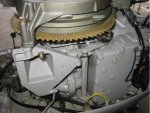
I thought I might be able to search online for an image to find out where these three yellow wires from the plug went. The best I have managed so far is this pic but it doesn't really help.

Picture 7.jpg

I am guessing they go into one of those black harnesses and of round the other side of the engine.
 
Thanks VicS for your very comprehensive reply.

This is starting to look a bit more complicated than I thought.

Interestingly I do have the plug on the lower cowling, but inside the three wires have been cut off. Do you know where they would have gone to? Looking at the diagram they seem to go to the stator (part 41) is that correct, or is the lighting coil something completely different?

Thanks, I really do appreciate your help

Yes its not quite as simple as you might think at first.


The socket would have been wired to a stator coil with three wires (coded yellow, yellow blue and yellow grey) The stator coils for lighting and battery charging are different part numbers but I don't know the actual difference... power output or voltage possibly. The battery charging kit ( illustrated at http://epc.brp.com/Index.aspx?lang=E&s1=60a9c7f1-158e-4459-8c89-cc4a92f3b201 ) would have plugged into this socket.

If the lighting coil still exists and is functional it would be possible to re-wire it to the socket, but there must be some reason why the wires have been cut, and obtain the AC lighting to battery charging kit ... if it's still available.

Alternatively wire it to a rectifier mounted like the one in my photo. ( for connection to a rectifier the distinction between the three yellow wires is not relevant, in fact replacement rectifiers have I believe 3 plain yellow wires)

Personally I would reconsider the solar panel option. Mounted permanently you only need a small one to recahrge the battery while you are away from it-
I have a small solar panel as mine is a small sailing boat and I dont often run the engine long enough or fast enough to keep the battery charged without it.
 
I thought I might be able to search online for an image to find out where these three yellow wires from the plug went. The best I have managed so far is this pic but it doesn't really help.


I am guessing they go into one of those black harnesses and of round the other side of the engine.

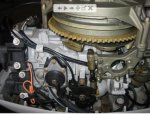
This is the other side of that same engine but I'm none the wiser.


Yes I expect the yellow wires would have gone in one of the black sleeves. On my engine there are two black sleeves coming away from under the flywheel. One appears to carry the ignition circuit wiring to the CD power pack, the other just the three yellow wires.
 
Thanks again Vic, you have been a great help

The more I look into it the more I suspect the lower cowling may not be original. I understand the model number for a rope start with AC lighting would have been BA rather than my BF. I suspect fitting a lighting Stator may not be straightforward if one was never there from the factory, so I may just go with the solar panel for an easy life.

Now here's another question that has arisen while I have been looking into this. The BF in my model number stands for derated. I know that the 20 and 25 of this era were pretty much the same engine, so I am wondering if this means I can get some more power out of the engine by reversing whatever it is that they did to derate it. Any ideas?
 
No, don't know what the derating involved or the reasons for it.

I dont see BA versions listed anywhere so all a bit of a mystery although sometimes difficult to determine exactly what was produced in Belgium.

It would be interesting to see if you can find a welch plug on the power head with a model number stamped on it and compare that with the number you have.
 
Top