Helm to Flybridge wire connection colour

AFAICS there is no definition of "current carrying conductor" in the relevant ISO standards ( unless it has been introduced in the latest version of ISO 13297 )

PR cannot therefor answer your question nor can any of the rest of us.

My interpretation of the expression would be that it is either of the live conductors of a low voltage AC system and the positive and negative conductors of an extra low voltage DC system but that probably does not go far enough. Perhaps I should add " or any conductor connected to them " ???

Yes Vic there is no definition so we can only use our knowledge and " common sense" to decide what it means and our knowledge is all different and well common sense ,I don't want to drift any more

My point is is signal and control wiring current carrying conductor as it is not clear or defined there is a multitude of interpretations not just Paul's or mine.

I saw somewhere a spec thet the plus DC to the engine control switch was Red but the cable to the engine from the switch was a different colour cannot who posted it
 
Yes Vic there is no definition so we can only use our knowledge and " common sense" to decide what it means and our knowledge is all different and well common sense ,I don't want to drift any more

My point is is signal and control wiring current carrying conductor as it is not clear or defined there is a multitude of interpretations not just Paul's or mine.

I saw somewhere a spec thet the plus DC to the engine control switch was Red but the cable to the engine from the switch was a different colour cannot who posted it
My post #49

Older VP engines with conventional wiring. Positive to the key switch is red but the switched supply to the instruments and the electronic module is red/blue. Other colours for other functions (starting, preheating and stopping) controlled by the key switch.

I am quite happy about blue, brown etc being used in the engine, control panel, and interconnecting harness. I reckon anyone who could confuse wiring around the engine and its control panel with the low voltage AC wiring should not be getting anywhere near the electrics.
 
My post #49

Older VP engines with conventional wiring. Positive to the key switch is red but the switched supply to the instruments and the electronic module is red/blue. Other colours for other functions (starting, preheating and stopping) controlled by the key switch.

I am quite happy about blue, brown etc being used in the engine, control panel, and interconnecting harness. I reckon anyone who could confuse wiring around the engine and its control panel with the low voltage AC wiring should not be getting anywhere near the electrics.
As i previously posted, the older ISO did not apply to manufacturers engine harnesses.
 
My post #49

Older VP engines with conventional wiring. Positive to the key switch is red but the switched supply to the instruments and the electronic module is red/blue. Other colours for other functions (starting, preheating and stopping) controlled by the key switch.

I am quite happy about blue, brown etc being used in the engine, control panel, and interconnecting harness. I reckon anyone who could confuse wiring around the engine and its control panel with the low voltage AC wiring should not be getting anywhere near the electrics.

This demonstrates my view

Another example is the wiring from the tachogenerator to the tachometer. 2 wires that carry an ac signal and there is no outside 12 + or negative to either

you could interpret that it should be brown/blue mine are red with number marking this contravenes the ISO standard Paul has quoted

The signal from the W terminal on the alternator is also ac so what should colour should be. brown ?

The ABYC chart does specify the colours for signals cables. Does the ISO have a similar setup

ABYC-Cable-Wire-Color-Codes-for-Yacht-Boat-Marine-Wiring.png
 
As i previously posted, the older ISO did not apply to manufacturers engine harnesses.

So dues the current ISO standard apply to manufacturers engine harnesses and the engine without a harnesses like mine where I wired it p myself with an electrical and mechanical engineering qualification
 
This demonstrates my view

Another example is the wiring from the tachogenerator to the tachometer. 2 wires that carry an ac signal and there is no outside 12 + or negative to either

you could interpret that it should be brown/blue mine are red with number marking this contravenes the ISO standard Paul has quoted

The signal from the W terminal on the alternator is also ac so what should colour should be. brown ?

The ABYC chart does specify the colours for signals cables. Does the ISO have a similar setup
All relevant to the RCD/RCR and ISO, as has been previously discussed on here at length.

Your view is totally meaningless, if you were required to comply with the standard you either comply, or you don't get to import any boats.
 
So dues the current ISO standard apply to manufacturers engine harnesses and the engine without a harnesses like mine where I wired it p myself with an electrical and mechanical engineering qualification
As i said previously, if you want to know what the ISO says, do what i did and buy a copy.

Your qualifications are totally meaningless, it matters not what qualifications one has, if required, you either comply with the standards, or you don't. If not, no imports.

It's very unlikely you would be able to comply with the RCD/ISO as you don't even understand the basics, like "what is a current carrying conductor".

Fortunately for you, you don't need to comply with the ISO, so you can interpret everything however you want (you always do anyway) and continue bodging to your hearts content.
 
Once year 5 have settled down and stopped bickering:ROFLMAO: Perhaps we could actually help the OP.
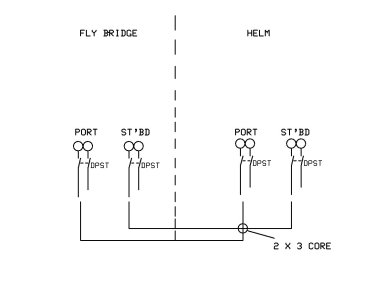
He initially states that the instruments will not switch over between positions? Is this a recent thing or has it been a long standing problem? I would be inclined to sort that out and find the fault before worrying about wire colour. He subsequently submits a brief description of what he has at the moment. A lot of detail missing!! I don't know the craft. However, I have attached a basic sketch of what I think he has? Maybe totally wrong! I have not included the feeds from the sensors and have assumed that two cores from each 3 core cable have been used to interlink the switches. He doesn't say what switches he has, Rotary, rocker, toggle, single pole, double pole, single or double throw?? There may also be a DC +ve for illumination, maybe not. Also I suspect that somewhere there is a common DC- ve. for the instruments. As I say short on detail and information. Perhaps as was suggested, photos would help!
My next point is why can't he use this sort of cable to rewire ?? https://www.tlc-direct.co.uk/Main_Index/Cable_Index/Alarm_Cable/index.html


HELM BRIDGE (2).jpg
 
Once year 5 have settled down and stopped bickering:ROFLMAO: Perhaps we could actually help the OP.
Impossible without the relevant information.
He initially states that the instruments will not switch over between positions?
Instruments don't switch over between helm positions, as such, they should power up when switched on at either helm, one/the other or both can be on.
Is this a recent thing or has it been a long standing problem? I would be inclined to sort that out and find the fault before worrying about wire colour. He subsequently submits a brief description of what he has at the moment. A lot of detail missing!! I don't know the craft. However, I have attached a basic sketch of what I think he has? Maybe totally wrong! I have not included the feeds from the sensors and have assumed that two cores from each 3 core cable have been used to interlink the switches. He doesn't say what switches he has, Rotary, rocker, toggle, single pole, double pole, single or double throw?? There may also be a DC +ve for illumination, maybe not. Also I suspect that somewhere there is a common DC- ve. for the instruments. As I say short on detail and information. Perhaps as was suggested, photos would help!
My next point is why can't he use this sort of cable to rewire ?? https://www.tlc-direct.co.uk/Main_Index/Cable_Index/Alarm_Cable/index.html


View attachment 169948
That cable is too thin.

The switch diagram cannot be correct, because for one thing the OP states two switches for each engine, at each helm.
 
For the sensible readers of this thread (the vast majority), the ISO allows some flexibility of colours for AC and DC wiring. A couple of examples:

1) AC wiring: white live, black neutral and green Earth.
DC wiring: grey positive and yellow negative.

2) AC wiring: brown live, blue neutral and green/yellow Earth.
DC wiring: Reg positive and black negative.

Both comply with the RCD/RCR/ISO, which would be the most logical, easily recognised ?
 
Once year 5 have settled down and stopped bickering:ROFLMAO: Perhaps we could actually help the OP.
He initially states that the instruments will not switch over between positions? Is this a recent thing or has it been a long standing problem? I would be inclined to sort that out and find the fault before worrying about wire colour. He subsequently submits a brief description of what he has at the moment. A lot of detail missing!! I don't know the craft. However, I have attached a basic sketch of what I think he has? Maybe totally wrong! I have not included the feeds from the sensors and have assumed that two cores from each 3 core cable have been used to interlink the switches. He doesn't say what switches he has, Rotary, rocker, toggle, single pole, double pole, single or double throw?? There may also be a DC +ve for illumination, maybe not. Also I suspect that somewhere there is a common DC- ve. for the instruments. As I say short on detail and information. Perhaps as was suggested, photos would help!
My next point is why can't he use this sort of cable to rewire ?? https://www.tlc-direct.co.uk/Main_Index/Cable_Index/Alarm_Cable/index.html


View attachment 169948
As you say a lot more information is needed to really help beyond trying to answer the original question , which was what colours to use.

The alarm cable you suggest is a bit too thin isn't it if it is to run between the helm positions ? Although it is available with 6 cores which might be better than the 2x 3 cores you suggest in your diagram.
 
As you say a lot more information is needed to really help beyond trying to answer the original question , which was what colours to use.

The alarm cable you suggest is a bit too thin isn't it if it is to run between the helm positions ? Although it is available with 6 cores which might be better than the 2x 3 cores you suggest in your diagram.

But it still has unacceptable colours according to Paul and the ISO standard.

Size of cable depends on the maximum current that it will carry

The one posted seems to be copper plated aluminium then tinned
 
Hi everyone many thanks for the help on this, I am going to the boat on Sat and will take pic to show people what the setup is and then I hope we can get somewhere.
 
But it still has unacceptable colours according to Paul and the ISO standard.
Why don't you read the thread, rather than endless trolling ?

As far as the OP is concerned the ISO is of no relevance, as he is not building a new boat, so he can use whatever colours he wants, as i said in post #2, yes, post #2, although i'd recommend not using AC colours for current carrying conductors. Also, as i have pointed out more than once, he can use the same colours as the original engine harness, as this would even have complied with the ISO when his boat was new.
Size of cable depends on the maximum current that it will carry
Subject to being of the minimum requirements for marine use, taking into account the need for robustness.
The one posted seems to be copper plated aluminium then tinned
So doubly unsuitable.
 
Impossible without the relevant information.

Instruments don't switch over between helm positions, as such, they should power up when switched on at either helm, one/the other or both can be on.

That cable is too thin.

The switch diagram cannot be correct, because for one thing the OP states two switches for each engine, at each helm.
Paul. Point taken about cable size but I cannot find, so far, the current rating. but we are dealing with instrumentation not megawatts! However having thought about it aluminium is probably not good for marine use:oops: He does say in #26 "Just two rocker switches. " Not for each engine. That sketch was my interpretation of #26.
To be fair I am not sure what he has, maybe when we get some pics we will have a better idea.
 
Having downloaded the list of ISO standards the RCD requires to comply with I would not bother

You say that the OP's boat is not a new build ISO do not apply.

So as my boat is not a new build but you say it dos apply you also said that I must pay UK VAT if i bring my boat into the UK
as a returning resident

That was again disproved and there is also conflicts in you statements.

I will stay where I am as the laws in South Africa protect the legal right of the individual much better than the UK and possibly the EU.
 
Paul. Point taken about cable size but I cannot find, so far, the current rating. but we are dealing with instrumentation not megawatts! However having thought about it aluminium is probably not good for marine use:oops: He does say in #26 "Just two rocker switches. " Not for each engine. That sketch was my interpretation of #26.
To be fair I am not sure what he has, maybe when we get some pics we will have a better idea.


So what is wrong with copper plated aluminium wire ,it is used on high voltage transmission lines

An aluminium wire have a 1.5 times larger cross section to pass the same current as a copper wire, but two times lighter. Weight is one of the most important parameters for high-voltage power lines that transmit power over long distances. Therefore, only aluminium wires are used in main overhead power lines.

I have aluminium bus bars carrying up to 600 Amps to my ow thruster

The size of my aluminium bus bars is 38mm by 19mm I would like to us Copper but not justify

I am sure Paul would condemn my choice but its my chaise

Aluminium hull boats are used in a marine environment anyway
 
Having downloaded the list of ISO standards the RCD requires to comply with I would not bother
If you were building new boats for the EU or UK markets you would have to.
You say that the OP's boat is not a new build ISO do not apply.
The RCD/RCR only applies to new builds, i have said that 100s of times on these forums.
So as my boat is not a new build but you say it dos apply
I have never said your boat has to comply, see post #67, for instance.
you also said that I must pay UK VAT if i bring my boat into the UK
as a returning resident

That was again disproved
That was something i was unaware of, Tranona explained the process, i was happy to be corrected. But nothing whatsoever to do with this thread.
I will stay where I am as the laws in South Africa protect the legal right of the individual much better than the UK and possibly the EU.
Excellent.
 
Paul. Point taken about cable size but I cannot find, so far, the current rating. but we are dealing with instrumentation not megawatts! However having thought about it aluminium is probably not good for marine use:oops: He does say in #26 "Just two rocker switches. " Not for each engine. That sketch was my interpretation of #26.
To be fair I am not sure what he has, maybe when we get some pics we will have a better idea.
Looking back, you might be right about the switches, but despite repeatedly asking for clarification, we're no further forward, time for me to get on with something more constructive. Might even find a thread without any trolls :)
 
Top