Hello! Newbie alert....

Are they still there? Crikey, I thought they'd long gone. I googled Strand Glass when we moved back down south from East Anglia but was unable to find them.

Well done that man - into the bookmarks with that one!

Now - while you're on a roll - Transatlantic Plastics???????
 
Well, we have about 6" space (front to back) between the existing strengthening crossbeams, but only 25mm 'depth' floor to ceiling before the bedroom 'ceiling' needs to go back in (this butts up to the trim around the front windows, so we can't really afford to lower the bedroom ceiling). The other half is looking at using a right angled piece of wooden batten, about 20mm deep (gluing this in place with no more nails or similar) to make a triangular section piece & then glassing it in. Sound any good (or should we use plain balsa?). Not sure if I explained that well enough or not...

Emma

Right Emma, see attached sketch:

Foredeckbeams.jpg


Fig 1 is what I think you are talking about, Fig 2 is what I assume you already have? Fig 2 is structurally stronger than Fig 1, the vertical sides of a square section give more resistance to downwards deflection than the sides of a triangle for loads imposed vertically downwards. Fig 3 gives 100% better resistance to downward forces as the vertical section is deeper by 100%, I assume it would be 50mm deep as opposed to an existing 25mm?

Fig 4 is how I envisage your fore-deck/front window section from your description, Fig 5 is a suggestion to improve the deck stability.

How does that look?
 
re - SAND
Sir - I was not trying to be critical thats why I said "I'm not sure" ..... I do take your point however ....
 
Clive, a couple of friends' boats have had superb results using crushed olive stones rather than sand. I asked last night how much it cost and he couldn't remember but said it was pennies. Thames Coatings - 01753-584500

The beauty of it is you can cut, sand or grind the surface afterwards.
 
Clive, a couple of friends' boats have had superb results using crushed olive stones rather than sand. I asked last night how much it cost and he couldn't remember but said it was pennies. Thames Coatings - 01753-584500

The beauty of it is you can cut, sand or grind the surface afterwards.

Crikey, that's novel. I wonder who dreamed THAT up? Bet it's not as cheap as sand tho' and not too sure why one would want to grind it off as it would need a re-paint after wouldn't it?

Edit: As an afterthought, surely the intention of non-slip on decks is permanency and NOT to have to strip it off in a few years and do it again. Anything soft will wear down and need re-doing. I've had sanded decks on my boats for many years, I never have to re-do them, merely freshen up any top coat with a thin coat of paint if it get scruffy.
 
Last edited:
Right Emma, see attached sketch:

<<snip>>

How does that look?

Blimey, did you draw that out specifically for our benefit or was it on t'interweb? If you did draw it yerself - thank you very much as it has explained things well.

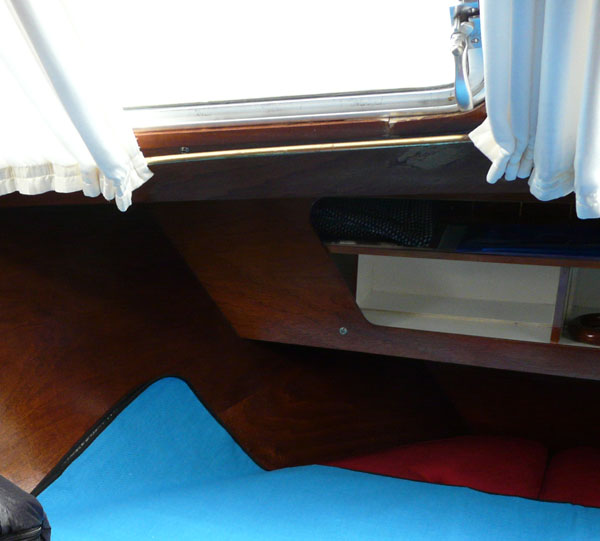
I understand what you are suggesting - but our trim around the front windows is really one great big piece of wood that goes right up to the bedroom ceiling. The window 'frames' then appear to be fixed onto the 'interior' (curtain) side of that. The wooden section between the windows and the cupboard 'ceiling' is about 4 inches deep (and tapering) so without adding another piece of wood trim on top of what's there (which is I suppose possible.) it could be a very tricky job. You might be able to see what I mean here:

frame.jpg


That wooden cubby hole in the pic is now removed, as is the ceiling inside it, and the 'back wall' to the cubby hole which is into the anchor chain storage area. We recently had all the front windows re-sealed as they were leaking so we need to avoid disturbing those again if possible...but next time we're down we will look at the possibility of adding something extra on here which would enable us to lower the cupbroad ceiling and fit some deeper section strengthening pieces.

Is it really better to stick the additional wood up to the existing batons rather than adding beams between them? We figured that filling the 'gaps' would help add strength to the squishy areas, but it looks like you are suggesting we use what is there and make them beefier. Won't it be harder fixing the new bits to 2 surfaces rather than just one?

Thanks again for all your help and suggestions!


Emma
 
Emma - Hi. I drew it, not hard really. It is unlikely the windows are fixed to the wood internal panelling, more likely they screw to the grp coach roof and the wood is just what it appears, an internal panel and trim that abuts the window frames and covers the fixings. Springfield (Maidenhead) also used to be very heavy on wood when they fitted out the Seamaster hull and superstructure, a sign of the fashion of the time I suppose.

My sketch shows doubling up with a deeper section, that was quicker to draw but you can quite usefully fit beams between the existing and so long as they are a deeper section they'll act as a deck beam. As you say, it will be easier to access to glass them in but you'll need to wedge them up and tack them first.

That member across the bottom of the front widow upstand acting like a fake carlin could have a trim piece fitted behind it and then a cover bead. This would visually have the effect of breaking up a heavy section but enable you to retro fit your beams and ceiling. Something like the sketch here that I've re-drawn:

Foredeckbeams2.jpg


I'm sure you get the idea.
 
That's brilliant - thank you!

Another stupid question tho' if I may (er, or 6!)...Is there any reason why you are suggesting that we 'wedge' the strengthening beams in place as opposed to 'glueing' them up and then glassing them in (which would be much easier in the confined space up the front).

I'm guessing that glueing them in place is not recommended as no more nails etc/ may damage the exisiting resin / glass foredeck? It would just be good to fill any irregularities between the baton and the underside of the foredeck and stop any movement of the baton when it's glassed in (I know this is unlikely).

What wood would you recommend for the strengthening beams? We've read balsa is good...

(And on a totally different subject....) Do we need an anode on our rudder / propellor shaft? We've heard people talking about them and know what they look like, but we don't appear to have one (we only chug up and down the Thames it's not used in salt water).

Thanks again!


Emma
 
That's brilliant - thank you!

Another stupid question tho' if I may (er, or 6!)...Is there any reason why you are suggesting that we 'wedge' the strengthening beams in place as opposed to 'glueing' them up and then glassing them in (which would be much easier in the confined space up the front).

I'm guessing that glueing them in place is not recommended as no more nails etc/ may damage the exisiting resin / glass foredeck? It would just be good to fill any irregularities between the baton and the underside of the foredeck and stop any movement of the baton when it's glassed in (I know this is unlikely).

What wood would you recommend for the strengthening beams? We've read balsa is good...

(And on a totally different subject....) Do we need an anode on our rudder / propellor shaft? We've heard people talking about them and know what they look like, but we don't appear to have one (we only chug up and down the Thames it's not used in salt water).

Thanks again!


Emma

When you are trying to glass in a batten to the underside of the deck (or to the underside of anything else for that matter) it's purely a case of holding it in place whilst you fix it. "No-nails" or "Gripfil" may not hold it in place and in any event you'd have to hang around for 24 hours or so with no guarantees that it will work. Easy way is to "tack" it with strips of resin/matt and wait till it sets, usually no more than 30 minutes. Then remove the springy batten or whatever you used to wedge your beam in place (plastic curtain rail is good for small spans by the way) and now that your beam is fixed finish the layup. The strength is in the glass, the wood contributes very little except stopping the resin-glass "U" shape from deflecting as it forms a solid core.

For that reason you could use balsa, but probably cheaper and as effective to use "tile batten" from a local timber merchant. Unless you have a massive curve it should spring into shape quite easily. You are not dealing with a weight issue here on a Seamaster! Gaps are pretty much irrelevant in the structural scheme of things, any severe gaps can have a bit of mat and resin stippled into them but under a foredeck that is unlikely to be necessary.

On the issue of anodes, my Ocean has no anodes and never has had. I've inspected the stern gear when it gets lifted and apart from rust on the keel band, and anodes won't stop that, there is no evidence of cathodic corrosion. I don't think it is a problem on fresh water boats. However, others will disagree with that statement and insist that you fit fresh water anodes. I do not bother as my boat is shaft drive as is yours. Up to you!
 
she doesn't look too bad from the pics. In my opinion, if any GRP cruisers deserve classic status, it's the humble Seamaster 27, and the early Freemans.

Quick question mind ... What engine has she got, to justify the raised section in the cockpit floor?

I've only seen one like that and she had a Merc OM636 in her.
 
Last edited:
What Ramage really meant but was clearly too polite to say was that sooner or later some old fart will drop by, park up his zimmer, and pontificate eruditely but incomprehensibly on the art of boat-bodging from his experience over the last century or so.


You're all on a one-way journey - if you're lucky!
 
Hello,

Yes, that bloody raised bit is the bane of my life...can't tell you how many times I've gone base over apex into the cabin after a few stiff shandies...I've stilll got the bruises.

It's got a 35hp Beta Marine engine in it, kindly installed by the previous owner...it was the deal-maker really.

Emma
 
Top