Heating a small boat

I think I would try either an Origo Heatpal or Heatmate 5200, in conjunction with a CO monitor.

I asked the same question a couple of years ago and the majority suggested the Origo. I still havn't bought one (It's not cheap and havn't needed it yet!) but it would be on top of my list from the recommendations that were given. I used tea lights last weekend, give them plenty of head room :eek: Roof linings get hot if they are less than say 4' above the candle!

The other obvious tip (but something I hadn't thought of) was to hang a blanket up to reduce the volume of space you are wanting to heat...
 
Last edited:
Looking at the replies in this thread, it really is quite surprising how few boats catch fire and how few people die of carbon monoxide poisoning.
A sailing yacht really is a very poorly ventillated space.
Plus, personally, I hate the smell of burning paraffin, candles etc, and find it contributes to seasickness.

My earlier comment about buying a bigger boat stands. It does not need to be a very big boat, but practically, you probably need an inboard diesel to support the electrical needs of any 'cabin sealed' heater.
If you are going to sail 3 seasons of the year, you will probably get enough use out of the boat to justify something with an inboard. It does not have to be that expensive a boat. A couple of blokes in my club have recently gone halves on a 25ft boat with a decent beta engine. Not the shiniest boat around but it does the job and gets well used.

Alternatively, it ought to be possible to run an eber on a smaller boat using a small generator for battery charging. Did anyone ever finish the micro-generator project?

Once you've had a boat with the clean dry heat of an eberbasto, you'll be converted.

OTOH those of us who only get out a couple of nights in the autumn, a fan heater and a marina makes an awful lot of sense!
 
Another vote for the Origo Heatpal. Used one here in a 20ft'er to good effect.
You can also use it as a safe container for burning tea lights if you just want to take the chill off the cabin.

Oh, and good "mummy" type sleeping bags, the 2 or 3 season ones. Toasty warm all night long... :)
 
Thanks for all the replies. I don't want to get a bigger boat yet as that will only be worthwhile if the boys continue to enjoy sailing. Plus, I've only had the Vivacity for 1 year, with only courses as previous experience, and want to make my mistakes on something cheap!

I suspect Tilley lamps may be the way forward, or forking out for the electric hook up - the other options seem a bit much for a small boat. I suspect this is only going to be occasional autumnal nights, and I guess I can reconsider if they remain keen.

Cheers,

Dennis
 
Thanks for all the replies. I don't want to get a bigger boat yet as that will only be worthwhile if the boys continue to enjoy sailing. Plus, I've only had the Vivacity for 1 year, with only courses as previous experience, and want to make my mistakes on something cheap!

I suspect Tilley lamps may be the way forward, or forking out for the electric hook up - the other options seem a bit much for a small boat. I suspect this is only going to be occasional autumnal nights, and I guess I can reconsider if they remain keen.

Cheers,

Dennis

Just to re-emphase the warnings about carbon monoxide. It is created when an open unflued heater hasn't got enough oxygen. And it will kill you. So always have the hatches open for ventilation when burning such a heater and don't leave it on overnight, or it might be your last. Like the campers who recently died when they left a barbecue burning inside their tent.
Don't want to put you off otherwise but I thought it needed to be said.
 
I think the most important bit of safety gear for inside your boat is a Carbon monoxide detector with a loud siren, mine is loud enough to wake the dead!, and if i'm awake when co levels rise, it has a display so i can see it going up and take pre-emptive action before it goes off

Fireangel CO-9D
 
I wasn't planning to run heating overnight, just in the cabin during the evening. Don't worry, I'm well aware of the CO problems, and have a CO alarm already. I'm still considering whether to go for a fan heater in the marina, but my marina wants to charge a small fortune for a meter and then further small fortunes for the leccy!
 
You could possibly install a dual purpose Wallas 85DP Diesel Hob wth blower lid, they can be turned down really low and you can open the lid and make breakfast. As already sad you would need to install a small (say 20l) tank and though the power draw is pretty low I would recommend a separate battery that you could take home to charge.
Some numbers: they use 0.09l per hour on low (900w) and draw around 0.20 amps.

I have installed the Wallas 85DP on my Contessa 26. Its great for heating but slow to get going when only cooking. The gas installation was condemned anyway so I needed a new cooking solution. Not cheap, but Eber type diesel heaters make too much noise, use too much battery power, cost about the same anyway if buying new and use valuable space. Oh, and dry heat when heating or cooking, so no condensation!
 
Last edited:
I wasn't planning to run heating overnight, just in the cabin during the evening. Don't worry, I'm well aware of the CO problems, and have a CO alarm already. I'm still considering whether to go for a fan heater in the marina, but my marina wants to charge a small fortune for a meter and then further small fortunes for the leccy!

I would avoid using a fan heater, purely due to most marinas (as you say) charge a small fortune for electricity and fan heaters aren't the most efficient form of heating (cost wise) on a good day.

Small gas/paraffin heater/ lamp, keep some air coming in and if you're nervous, a CO meter.
 
I would avoid using a fan heater, purely due to most marinas (as you say) charge a small fortune for electricity and fan heaters aren't the most efficient form of heating (cost wise) on a good day.

I'm glad you added "(cost wise)" since an electric heater is thermally 100% efficient. :)

Marina charging systems vary considerably, but for a single overnight stay a flat rate daily visitor charge of about £2 - 3 for electricity is quite a common arrangement. For the limited usage envisaged by the OP a few nights on this basis would not run up too big a bill. The other advantages of an electric heater have been mentioned: no fuel to store, no condensation, no fumes, no smell. A fan type in particular is also easy and clean to store in a locker or below a bunk.
 
Just to re-emphase the warnings about carbon monoxide. It is created when an open unflued heater hasn't got enough oxygen. And it will kill you. So always have the hatches open for ventilation when burning such a heater and don't leave it on overnight, or it might be your last. Like the campers who recently died when they left a barbecue burning inside their tent.
Don't want to put you off otherwise but I thought it needed to be said.

+1
but it does not even have to be an un-flued heater!
As a few cases in Spanish villas will point out.

Don't forget that good hot meals and adequate clothing, plus the right frame of mind will change 'cold damp and miserable' into ' the great outdoors '.
 
Possibly a very uninformed comment coming up...correct me if I'm off course, you'll save me months of wasted work! :rolleyes:

...every time this frightening question comes up, I reach the same conclusion, and I've never heard why it's a bad idea...

...if one had a simple LPG boiler, insulated and located in a vented cockpit locker with no link to the accommodation, couldn't the heated water be pumped to supply radiators or under-floor panels inside the cabin, without any danger to the crew? If not, why not?

I've seen all the kit that would be needed...and completed and fitted, it'd barely cost 10% of a basic Eberspacher.

It's very strange to me: only two routes seem to be available to yachtsmen in cold weather - one is vastly expensive & uses lots of power, the other is barely advanced from sitting round a fire in a cave! Why not burn gas outside, and pipe the heat back into the cabin? :confused:
 
Possibly a very uninformed comment coming up...correct me if I'm off course, you'll save me months of wasted work! :rolleyes:

...every time this frightening question comes up, I reach the same conclusion, and I've never heard why it's a bad idea...

...if one had a simple LPG boiler, insulated and located in a vented cockpit locker with no link to the accommodation, couldn't the heated water be pumped to supply radiators or under-floor panels inside the cabin, without any danger to the crew? If not, why not?

I've seen all the kit that would be needed...and completed and fitted, it'd barely cost 10% of a basic Eberspacher.

It's very strange to me: only two routes seem to be available to yachtsmen in cold weather - one is vastly expensive & uses lots of power, the other is barely advanced from sitting round a fire in a cave! Why not burn gas outside, and pipe the heat back into the cabin? :confused:

Its mostly to do with the huge amount of gas you would have to carry to run an LPG heater, they consume huge amounts and you could empty a 16kg cylinder in a day using a water heater to supply hot water to radiators

You can get gas versions of an eberspacher, they are made by propex, here's a link to one, but again, you need lots of gas to run them and they dont put out as much heat as an eberspacher

Propex Heatsource gas heater
 
If you go for an electric heater, safest and easiest solution by far, a fan might be best. In principle the oil filled radiator type would be nice but they can be rather bulky. Don't waste your time with a tiny 600W heater, no matter how small the boat you'll find it inadequate. Fan heaters cost next to nothing and you'll easily find a place for it.
An alternative to Tilley would be the Aladdin lamp btw. Around 1Kw heat output and quality seems to be better than with new Tilleys. Not expensive to buy s/h and since there isn't really much to go wrong with them, check ebay. Condensation of course being the downside with both.
 
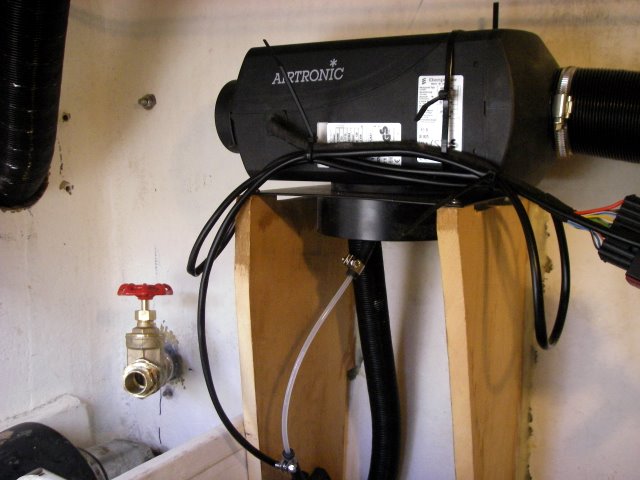
installed a diesel heater

To extend our cruising time in Tasmania, last summer we installed a eber Ever since its been a dream! If its cold we now just push the little red button.

IMGP9021.jpg
 
We bought ourselves a Taylors kero heater when we lived in Holland. Brrrrrr! It was cold. Our water tank froze one night. Anyway, the kero heater was a godsend and it is a dry heat. There is a chimney installation (I accidently sat on it once and burned my bum). We haven't used it when sailing and haven't used it for several years now since we are in much warmer climes. Hope you can see the heater in the photo, just by the v berth next to the laundry bag.
 
Possibly a very uninformed comment coming up...correct me if I'm off course, you'll save me months of wasted work! :rolleyes:

...every time this frightening question comes up, I reach the same conclusion, and I've never heard why it's a bad idea...

...if one had a simple LPG boiler, insulated and located in a vented cockpit locker with no link to the accommodation, couldn't the heated water be pumped to supply radiators or under-floor panels inside the cabin, without any danger to the crew? If not, why not?

I've seen all the kit that would be needed...and completed and fitted, it'd barely cost 10% of a basic Eberspacher.

It's very strange to me: only two routes seem to be available to yachtsmen in cold weather - one is vastly expensive & uses lots of power, the other is barely advanced from sitting round a fire in a cave! Why not burn gas outside, and pipe the heat back into the cabin? :confused:

Surely an LPG boiler is hundreds of pounds like an eber?
But yes, you're right, many bigger live-aboard boats and house boats basically have a domestic gas boiler running on LPG.
Not sure what's available in smaller sizes for pumped water systems.
My last boat had a pumped water eber, which was great, it heated the calorifier but the heater matrices I had to heat the cabin were not great. A car heater fan takes a lot of amps! It has to move a lot of air.

My next boat will have a good heating system, because being able to enjoy the boat 12 months of the year looks like the best route to getting value for money from it.
 
Top