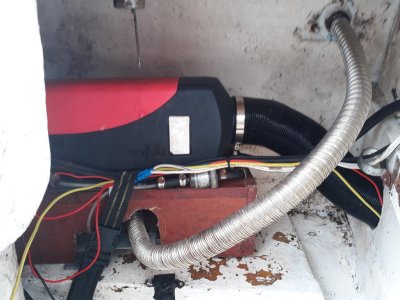
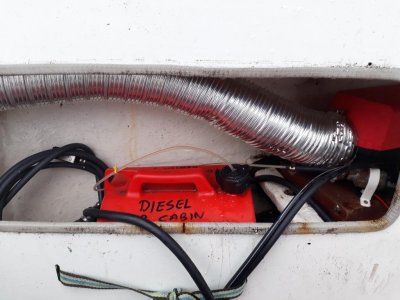
Heater exhaust burning

strawbs

New Member
Joined
12 Apr 2013
Messages
18
Location
Faversham
Visit site
I've installed a planar heater over the winter...which was a game changer for comfort on board! There was a bit of a burning smell though...which turns out to be the pipes for the exhaust in contact with the hot air outlet. The heater is close to the transome...so in order to have the 2m run for the exhaust, it's kinda looped round the heater. The exhaust pipe is wrapped in the supplied lagging and then run inside some additional ducting plus some lagging and it doesn't seem excessively hot on the outside

Is there a better way to route the exhaust so it doesn't go near the hot air outlet?
Is there a better way to insulate/wrap the exhaust so it doesn't melt anything it comes in contact with?
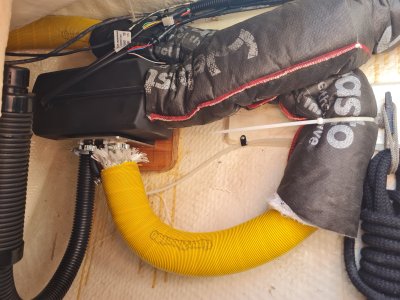
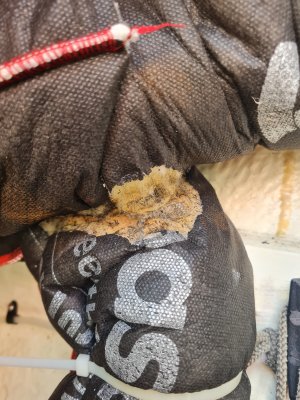
20230520_121343.jpg20230520_121400.jpg
 
You could try separating the two hoses with a plumbers mat, not an ideal solution but it should provide a greater degree of insulation. The real answer is to relocate the heater forwards to allow for rerouting such that both ductworks are separated.
 
Might be worth double checking with Planar (Autoterm UK) if the instruction to 2m is correct. As mentioned Eber don't use that long, the Chinese copies certainly don't and the Websato I had didn't - all about a foot or so - though I put a muffler in as well which extended it but that was an optional extra.

I'd cut it shorter and route it backwards first
 
Might be worth double checking with Planar (Autoterm UK) if the instruction to 2m is correct. As mentioned Eber don't use that long, the Chinese copies certainly don't and the Websato I had didn't - all about a foot or so - though I put a muffler in as well which extended it but that was an optional extra.

I'd cut it shorter and route it backwards first
It could be a vehicle recommendation as opposed to boat recommendation.
 
Thanks for the replies. I did ask if the exhaust could be cut shorter and autoterm told me that the marine exhaust has an integrated silencer and lagging which cannot be cut shorter.

Going direct to the outlet would solve a lot of problems
 
As far as I can see the standard boat kit is supplied with the kidney-shaped silencer unit, 1 metre of uninsulated exhaust hose and some exhaust lagging, presumably 1 metre also but it doesn't say. You've bought the 2m special exhaust which comes with integral silencer and lagging already fitted; no idea what's inside but I'd be surprised if it cannot be shortened.

I've looked that webasto outer lagging up; it's thinsulate, it should not be around the exhaust duct, I'd remove it and arrange the exhaust so it was not touching it at any point. It's only for the heater ducts.
 
Last edited:
If I felt the need to add to the lagging already on the exhaust I'd use motorbike exhaust wrap. But I'd be surprised if it were necessary with Planar kit...
 
Thanks for the replies. I did ask if the exhaust could be cut shorter and autoterm told me that the marine exhaust has an integrated silencer and lagging which cannot be cut shorter.

Going direct to the outlet would solve a lot of problems
I have spoken to Owen of Autoterm . I suggest you message him from the website. You seem to have misinterpreted what you were told. There are a couple of issues with your installation.
 
I've installed a planar heater over the winter...which was a game changer for comfort on board! There was a bit of a burning smell though...which turns out to be the pipes for the exhaust in contact with the hot air outlet. The heater is close to the transome...so in order to have the 2m run for the exhaust, it's kinda looped round the heater. The exhaust pipe is wrapped in the supplied lagging and then run inside some additional ducting plus some lagging and it doesn't seem excessively hot on the outside

Is there a better way to route the exhaust so it doesn't go near the hot air outlet?
Is there a better way to insulate/wrap the exhaust so it doesn't melt anything it comes in contact with?

View attachment 161638View attachment 161639
Apart from anything else you appear to have lagged the hot air outlet all the way to the heater. Typically the advice is not to insulate the first section to avoid the unit overheating
 
Isn't 2m the maximum exhaust length? I don't see why it needs to be that long.

Also it looks like your exhaust is very close to the plastic fuel line which is a hazard, that fuel line wouldn't pass a BSS test and although you might never go on a river that requires a BSS it is still worth following their guidance and using ISO rated fuel hose.
 
A metal heat shield with air around it works for me.

What the OP has there insulates the yellow ducting, so where it's also lagged by the hot air outlet's lagging, the ducting gets very hot.
If the yellow ducting is metal, if unlagged it would be a fairly even temperature, losing heat to the locker.
The lagging inside the yellow controls how much heat the ducting has to lose and thus its temperature.

I added extra layers of glass fibre lagging, then wrapped the whole lot in thin aluminium. The aluminium doesn't get too hot to touch.
I then put a kind of grating between the exhaust and everything else, so anything in the locker is kept at least 1cm away and air can circulate.
The lagging is sold for engine exhausts.

I ran the fuel ine inside a copper pipe, it was a convenient way of controlling its route close to the heater as well as a heat shield and impact protection.

My heater is too close to the bottom of the locker (hull skin) and needs protecting from the inevitable ton of 'stuff' in the locker.
 
When I fitted my Chinaspacher heater I wrapped the exhaust in heat resistant exhaust wrapping - what was asbestos years ago - can't remember the name, wrapped twice and secured each end with a stainless hose clip, and also made sure it was not near any of the insulation for the hot air. The exhaust length was about1 metre + the silencer.
 
I thought I would add some pictures of my re fitted heater.

Heater_Front.jpg
The exhaust hose, the SS pipe that gets very hot goes direct to the exhaust fitting and everything else is kept well away from it.

The wooden box the heater sits on was made by the original installer. The result of a stupid design of heater that has combustion air intake, exhaust, and fuel in from the bottom. I modified it a bit as originally the very hot exhaust pipe touched both the wooden box and the GRP of the locker bottom.

This heater came with a fuel pump and fuel filter which were separately fitted. I mounted both onto this wooden box to keep it all up together as one working "package" and to shorten fuel line lengths.

the big black hose is the hot air out to the cabin, that is the hose that came with the kit.

Heater_Rear.jpg

The other end of the heater, this is the air intake. Bizarrely the same black hose that came with the kit did not fit the intake. I found this bit of aluminium semi rigid ducting left over from fitting a wood burning stove in my house. At least it fits the air intake fitting of this heater.
 
Top