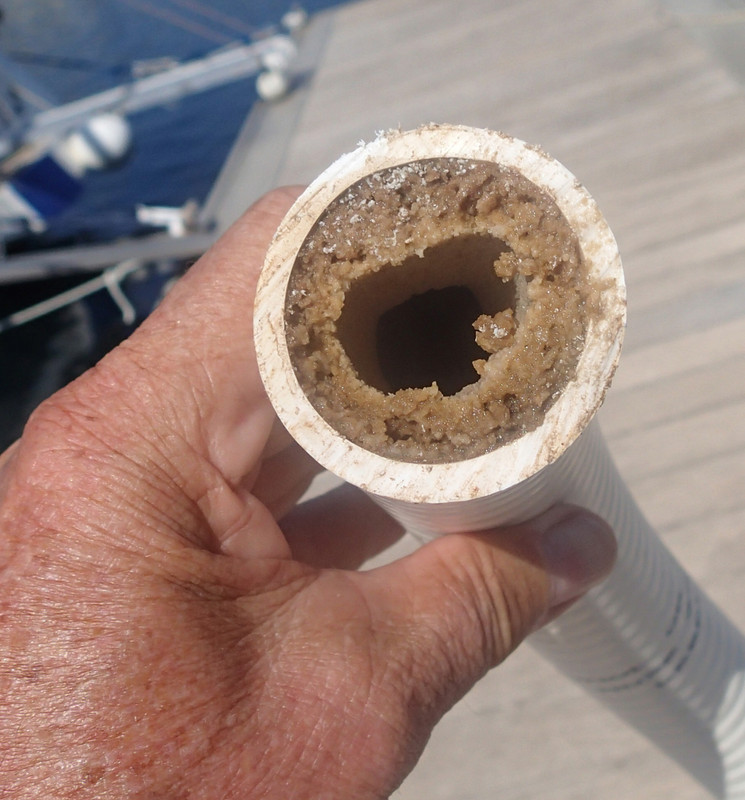
Heads Pipe Blockage

Sailfree

Well-Known Member
Joined
18 Jan 2003
Messages
21,672
Location
Nazare Portugal
Visit site
Found a plug of paper blocking hose. I suspect at its "U" bend that's positioned just under deck.

Cleared it using a hose and water pressure but suspect the "salt?" Build up will make it prone to repeat blockages.

Is there any way to remove the salt deposits. My understanding is that salt is caused by urine mixed with salt water.

Dont want to use a chemical that will damage through hull fitting or Jabsco pump

Not sure it's possible to replace pipe as it appears to be installed before deck was installed and a heads cupboard (beside it) appears to be glued in place before deck pit on.

Boat is a 2005 Jeanneau 43DS.
 
Number one suggestion is a complete ban on anyone putting paper down the heads.
Toilet hoses always get a build up of deposits if seawater flushed, because of a reaction between seawater and urine. It is unavoidable unless you switch to freshwater flushing.
Hoses should always be installed so that they can be removed and replaced. I suggest you investigate further. They are rarely easy to change because the hoses used are not very flexible, particularly when choked with hard deposits.
 
"Brick Cleaner" from B&Q, and presumably other outlets, is excellent for cleaning away this type of encrustation. The brick cleaner is dilute hydrochloric acid. If you can devise a way to get it to the affected pipework, and keep it there for 30 minutes or so, it works wonders. You may have to use multiple applications.

Like the OP, I had a choked outlet hose, and eventually managed to get through the blockage with a flexible "snake" wire drain cleaning device (Aldi/Lidl), and then used the brick cleaner. The way my outlet hose is run, makes it well high impossible to renew it, without some major surgery to the boat's interior.

The way to completely prevent this type of blockage happening, is to pump plenty. Jabsco recommend at least seven strokes of the pump per metre of hose. Since religiously adhering to that, I have had no further problems. Our used toilet paper goes down the loo.
 
The problem with chemical methods is that it is almost impossible to fill the discharge pipework. If the seacock is open the acid will simply fall over the 'weir' and away. If it is closed the toilet cannot be pumped. The only foolproof method is to replace the hose, although banging it on the dock wall comes a close second. My experience is that it takes a great deal of acid to dissolve heavy salt deposits.
 
Pipe should be replaced it is not going to get better. thereafter only use ultra cheap loo rolls that disintegrate swiftly file your nails down smooth though) or better still don't put any paper down the loo at all. We have a small lidded tub (ex wholesale size coffee tub) and put Asda scented bio degradable nappy sacks in that as liners for paper disposal.
 
If the blockage is due to paper, it has to be cleared mechanically. If the blockage is due to encrustation, it is often at the lowest point in the pipework. If it's at the lowest point, it's relatively easy to use the brick cleaner.

In my own case, there are diverter valves to allow the possible use of a "Black" tank. The first diverter valve, in line from the bog, is reasonably accessible, and is fairly high under the deck. It has quick release hose connections. The bad news is that from this valve to the outlet seacock, is a length of 3 metres, going down into the bilge, right across to the other side of the boat, aft under part of the galley, through the engine room bulkhead, under a built in battery compartment, before appearing beside the engine, close to the seacock.

Having managed to get the "snake" through the blockage, I then had to clear the encrustation.
To apply the acid, I disconnected the hose at the diverter valve, with the seacock open, I pumped air as rapidly as I could, using a dinghy pump. When air could be heard going out of the seacock, my wife closed the seacock. This ensured that the whole outlet pipe was empty of water. I then poured the brick cleaner into the hose, and left it for half an hour. Warning! At this stage, brown bubbles are likely to appear at the end of the hose! That's alright, it just means that the acid is doing its job. This performance may have to be repeated, but in my case, has been entirely successful.

The main thing is to prevent it happening in the first place, by pumping plenty.
 
If the blockage is due to encrustation, it is often at the lowest point in the pipework.

While I see how that would be intuitively correct, when I last removed my pipework for a good bashing the encrustation was all the way up to the vented loop (ie highest point)
 
Yes. Absolutely no reaction, not even staining with acid of the concentrations being discussed. Same with brass and DZR. Stainless steel components of the toilet also not affected short term but flush through after acid treatment.
Does that also apply to True Designed type ones (plastic/nylon) vyv?
 
Very surprised indeed that on a 2005 Jeanneau you cannot get access to change the pipe. On my 2005 Jeanneau SO35 it is really not that difficult. Almost everything has been designed to be get-at-able, though in some cases you need a lot of awkward squeezing into places, and occasionally unding a few self-tapping screws holding panels on. I always say that a highly trained, small, long-armed and double-jointed chimpanzee would be the perfect yacht maintainer.

If your outlet pipe is original it's probably at least as bad or worse than Vyv's photo. Mine has now been changed 3 times since new. First time after about 7 years, was similarly so rerstricted and stiff with limescale crud that I had to cut it out in sections. Since then I just change it every 3 years before it gets stiff with crud. The remove, bang on pontoon or quayside and put back option also works, but I'm happier with 2M of new pipe.
 
Re acid: whilst I replace the pipe, you can get a similar buildup (but less) in the plastic Jabsco parts that leads from bowl to bend and joker valves. Brick acid (hydrochloric) cleans those beautifully, as it does the very bottom of the ceramic bowl.
 
I now use Seaflow Butyl Sanitation hoses which are very flexible compared to the more rigid PVC hoses.

If you have to cut out the old hose, replacement with Butyle should be possible without dismantling interior. They are more expensive than PVC but I think superior.
 
I now use Seaflow Butyl Sanitation hoses which are very flexible compared to the more rigid PVC hoses.

If you have to cut out the old hose, replacement with Butyle should be possible without dismantling interior. They are more expensive than PVC but I think superior.
The butyl I bought, at vast expense, was wire reinforced and not very flexible at all. Within a couple of years rusty seawater was dripping out of the ends due to the inner liner breaking up. So beware, do not buy the reinforced type.
 
Top