
Headlining glue removal

DangerousPirate

Well-Known Member
Joined
24 Feb 2020
Messages
963
Location
N. Ireland
Visit site
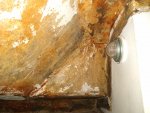
My forecabin always looked horrific without the old headlining and that orange glue everywhere. So I figured it is time for me to finally install the new headlining and spent probably 4 hours with a mouse style sander on a 50cm by 40cm area, and although I got some chunks off the majority still sticks not matter what.

Now I am not sure how to go from here as I didn't expect this.

The plan is to glue some chunks of wood to the ceiling and sides and then use thin plywood to Cover it up. The headlining will go onto the ply.

Do I even need to sand it down? Will the old glue be a good enough surface so I can glue wood pieces on(that I intend to drill into later so the ply holds up)?

If not what tools can I use to get the old stuff off?IMG_20210925_184404274-min-min.jpg
 
Bosch universal tool thing with a scraper blade and the vacuum attached.

We used Europlas soffit cladding onto strips of timber no nailed on. Beat the crap out of head lining.
We put closed cell foam between the ply strips. Amazing improvement in insulation.

Can also be removed for access.
 
Horrible, horrible job - I'd remove what I could from where the battens will go with a scraper and leave it at that. CT1 make a product called D-Solve it which might help dissolve the glue and make it easier to remove. I'd use CT1 to glue the battens in place. IMO doing what you're doing (battens & thin ply) is a much better option than gluing more headlining or carpet on...
 
If it is friable, nothing is faster than an angle grinder with a cup brush. And not a cup brush on a drill--way too slow. Lots of mess, but it vacuums up. Wear an N100 respirator. And a box fan on the deck hatch on exhaust.

If it is not friable, xylene, rags, a scrapper, and a fan on exaust over the deck hatch (really, really helps). Acetone also works, particularly after a good pass with scraper and xylene.
 
If it is friable, nothing is faster than an angle grinder with a cup brush. And not a cup brush on a drill--way too slow. Lots of mess, but it vacuums up. Wear an N100 respirator. And a box fan on the deck hatch on exhaust.

If it is not friable, xylene, rags, a scrapper, and a fan on exaust over the deck hatch (really, really helps). Acetone also works, particularly after a good pass with scraper and xylene.


Thank you for your answer. The headlining glue is really resilient and basically gave me the finger when I tried to sand it off. I had patches that came down with relative ease, others just stick on no matter what. I was on one spot for like 10 minutes and nothing,but really nothing, came off.

Will try the angle grinder with cup brush as it's easier to get by and then take it from there.

This is a job that would last a million years, unfortunately the foam didn't :rolleyes:
 
Thank you for your answer. The headlining glue is really resilient and basically gave me the finger when I tried to sand it off. I had patches that came down with relative ease, others just stick on no matter what. I was on one spot for like 10 minutes and nothing,but really nothing, came off.

Will try the angle grinder with cup brush as it's easier to get by and then take it from there.

This is a job that would last a million years, unfortunately the foam didn't :rolleyes:

Have you tried acetone to soften the glue so that it can be scrubbed/scraped off?

As far as relining it I wouldn't use timber but headliner as used in vans and cars and I wouldn't worry about removing the glue.

But here is another idea along your lines.

 
  • Like
Reactions: RMC
I used a disc from Hawk House marine on my angle grinder. Think they referred to it as a face off disc. Bit like a really hard/industrial version of a Scotch pad. Very effective without damaging the grp behind.
 
Acetone or other solvents in an enclosed space could be very nasty without a respirator.
There are solvents I wouldn't want to get on my skin or breathe the vapor but acetone is relatively safe. (Our bodies actually produce small amounts of acetone). I would ensure there is plenty of ventilation when using it at the very least.

If in doubt use a respirator.:eek:

I am particularly careful with catalyst used in fiber glassing:
Catalyst (hardener) used for polyester resins is an organic peroxide (methyl ethyl ketone peroxide) and is particularly dangerous. ... If these come into contact with the skin, they can destroy the natural oils and may lead to an unpleasant form of dermatitis.
And
Welding pickle
Pickling pastes contain a combination of hydrofluoric acid and nitric acid which can cause serious burn injuries. They are primarily used to post weld clean stainless steels and can be applied by brush or by a spray on process.(I don't think they are used anymore)
 
Did this job last year.
You need a pack of these and an angle grinder. Plus a full face respirator, gloves and a full body overall.

Plus a vacuum cleaner to clean up the mess...

NEW Non-Woven Preparation Wheel 115mm UK SELLER, FREEPOST | eBay

Horrible job....

Then.

Don't stick up more foam backed vinyl or you will be doing it all again in 8 years.

Instead use double sided sticky backed foam from Hawk House in Gosport. Then apply plain vinyl.

PM and I'll send you some pictures.

Andrew
 
I did not get on with the Hawke House face off wheel and so probably would not have for on with the other similar wheels suggested. The cup brush on an angle grinder worked better for me. It might have been because all surfaces were curved.

I did not get every last scrap off, figuring that if it took that much work to get it off, it was pretty firmly bonded on.
 
Top