Headling ideas for Westerly Longbow

Akestor

Well-Known Member
Joined
12 May 2018
Messages
428
Location
Athens, Greece
www.youtube.com
Hello!

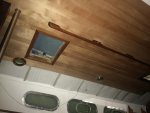
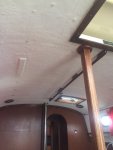
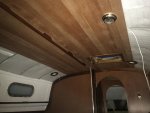
As you can see at the pic ,the top side is naked and i am thinking of ways to make a nice and warm headlining. Previous owner had removed the original messy headlining and painted the fiberglass with white paint (acrylic home paint for external use).
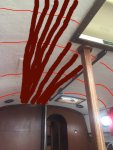
Now i am thinking of sticking velcro (red lines at the pic) and attach 4mm plywood planks alongside the length of the boat (brown lines). The pros is that i will be able to remove the planks for any reason needed easily, but the cons is probably that the velcro will detach at the first warm day of the summer...
Ideas are very welcomed!44422198_244290233107822_5926468425055469568_n.jpgheadlining.jpg
 
Last edited:
Personally I would use much larger pieces of plywood. The main section of the cabin roof should only be 2 pieces. Use sheet cardboard as a template before cutting the plywood. You can add small plywood pads bonded to the GRP for screwing into. Then cover the screws with button covers. The coachroof sides are more difficult as the windows would need additional trimming. My Fulmar has panels covered in foam backed vinyl for the roof, but the sides was recovered directly on to the GRP. It is a common problem to solve and there are plenty of solutions on the Westerly Owners web site.
 
6mm Marine Ply strips cut 40mm wide by how ever long they need to be bonded with epoxy or mechanically fastened beam-wise at 400mm centres then cut /shape 3mm ply panels to suit shape of coachroof and attach them with 3M.com velcro just painted or covered in leatherette - job done.
 
This is what I had done to a previous boat, a Westerly Centaur.

BwNo3WN.jpg


3mm plywood panels covered with non-woven carpeting using contact adhesive (as used for plastic laminate like Formica, etc.) and was carried round the edges for around 30mm. The side panels overlap the central one and the panels were screwed directly to wooden laths, with 2 along the length of the central panel and one in the middle of each side panel to take care of the camber. Screws were SS self-tapping countersunk Phillips and the *OVAL* heads sink into the carpeting (only visible if examined closely). The laths were screwed directly to the FGP of the coachroof because the thickness on a Centaur was more than sufficient. The overlapping edges share the same laths.
This work was done some twenty years ago and, as far as I know, it is still in place; I sold that boat six years ago.
You might like the effect or might not; many others have copied the idea. It is easy, doable with average DIY 'skills' and is an affordable solution.

p.s. The thickness of the laths is about 10mm. This provides an air gap between the panels and the GRP giving thermal insulation and which made a huge difference in cabin temperature. Also, the problems of condensation became a thin of the past.

*CORRECTION*: The screw head should have been described as 'Oval or raised-head' and not 'fillister' as I had written. Sorry for the confusion in terminology; comes with the turf when writing in a foreign (to me) language!
 
Last edited:
Hello!

As you can see at the pic ,the top side is naked and i am thinking of ways to make a nice and warm headlining. Previous owner had removed the original messy headlining and painted the fiberglass with white paint (acrylic home paint for external use).
Now i am thinking of sticking velcro (red lines at the pic) and attach 4mm plywood planks alongside the length of the boat (brown lines). The pros is that i will be able to remove the planks for any reason needed easily, but the cons is probably that the velcro will detach at the first warm day of the summer...
Ideas are very welcomed!
Later versions of the Longbow/Berwick/Renown/Pentland range had the headlining on ply boards. 4 pieces IIRC, supported by covered buttons and I think the curtain rails,

I'd suggest you try to get a look at one and do yours the same although they did not have the wooden post or the handrail.

I've used a mix of covered buttons and Vecro to support ply panels in my boat. No problem with the Velcro becoming detached, but I used the same "high temperature" contact adhesive for the Velcro that I used elsewhere to stick the lining direct to the GRP
 
Last edited:
Thank you all for your replies, very helpful sharing the way you did it. I guess i ll use a combination of the info to do this. The challenge for me making panels vs attaching laths, is that i guess i can trim each lath on ancorage (i am not on a dock..) but think its harder to copy the coachroof pattern for 3-4 big panels. I will update the thread as soon as i proceed !
 
This is what I had done to a previous boat, a Westerly Centaur.

BwNo3WN.jpg


3mm plywood panels covered with non-woven carpeting using contact adhesive (as used for plastic laminate like Formica, etc.) and was carried round the edges for around 30mm. The side panels overlap the central one and the panels were screwed directly to wooden laths, with 2 along the length of the central panel and one in the middle of each side panel to take care of the camber. Screws were SS self-tapping countersunk Phillips and the *OVAL* heads sink into the carpeting (only visible if examined closely). The laths were screwed directly to the FGP of the coachroof because the thickness on a Centaur was more than sufficient. The overlapping edges share the same laths.
This work was done some twenty years ago and, as far as I know, it is still in place; I sold that boat six years ago.
You might like the effect or might not; many others have copied the idea. It is easy, doable with average DIY 'skills' and is an affordable solution.

p.s. The thickness of the laths is about 10mm. This provides an air gap between the panels and the GRP giving thermal insulation and which made a huge difference in cabin temperature. Also, the problems of condensation became a thin of the past.

*CORRECTION*: The screw head should have been described as 'Oval or raised-head' and not 'fillister' as I had written. Sorry for the confusion in terminology; comes with the turf when writing in a foreign (to me) language!

This is looking very nice:) Can you recall how deep you went drilling into the fiberglass roof for screwing the supporting laths? Also..did you make templates for the panels first? or just measured and cut the plywood ?

Ps (my english is not so fluent either lol)
 
Later versions of the Longbow/Berwick/Renown/Pentland range had the headlining on ply boards. 4 pieces IIRC, supported by covered buttons and I think the curtain rails,

I'd suggest you try to get a look at one and do yours the same although they did not have the wooden post or the handrail.

I've used a mix of covered buttons and Vecro to support ply panels in my boat. No problem with the Velcro becoming detached, but I used the same "high temperature" contact adhesive for the Velcro that I used elsewhere to stick the lining direct to the GRP

Hi Vic:)
Indeed the posts and handrail making it a bit more difficult..I found some high temperature adhesive, i suppose you mean the ordinary brownish glue that smells gasoline?
Buttons is something i havent thought of, sounds good. Should buttons be glued also with epoxy maybe , lets say female side on coachroof male on the panel? Or another way?
 
Personally I would use much larger pieces of plywood. The main section of the cabin roof should only be 2 pieces. Use sheet cardboard as a template before cutting the plywood. You can add small plywood pads bonded to the GRP for screwing into. Then cover the screws with button covers. The coachroof sides are more difficult as the windows would need additional trimming. My Fulmar has panels covered in foam backed vinyl for the roof, but the sides was recovered directly on to the GRP. It is a common problem to solve and there are plenty of solutions on the Westerly Owners web site.

"sheet" is a good keyword, smaller cardboard sheets can be attached with duct tape filling coachroof the top piece by piece, making 2 precise big templates for the tops (same for the sides).
 
Hi Vic:)
Indeed the posts and handrail making it a bit more difficult..I found some high temperature adhesive, i suppose you mean the ordinary brownish glue that smells gasoline?
Buttons is something i havent thought of, sounds good. Should buttons be glued also with epoxy maybe , lets say female side on coachroof male on the panel? Or another way?

I used the contact adhesive from Hawke House ( from whom I bought all the materials , except the ply but they can supply this too IIRC.)

By buttons I mean the matching covered screw caps, also from Hawke House

https://www.hawkehouse.co.uk/
 
Can you recall how deep you went drilling into the fiberglass roof for screwing the supporting laths? Also..did you make templates for the panels first? or just measured and cut the plywood ?
From memory, it was around 10mm. At first this might sound crazy but there are so many screws that the weight that is carried by each screw is minimal. If you have any doubts you could also bed the laths onto thickened resin, making a sort of adhesive putty.

Cutting the panels.
Start by first cutting the central panel. This is rectangular in shape and is easy. Cut a slot in one end so that the panel can go around the mast support; this slot will be filled later. Use lengths of scrap wood to prop the panel so that it is held in place. adjust until you are satisfied with the fore and aft alignment.
Mark the edges with a pencil, directly onto the GRP. Mark a line on the panel, parallel to the edge, around 25-30 mm inside the side edges. The laths will be fixed beneath the long edges, using the lines that were marked on the GRP as a guide.
Measure from the inner lines on the central panel and out to the cabin sides at intervals of 300mm (or closer if necessary) and write the offset distances on the panel near each 'station'. Now take the ply from which you will be cutting the side panel and mark 'stations' at the same intervals that you used when measuring, making these lines perpendicular to the straight edge. Mark the lengths of each 'station' using the offsets that you took before. This process is called 'spiling'.
Now join these marks with pencil lines so you now have an idea of the shape and the size of the side panel. Cut the outer edge roughly, going some 30mm OUTSIDE of the line that joins the dots.
You now have a panel that is roughly close to what you need. Offer it up to the central panel and start to trim the outboard edge as necessary. Continue until the straight (inboard) edge coincides with the pencil line that you made for the overlap. Repeat for the other side panel. You are NOT seeking an exact fit; close enough is good enough.
Fix three other laths, one for each panel, roughly central along the length (i.e., going fore & aft). Stick strips of masking tape on the bulkheads to mark the location of the ends of the laths. You will use this as a guide when screwing the panels in place. Note that the outboard laths do not follow the curved edge but are placed roughly 100-120mm away from the edge.
Prop the side panels firmly in place and check the result so far; make corrections if or where necessary.
Covering the panels.
N.B. What follows is what I did to cover the panels with non-woven carpeting and might not apply to other materials.
Find a well-ventilated level area, e.g., garage, drive, spare room etc. Roll out the carpeting face down and place a panel also face down on the material and weight it to hold it firmly in place. Mark round the edges with a pencil; a flat type 'carpenters pencil' is ideal because it is strong enough to resist the abrasive texture of the treated 'back' side of the carpeting. Using a short 50mm-wide strip of scrap ply mark the overlap. Cut round this 'overlap' mark. Paint the mating faces of the panel and the carpeting with contact adhesive. (Much cheaper to buy a commercial size, say, a 5-litre can). Wait until the adhesive stops being tacky and is 'touch dry'. usually 5-10 minutes depending on temperature.
Lay the panel onto the carpeting making sure that you align as correctly as possible. Hint: cover the touch-dry adhesive with sheets of newspaper to prevent premature contact between the two parts; there is no second chance to make corrections! Pull out the paper and press the panel firmly in place and tap with a soft-headed mallet on a piece of wood to ensure good contact between the mating faces. Cut the four corners of each panel covering at 45o leaving around 4mm distance from the panel corners. Paint adhesive over the overlap area, let dry and carefully fold the carpeting over the panel edge, pressing firmly. Do this in stages: ends, middle, mid-points, etc., to avoid puckering. Repeat for the other panels.

Putting the finished panels in place.
Start with the central panel. Prop firmly in place making sure that the panel makes contact with the central lath; this ensures that the camber of the coach-roof is followed. Start screwing the middle at intervals of 300mm or so. (This is where the marks on strips of masking tape are useful. Remember them?). Now screw along the side edges and you have the central panel firmly in place!
Follow the same method for the side panels BUT this time leaving a closer interval, say 120-150mm, between the screws. From memory I used 3x16mm screws except for the overlap where I used 3x19mm.
Remove the props and peel off the masking tape.

Time to admire your work and celebrate with Single-malt, Cognac, Grappa, Schnapps, coffee, tea... or whatever is your favourite tipple. ;)

Job's done! :encouragement:
 
This is looking very nice:) Can you recall how deep you went drilling into the fiberglass roof for screwing the supporting laths? Also..did you make templates for the panels first? or just measured and cut the plywood ?
Ps (my english is not so fluent either lol)

Id not use screws in to the fibreglass. epoxy them in properly with 406. then put a fillet either side.

Steveeasy
 
A friend of mine lined the cabin of his leisure 28 with a thin lining sheet that was intended for showers. It has a white plastic face one side. He fitted lathes to the ceiling at 400mm c/cs then strips of lining butted at each lathe & very lightly pinned temporarily. He then screwed hardwood battens over the joints with cups & screws carefully placed so that they were all in line.
The cover moulding hides the slightly mis-aligned joints in the sheeting & any piece can be removed for wiring access.
If one could not find shower backing I suppose cream or white hardboard bath panels could be used as this is easy to work & can be obtained in 8ft * 4 ft sheets.
Being narrow strips it made it easy to follow the curve & each piece was easy to handle
 
Last edited:
I am somewhere in the middle of the headlining project, completing the top in a while and then will have the sides.

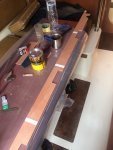
-7cm stripes of okoume plywood(4mm) which are trimmed and then attached with velcro.
-5mm thickness pads of male velcro are glued on the top to give some space bettwen the plywood stripes and the insulation. For insulation i am using 3mm airbubble packing material..
Every plywood stripe has the female velcro at the backside. I am using high temperature glue (the one that smells gasoline and is for car headlining)
So far so good!
IMG_0078.jpgIMG_0130.jpg
 

Attachments

  • IMG_0122.jpg
    IMG_0122.jpg
    481.6 KB · Views: 7
Top