
Has my petrol (gas) totally evaporated? What else could be happening?

ChasB

Well-Known Member
Joined
11 Nov 2006
Messages
543
Location
Limehouse
Visit site
Finally I'm getting around to removing my old petrol from my ancient Carver cruiser.

So I pushed some CPVC piping in, pumped for a while, and out came... nothing!

There's a petrol smell emerging, but not as strong as I think there should be.

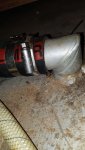
The petrol inlet hose goes to a right-angle join that enters the tank. Pic below. I was concerned my CPVC piping would bend inside the tank and the end not sit on the bottom - I would just be sucking out petrol vapor! So I put a rothenberger spring (pic below) inside the end of the piping to weight it down (held inside with a cable tie to make sure the metal didn't emerge and scrape against the inside of the tank). With some twisting while pushing this in it went through the right-angle hose join, and should then have gone straight down to meet the bottom of the tank. It certainly reached a point where it wouldn't go any further, which felt like the right distance. (The piping end was cut in a way where fluids could still enter if it hit the bottom square on.) This should have worked.

Well, all of this is assuming the fuel inlet goes straight down into the tank after the bend. Or... could it then be going off in some different direction? How are these tanks designed? Or has the petrol simply evaporated??

I tested the pump using water, and drawing it up to the same height, and it works ok.

Any insights? Cheers!
 

Attachments

  • petrol inlet joint.jpg
    petrol inlet joint.jpg
    335.7 KB · Views: 0
  • rothenberger.jpg
    rothenberger.jpg
    13.5 KB · Views: 0
50 litres? More perhaps. It seems insane that it would all just evaporate. Still, it's had 10 years to do so... But you expect a residue.

I'm hoping someone here knows soemthing about the innards of petrol tanks and can shed some light. The dimensions are 15"(h) x 18" x 60". Huge.
 
There's a petrol smell emerging, but not as strong as I think there should be.

Do you really think the volatile hydrocarbons would still be in the tank after 10 years?:(

With such a large surface area you don't think the petrol would evaporate over ten years?:(

If there was fuel in the tank it might be useful for cleaning but nothing else...
 
Last edited:
Same thing happened to friends motorboat over the winter. He stored boat ashore with diesel tank full, come spring time the tank was almost empty. Some lowlife must have siphoned off almost 150 litres. There was no other explanation of how it could disappear.
 
Was your pipe and/or spring wet with fuel when you retrieve them? Just toss a bit of string with a washer for ballast in and pull it back up when you hear it hit the bottom. That should at least give you a read of the level of whatever liquid (if any) is still in there.

When I bought our boat, the petrol in the included outboard was mostly evaporated and much of it turned to yellow gunk ("varnish"). The liquid remainder smelled weird and didn't really want to combust much anymore either. That was after just 3 years of sitting around, although a much smaller amount.

Take the hose off and shove one of those €10 USB inspection cameras in there to see what's going on if the washer and string found liquid.
 
50 litres? More perhaps. It seems insane that it would all just evaporate. Still, it's had 10 years to do so... But you expect a residue.

I'm hoping someone here knows soemthing about the innards of petrol tanks and can shed some light. The dimensions are 15"(h) x 18" x 60". Huge.

50 litres? Good grief. There's no way that could evaporate through the tank breather, even in 10 years.

Why can't you simply disconnect the fuel line which feeds from the tank to the engine/filter, either on top of the tank or at the engine/filter, and blow down it? You'll soon feel the resistance and hear the fuel bubbling. If you can't detect anything, then give it a suck. If there's nothing in there then I think that it must have been stolen.

Richard
 
I most certainly don't pretend to be expert on this subject but I have friends who are diesel mechanics (including Son) and they would never use old fuel.

How Long Can You Store Diesel Fuel For?

If you ask different people this question, you will likely get different answers. That's because the storage life of any fuel is dependent on the conditions. The military has an obvious interest in fuel storage, given what they do, so they've studied storage life of fuels pretty closely over the years. The key is keeping the fuel cool and keeping the fuel dry. Under ideal conditions, diesel fuel can be stored between six and twelve months. To extend the life past twelve months, even under the best conditions, it needs to be treated with fuel stabilizers and biocides. If the fuel can't be kept cool, below 70 degrees F consistently, twelve months is the longest reasonable estimate for storage. Keep in mind that this is for diesel fuel, not ethanol blends or biodiesel blends.
https://www.bellperformance.com/blo...term-fuel-storage-of-diesel-and-storage-tanks

Does diesel fuel go bad?

Depending on what you mean, sure it can. But do we really know what we mean when we ask the question?
Diesel fuel used to have a long shelf life – U.S. Army regulations from the 50s and 60s talked about getting multiple years of life out of stored diesel. Now, you’ll probably get less than a year if the fuel isn't treated in some manne

What Makes it Go Bad?

Diesel fuel goes bad when it is exposed to something in the environment that accelerates the natural processes which attack its quality. All petroleum fuel, whether gasoline or diesel, is made of a mix of molecules of different sizes and lengths. Fuel starts with a number of molecules that are unstable – the "precursors". Over time, these precursors look to react with other molecules and start chain reactions that, given enough time, cause the fuel to form gums, varnish, and sludge, and become dark and stratified. This end result is what we think of as “fuel gone bad”.

We talked about it "going bad" because it no longer does what we want it to do, as well as it should. Fuel that's darkened and full of sludge or varnish won't burn properly, it makes black smoke, and may not even start an engine at all if it is bad enough.

In years past, this was a slow process, which is why you could get years of good life out of the fuel. Today, it’s still a slow process but it’s much faster than it used to be. Usable life for diesel is now measured in months instead of years.

https://www.bellperformance.com/blog/does-diesel-fuel-go-bad
 
Last edited:
Thanks for all the responses. It is gas (petrol) rather than diesel, though they do have a lot in common.

The CPVC piping I sent down came back completely dry. But the pump pulled out some vapor.

A friend suggested that maybe the tank has a deliberately uneven floor (with two levels) in order to catch any muck in the lower level, as (he said) some car tanks do. So the petrol sludge might be stting down in there. But such a design seems pointless to me in a sea-going vessel that would be tossed around and the contents constantly mixed up. Still, I'll investigate that, but it doesn't visually look like that.

I put in 10l today to see what happened, and the piping then came out wet with fuel that was clear. I'll leave it in for a couple of days and see if it dissolves anything sludgy that's sitting somewhere in there. I'll report back what I find.

I'm reluctant to send anything electrical, like a camera, down into an environment with explosive vapors. A fibre-optics endoscope would work, but even if I had one the fuel inlet hose is 10ft long!

So far this is going against all expectations (to say the least!). But I'm a bit pleased - I'd expected to find a considerable amount of old petrol I'd have to get rid of. But it seems to have gone! On the other hand what's left there might turn out to be worse. Still, if I can dissolve it, I can carefully remove it.
 
Here is a link that might help you decided whether you can disolve old "bad" petrol.

How long does petrol last in a tank?
The storage life of petrol is one year when stored under shelter in a sealed container. Once a seal is broken the fuel has a storage life of six months at 20°C or three months at 30°C. The storage life of petrol in equipment fuel tanks is one month.
Opal fuel storage & handling fact sheet - BP

https://www.bp.com › dam › bp-country › en_au › products-services › fuels

Does old petrol damage engine?
The less volatile the fuel, the less effectively it burns in your engine. The result is diminished engine performance. Your engine may still start and run, but it probably won't run as well. The good news: Once the old gas has been consumed and the tank is topped off with fresh fuel, the problem should cure itself.Jan 5, 2017

https://www.autoblog.com/2008/03/31/does-gas-go-bad/

After 2 years, will 10 gallons of gas evaporate from a gas tank?
Mark Goodwillie, BS Chemistry, Knox College (1970)

It depends to some degree on the environmental temperature for the 10 years. The hotter the climate, the more gasoline will be lost. This is because all tanks are vented, to allow air to replace the gasoline as it is used. If the tank was not vented, it would collapse due to the pressure differential.

The other issue is that gasoline is a complex mixture of many different molecules. Some are very short hydrocarbons, others are longer chained molecules, which typically have a higher vaporization value. So the mixture does not evaporate equally. The small molecules go first and slowly the gasoline turns into a gooey sludge. At that point you will wish it all evaporated! This why you should drain tanks and carburetors if you plan to store them for long periods of time.

So, after 2 years you probably will have done(?) liquid left but not what you wanted.
 
Last edited:
Finally I'm getting around to removing my old petrol from my ancient Carver cruiser.

So I pushed some CPVC piping in, pumped for a while, and out came... nothing!

There's a petrol smell emerging, but not as strong as I think there should be.

The petrol inlet hose goes to a right-angle join that enters the tank. Pic below. I was concerned my CPVC piping would bend inside the tank and the end not sit on the bottom - I would just be sucking out petrol vapor! So I put a rothenberger spring (pic below) inside the end of the piping to weight it down (held inside with a cable tie to make sure the metal didn't emerge and scrape against the inside of the tank). With some twisting while pushing this in it went through the right-angle hose join, and should then have gone straight down to meet the bottom of the tank. It certainly reached a point where it wouldn't go any further, which felt like the right distance. (The piping end was cut in a way where fluids could still enter if it hit the bottom square on.) This should have worked.

Well, all of this is assuming the fuel inlet goes straight down into the tank after the bend. Or... could it then be going off in some different direction? How are these tanks designed? Or has the petrol simply evaporated??

I tested the pump using water, and drawing it up to the same height, and it works ok.

Any insights? Cheers!

Are you sure that the tubing is weighted sufficiently to be pulled downwards and not just naturally coiling inside the tank.

You can tell if the fuel is there by tapping the tank and listening.

The fuel will not evaporate to any great extent so it it is missing then it was removed.
 
Top