Halyards - Shackles or Snap Shackles

When I grew up dinghy sailing I used to use a variety of snap and captive shackles (whatever was on the boat I happened to have blagged). When I went back to the dinghy world 10 years ago I discovered such bits of metal work were (a) relatively expensive (b) not hugely liked anymore in the dinghy world (being whipped in the face by them while rigging I can understand why!). Dinghies tend these days to use a ball on the end of the halyard.

This Wayfarer post : http://www.wayfarer-international.org/WIT/race.related/RiggingTips/TonJaspers/TJhalsheet.html shows how its done. In the dinghy world I've yet to find a reason to think it is not the "perfect" solution. I can't quite see why that shouldn't work on a bigger boat provided the eye on the sail will let a bight be pushed through and provided a big enough ball can be found.

No moving parts
Lighter - so less damaging if hits you when rigging
Virtually no head space
Not had any issues undoing it but I accept my rig tensions on a dinghy are less than most yachts

You will likely look at it and think - thats not going to work! I did. It does.
 
The only possible problem I can see with that is the plastic ball deteriorating in the sunlight and breaking up. But regular inspection/renewal would avoid that.
 
The only possible problem I can see with that is the plastic ball deteriorating in the sunlight and breaking up. But regular inspection/renewal would avoid that.

You're also dependent on two knots. The one at the ball probably won't matter much, but the one at the headboard will result in the usual reduction in strength, compared to an eye splice.
 
You're also dependent on two knots. The one at the ball probably won't matter much, but the one at the headboard will result in the usual reduction in strength, compared to an eye splice.

The ball does not take any weight. It is actually left an inch along the line & is only there in case there is slippage as an emergency to prevent the end of the halyard coming out & releasing the knot.
On my dinghy the ball does engage but is far stronger than the knot & in reality the knot is only working a couple of hours a week for 25 weeks a year on a 4mm halyard.
On my cruiser, with 8mm dynema halyards, the halyard is tighter in the hole in the headboard & the tail of the halyard is left a couple of inches long so the ball does not actually come into play as stated earlier.
 
I use these. I have just discovered that they are called "key pin shackles". Wichard make them, or at least they made mine.
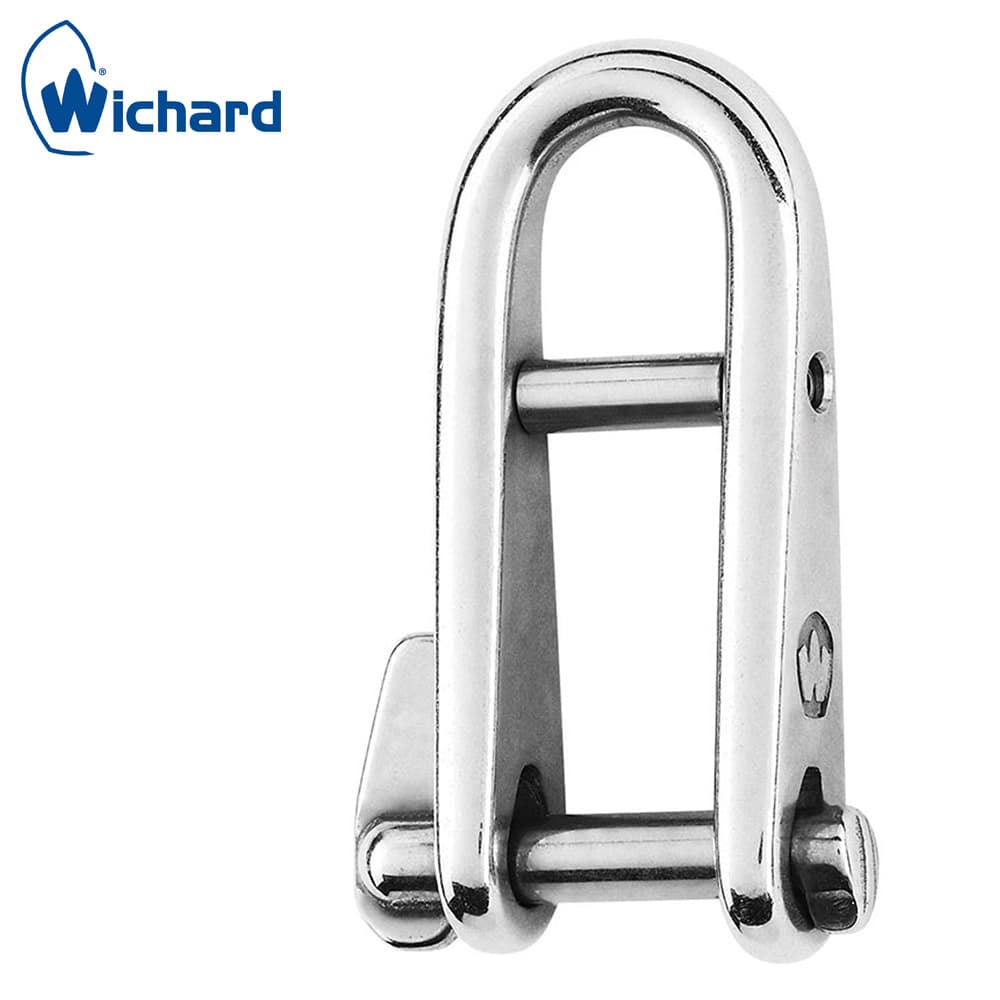
wichard-hr-key-pin-shackle-main.jpg

+1. Used on both boats we have had. And attached with the Selden Halyard knot. Clip to end of boom when not in use
 
My balls are out all the time - and I think are about 10 years old now. They have faded slightly but no signs of cracking.
 
+1. Used on both boats we have had. And attached with the Selden Halyard knot. Clip to end of boom when not in use

You really only need the (more expensive) version with the retaining bar if your halyard ends in an eye splice; a Selden knot will grip the shackle firmly and not tend to slip off. The captive shackle-pin, however, is definitely recommended.
 
Just read this post and surprised so many people use shackles of some sort. For our halyards we simply tie a bowline. We have done this for far more years than i care to remember. Once the bowline is under load it wont fail.
The bowline can always be undone when the load is removed. Nothing to go wrong, free and simple
 
Not very likely. Never snapped one or even had any noticeable wear in region of a bowline in 40,000 miles and three Atlantic crossings. May be an issue in 5nm dyneema but halyards on main mast are 12mm. Mizzen halyards are both 10mm and no problem there either.
We also remove main and mizzen halyards from sails when we have finished sailing. Always easy to undo the bowlines.
 
The only problem with bowlines is that they take up more space than a halyard knot. This is sometimes a problem if you need to hoist the full length of your mast. (This also applies to shackles). The drawback to halyard knot is that you often can't undo it. The reduction in strength doesn't usually matter as most halyards are oversized for ease of handling so not close to stress limit.
 
Not very likely. Never snapped one or even had any noticeable wear in region of a bowline in 40,000 miles and three Atlantic crossings. May be an issue in 5nm dyneema but halyards on main mast are 12mm. Mizzen halyards are both 10mm and no problem there either.
We also remove main and mizzen halyards from sails when we have finished sailing. Always easy to undo the bowlines.

Here's the proof... 44.9% reduction in polyester braid on braid,59.33% in dyneema

http://www.neropes.com/Resources/sail_reprint.pdf
 
Last edited:
Here's the proof... 44.9% reduction in polyester braid on braid,59.33% in dyneema

http://www.neropes.com/Resources/sail_reprint.pdf

And whats the problem with that? The 12mm line is selected for the ease of handling not its breaking strain. At half its rated strength my dyneema halyard will still be significantly stronger than it needs to be. Even the polyester halyards on the genoa and staysail are massively strong compared to the load they are exposed to with a bowline at one end. My 10mm mizzen halyard is over 15 years old and was previously the main halyard on my last boat. It has done tens of thousands of miles and has no noticeable wear from hundreds of bowlines that have been tied in the end. Far safer having a bowline in the end of a halyard than any snap shackle in my opinion
 
Here's the proof... 44.9% reduction in polyester braid on braid,59.33% in dyneema

http://www.neropes.com/Resources/sail_reprint.pdf

And whats the problem with that? The 12mm line is selected for the ease of handling not its breaking strain. At half its rated strength my dyneema halyard will still be significantly stronger than it needs to be. Even the polyester halyards on the genoa and staysail are massively strong compared to the load they are exposed to with a bowline at one end. My 10mm mizzen halyard is over 15 years old and was previously the main halyard on my last boat. It has done tens of thousands of miles and has no noticeable wear from hundreds of bowlines that have been tied in the end. Far safer having a bowline in the end of a halyard than any snap shackle in my opinion
 
I use these. I have just discovered that they are called "key pin shackles". Wichard make them, or at least they made mine.

wichard-hr-key-pin-shackle-main.jpg

I had those on both the main halyard and the topping lift. When I leave the boat I normally move the halyard to the end of the boom where it sits along with the topping lift. One day I returned to the boat and the main halyard was nowhere to be seen, until I looked up to see the shackle sticking out of the sheave at the top of the mast. Thanks to a bunch of fishing hooks attached to the topping lift, I eventually managed to recover it, to find the shackle open. I've now replaced the shackle on the main halyard with a screw shackle, and I've fitted a spring ring round the shackle on the topping lift, like a miniature key ring it sits around the leg of the shackle and drops over the "wing" to stop the pin turning. I just lift it out of the way to open the shackle, and it drops back into place by gravity. Both shackles are attached with halyard knots.
 
Top
