TomK
Member
Question for knowledgable riggers on the forum:
I’m on a boat in Italy (grand soleil 46). The owner/skipper had a new main halyard from a rigger in Sicily, as the previous one become worn and chafed the outer. The rigger also replaced the sheave at the top of the mast (as this was what was causing the wear on the rope).
The rigger has spliced what appears to be a dyneema outer over the last 6 or so metres of the halyard at the shackle /mast head end. So far so good.
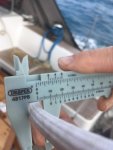
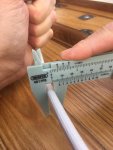
The interesting part is that when we took the sail down yesterday we noticed that the middle part of the last 6 metres has become much thinner (7mm on verniers) and is bar tight like a cable. So the core has clearly come apart at some point.
My question: is this a normal / standard way of doing the sheathing? Or has the core broken where it shouldn’t have?
We are waiting for the rigger to get back to us now, but we are on passage now (under motor.)
Not inclined to raise the main without a second opinion….
I’m on a boat in Italy (grand soleil 46). The owner/skipper had a new main halyard from a rigger in Sicily, as the previous one become worn and chafed the outer. The rigger also replaced the sheave at the top of the mast (as this was what was causing the wear on the rope).
The rigger has spliced what appears to be a dyneema outer over the last 6 or so metres of the halyard at the shackle /mast head end. So far so good.
The interesting part is that when we took the sail down yesterday we noticed that the middle part of the last 6 metres has become much thinner (7mm on verniers) and is bar tight like a cable. So the core has clearly come apart at some point.
My question: is this a normal / standard way of doing the sheathing? Or has the core broken where it shouldn’t have?
We are waiting for the rigger to get back to us now, but we are on passage now (under motor.)
Not inclined to raise the main without a second opinion….