Halyard replacement

MADRIGAL

Well-Known Member
Joined
12 Jan 2019
Messages
382
Visit site
On a recent cruise, the wire portion of the jib halyard parted where it passed over the block on the forward side of the mast. I would like to replace it with an all-rope halyard, which would be easier to fix on a cruise. Since the jib halyard provides the tension for this rig, I've been thinking of using something like Spectra with an outer sheath of braided polyester to provide UV protection. Any advice would be appreciated.
 
How is the halyard tensioned? if it's a highfield lever or a hook up to a muscle box/ purchase system there is no real alternative to wire. with a rope tail. Do check the sheave too.
 
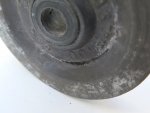
I changed the halyards on my present boat from rope/wire to solely rope, after dropping the mast and finding the wire had had had the effect of a ‘cheese cutter’ on the sheeves, almost cutting them in half, new sheeves were not expensive and I feel happier knowing that they won’t be damaged by the wire. Couple of photo’s showing damage.
Sheeve 1.jpg Sheeve 2.jpg
 
Last edited:
How is the halyard tensioned? if it's a highfield lever or a hook up to a muscle box/ purchase system there is no real alternative to wire. with a rope tail. Do check the sheave too.
I beg to differ. We have tensioned dyneema halyards. The jib one is 5mm running over a block designed for wire, and has a spliced loop for the tensioner. As it happens, it‘s a hook and a 8:1 system, but no difference to any other really. With the live part of the halyard as SK78 12 plait with a loop at each end, easy diy spicing too, you can put a 10mm, or whatever you like, as the uphaul part just as you would on a rope/wire setup. It‘s the modern way, and fully compatible with DIY, unlike wire
 
Surely the tension difference between a wire/ rope combination and a rope only combination will will fairly slight, as both have rope in the system, the use of pre stretched and low stretch ropes should surely minimise any noticeable tension loss.
 
We replaced the headsail halyard on our X-99 with dyneema in the late 80's. I took the mast out, replaced the sheave (for wire) with a sheave for rope (any old rope). We were CHS Class Champions for 2 years in a row (still have the glass ware)

Based on this experience we specified dyneema for the main and headsail halyard on our cat and our unstayed screecher (Code Zero ish). The Screecher (Code Zero) has a dyneema bolt rope).

As Chiara says - its common place and mainstream.

Rope/wire combination is prone to failure and even partial failure can cause injury

Jonathan
 
Looking at the OP's avatar, its a Wayfarer, Getting the splice of even naked dyneema through the sheaves is going to be tight., if not impossible. A simple talurited soft eye arrangement has been used for eons on dinghy jib halyards.

I whole heartedly agree with the binning of wire halyards in every other circumstance.
 
I forgot to mention - dyneema is UV resistant - and now that I discover your yacht - a devil to handle by hand under high loads when of small diameter. I'd suggest for your consideration. Buy covered dyneema, strip off the cover for the working part and leave the cover on the portion you will work with, by hand. You can do this yourself (there must be YouTube vids) or any rope purveyor should do it for you or a sail maker.

Jonathan
 
On a recent cruise, the wire portion of the jib halyard parted where it passed over the block on the forward side of the mast. I would like to replace it with an all-rope halyard, which would be easier to fix on a cruise. Since the jib halyard provides the tension for this rig, I've been thinking of using something like Spectra with an outer sheath of braided polyester to provide UV protection. Any advice would be appreciated.

Presuming it's for the wayfarer on your picture, how do you shrouds attach to the mast? The reason I ask is on my W with a proctor mast, the shrouds attachment tang has a hole through the mast from the giant rivet holding them on at the same height as the jib halyard sheave. Through this I fed a loop of dyneema with a block. This block sits at the same height as the in mast sheave for the job halyard.

As a result, I have replaced the wire halyard with a dyneema one (5mm diameter). As it runs down the mast externally, it has a loop tied at the appropriate point so that a hook and 6:1 (I think) tension system to tension the rig to go sailing.

As a system it works really well. Sorry, but I have no photos. Hope this helps
 
Presuming it's for the wayfarer on your picture, how do you shrouds attach to the mast? The reason I ask is on my W with a proctor mast, the shrouds attachment tang has a hole through the mast from the giant rivet holding them on at the same height as the jib halyard sheave. Through this I fed a loop of dyneema with a block. This block sits at the same height as the in mast sheave for the job halyard.

As a result, I have replaced the wire halyard with a dyneema one (5mm diameter). As it runs down the mast externally, it has a loop tied at the appropriate point so that a hook and 6:1 (I think) tension system to tension the rig to go sailing.

As a system it works really well. Sorry, but I have no photos. Hope this helps
Thank you; that's brilliant, just the sort of think I had in mind. :)
 
My advice would be to make sure the halyard sheave in the mast is suitable for your new halyard. Your current one might be specifically for wire. Check for sharp edges where the wire might have abraded the mast/sheave housing as it exits the mast.
Yes, the sheave is for wire, and will have to be changed.
 
How is the halyard tensioned? if it's a highfield lever or a hook up to a muscle box/ purchase system there is no real alternative to wire. with a rope tail. Do check the sheave too.
The current halyard is tensioned with a hook through a permanent loop at the lower end of the wire halyard attached to a purchase using two triple blocks.
 
Now that I've purchased my first piece of Dyneema, I need to attach it to the halyard shackle at the head of the jib. Can I use an anchor bend with the rope tail seized, or a just a seizing, or do I need to splice a loop around the skackle?
 
Top