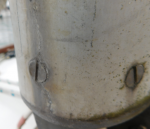
Hairline Crack in Mast

LancsCaptain

New Member
Joined
22 Jun 2020
Messages
4
Visit site
Hello,
I have found a small hairline crack at the base of the forward side of the mast on my 30ft yacht. Is this a major problem and if so what would others recommend?
Thanks!
 
Depends a little on exactly where it is and which way it is propagating. Standard instruction is to drill a small hole at the crack tip to arrest it. This would apply regardless of direction. A photo would be helpful.
 
Hello,
I have found a small hairline crack at the base of the forward side of the mast on my 30ft yacht. Is this a major problem and if so what would others recommend?
Thanks!
To stop it from running any further, drill a small hole at the end of the crack. Keep an eye on it. Never mind, what he, vyv_cox, said.
 
I had a similar thing happen and I got a firm in Chichester marina to weld a thick aluminium sleeve around the base of the mast. They did a first-class job.

Then I re-drilled for the mast base plug fastenings
 
Last edited:
You might want to address the question of what caused it, ie it runs up through a screw into the base plug which suggest movement. Is your standing rigging slack?
 
The cause is normally ice, although it can be corrosion, which also causes corrosion. It is not related to rigging forces.

A sleave will fix it, since it need only resist compression and avoid buckling. Address the corrosion if possible, and make sure there are drain holes for water. Possibly the original holes became plugged.
 
If the damage was caused by ice in the base of the mast (not something i am familiar with) then presumably there will be no more stress trying to open up the crack until you get more ice. The crack has obviously started at the screw hole. It would be good to remove the screw and seal it with Duralac or just grease to minimise corrosion. This area of the mast as said only recives stress from compression in downward direction. I would not drill a stopper hole (perhaps I am just slack and careless) I would just keep an eye on the crack and if it propagates further then become alarmed. ol'will
 
Thanks everyone for your all your comments, as you probably gathered I am a novice! Re the cause, I will check the rig tension as I have not done this yet, will also look at the screw and drainage for the ice theory, but as moored up permanently in a NW UK marina I am not sure this would be a frequent occurrence. As shes an old boat the long term corrosion of dissimilar metals plus salt maybe a distinct possibility. Sleeving sounds like a belt and braces solution and, but I presume a big job and a major expense my NHS salary wont stretch to at the moment! So drilling a small hole to stop crack propagation and see what happens seems like best short term solution, what would be the diameter of hole people would suggest and would you fill the hole with flexible marine sealant?
 
If you've got enough spare length, I'd chop a few inches of the mast foot. If not do as others say and drill a small hole to stop further propagation.
 
Thanks everyone for your all your comments, as you probably gathered I am a novice! Re the cause, I will check the rig tension as I have not done this yet, will also look at the screw and drainage for the ice theory, but as moored up permanently in a NW UK marina I am not sure this would be a frequent occurrence. As shes an old boat the long term corrosion of dissimilar metals plus salt maybe a distinct possibility. Sleeving sounds like a belt and braces solution and, but I presume a big job and a major expense my NHS salary wont stretch to at the moment! So drilling a small hole to stop crack propagation and see what happens seems like best short term solution, what would be the diameter of hole people would suggest and would you fill the hole with flexible marine sealant?
I suspect that the cause is corrosion. Growth of corrosion product has expanded the mast tube, which has cracked along the line of least resistance, i.e. through the screw. A 2-3 mm hole at the end of the crack will arrest it for now but the corrosion will continue to 'grow' the mast. A small drain hole in the mast immediately above the casting will help by draining away water that comes down inside but ideally the casting needs to be removed and cleaned up before applying something that will help to arrest the corrosion.
 
It all looks like age and the inevitable corrosion between the Mast foot casting, the Stainless steel screws holding the mast foot on to the aluminum mast. 3 different materials and salt water.
In the Spirit of PBO, I would not worry right now and sort out next time you have the mast down. In the mean time if you are worried as well as as the 3mm hole at the end of the crack you could strap up the bottom with some large stainless steel jubilee clips and some plastic / rubber to prevent the jubilee clip stainless steel coming in contact with the aluminum of the mast and exacerbating the problem.
 
Sleeving the mast is quite simple, finding the appropriate shelve might be more difficult. We sleeved a mast once, the forestay toggle failed after a life of 3 years. We had the mast maker supply the sleeve, we told him where the mast had failed, keel stepped and failed at the deck, and then sailed the yacht back from Manilla to Hong Kong (and then replaced the mast). So - mast makers are source of sleeves but you might find scrap masts at you local boatyard and be able to recycle a portion.

Jonathan
 
Top