
srm
Well-Known Member
Why do you think they need internal support. Is the fibreglass around the hull / keel joint area showing cracks or flexing?however our Lysander has fully fibreglass enclosed keels so not sure how to internally support them.

Why do you think they need internal support. Is the fibreglass around the hull / keel joint area showing cracks or flexing?however our Lysander has fully fibreglass enclosed keels so not sure how to internally support them.
I was wondering that, since they are short, the leverage is not great.Why do you think they need internal support. Is the fibreglass around the hull / keel joint area showing cracks or flexing?
If they are bolted on there will be similar reinforcing framework, either extra layup or moulded in stringers. You would also of course see the heads of the bolts although they may be glassed over and just look like lumps. If they are part of the moulding then there won't be any specific "support" but the layup will be such as to carry the load of the ballast. Normally the ballast would be bonded in and glassed over so the area where the keels are would look like the rest of the bilge area of the hull.Thanks for the photo however our Lysander has fully fibreglass enclosed keels so not sure how to internally support them.
It's belt and braces really if we beach the Lysander on rock etc.Thanks for the photo however our Lysander has fully fibreglass enclosed keels so not sure how to internally support them.
Also LOA definitely joining when our printer gets working for the application print off.
Best regards N&P.
If wanting protection for the bottom of the keels I would suggest the system I had on my Prout catamaran. Simply a hard wood strip about 50mm thick bonded to the bottom of the keel with Sikoflex or similar and shaped to blend in with the keel. The wood should then protect the grp and ballast in the event of a grounding. If unsure about the bond a glass and epoxy tape could be run over the sides of the wood and onto the sides of the grp keel.I think the top hats refers to adding sacrificial shoes to the bottom of the keels.
I suspect the 'tophats' would be transverse stiffeners formed by laying glass over paper rope or foam square section to form 'girders'.
Hi I've tried to load up some photos to show what we have, however the forum tells me that they are to big to process!I was wondering that, since they are short, the leverage is not great.
a) Are they splayed, or vertical?
b) Moulded with the hull or fastened on afterwards?
If a, then likely mouldedwith the hull and no extra internal bracing.
And, what do you have in the hull now? One is assuming a restoration, not a hull that was never finished.
Hello,
We Nigel and Paula are currently starting to restore a rare GRP Lysander.
Any help and guidance will be most appreciated.
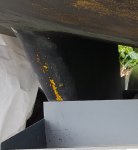
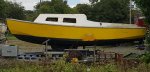
Thanks for all that and hull soda blasted definitely a good idea.Looking at the pics I suggest that you clean off all the old antifouling etc. and get back to the gel coat. Note that some of the earlier grp hulls were laid up with clear gel coat below the waterline.
When you are back to the gel coat it will be easier to assess the state of the keel / hull area and decide if you need additional support inside the hull. You will also be able to see the state of the rest of the gel coat and make good any damage. Any cracks or damage must be made good as the gel coat is the (semi) waterproof membrane for the hull.
Having cleaned the hull, and with the hull dry after being ashore for the renovation it would be advisable to apply an epoxy coating below the waterline before antifouling as this gives a second (almost) waterproof membrane to protect the grp lay up..
Note: cleaning the hull back to the gel coat is a most unpleasant job and the old antifouling will have residual poison in it. I did it on my previous catamaran. With my current boat I paid to have it soda blasted and only had to use an orbital sander to remove the remaining base coat.

