GRP Lysander restoration

Welcome, If you can ask quite specific questions then I am sure you will get plenty of advice. Generally, give us as much info about the problem as you can. The PBO forum can also provide help as your boat is GRP. Also, do make use of the search facility on the website as many topics come up at regular intervals.
 
Welcome, If you can ask quite specific questions then I am sure you will get plenty of advice. Generally, give us as much info about the problem as you can. The PBO forum can also provide help as your boat is GRP. Also, do make use of the search facility on the website as many topics come up at regular intervals.
That's brilliant thank you.
Our first problem is the toe in of the boats GRP covered twin keels, is this how the keels should be?
And as soon as we can post photos we will.
Best regards Nigel and Paula.
 
There is a Lysander's Owners Association but the website appears down at the moment. Maybe there is an alternative way of making contact?
 
Thinking about toe in of bilge keels.

Assuming the bottoms are angled out from the vertical. With the wind forward of the beam and the boat heeled the leeward keel would be nearer vertical and could provide a slight lift to windward, potentially reducing leeway. The windward keel would approach the horizontal and provide a slight downward force reducing angle of heel and improving stability.

All theory of course, must admit to have only had twin keels on a Prout catamaran.
 
Welcome to the Forum Paula and Nigel.
I guess you cannot post photos just yet, as you are new, but when you are able to, please do post some photos of your Lysander on this thread.
If N&P want to post pics, they could e-mail them to you to put up. I'm not too good at this, or I would offer.
 
Don't think there is a restriction on posting pics, it is the delay in getting the approval to send private messages for new members
 
Thinking about toe in of bilge keels.

Assuming the bottoms are angled out from the vertical. With the wind forward of the beam and the boat heeled the leeward keel would be nearer vertical and could provide a slight lift to windward, potentially reducing leeway. The windward keel would approach the horizontal and provide a slight downward force reducing angle of heel and improving stability.

All theory of course, must admit to have only had twin keels on a Prout catamaran.
Thanks for your reply we definitely need to up date our tec knowledge!
Any idea about internal framework support for the twin keels as the Lysander is completely gutted.
 
Thanks for your reply we definitely need to up date our tec knowledge!
Any idea about internal framework support for the twin keels as the Lysander is completely gutted.
My wooden Lysander had two steel plates for each keel, each about 2 inches wide and 18 inches long on wooden bearers attached to the hull.
 
That's brilliant thank you.
Our first problem is the toe in of the boats GRP covered twin keels, is this how the keels should be?
And as soon as we can post photos we will.
Best regards Nigel and Paula.
Toe in was common at the time following the success of the Centaur which was the first production boat to feature it. Perhaps you can post pictures of the keels inside and out. Suspect there are stubs in the hull moulding and keels are bolted on as it is difficult to mould complete keels in unless they are straight. Are there any signs of a joint between the keels and the hull? - that is an indication of bolt on. If not then the keels could be part of the moulding and ballast inserted in the hollows. This was also very common, often using steel punchings for ballast and then glassing over.
 
What did the internal support framework look like that supported the keels please?
Regards N&P.

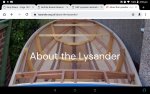
If you observe this photo of a wooden Lysander under construction. Stolen from the LOA site.
The longitudinal bearers you can see, they were infilled by timber across the hull just where two steel plates for rack keel crossed, then two keel bolts were fed through the top of the steel keels through skin, bearers, each steel plate and nuts on top. Other keel bolts fed only through the longitudinal bearers.
I would recommend joining LOA it's only about £15 a year .
 

Attachments

  • 20220506_165535782.jpeg
    20220506_165535782.jpeg
    218.8 KB · Views: 20
Last edited:
If you observe this photo of a wooden Lysander under construction. Stolen from the LOA site.
The longitudinal bearers you can see, they were infilled by timber across the hull just where two steel plates for rack keel crossed, then two keel bolts were fed through the top of the steel keels through skin, bearers, each steel plate and nuts on top. Other keel bolts fed only through the longitudinal bearers.
I would recommend joining LOA it's only about £15 a year .
Thanks for the photo however our Lysander has fully fibreglass enclosed keels so not sure how to internally support them.
Also LOA definitely joining when our printer gets working for the application print off.
Best regards N&P.
 
Top