Go with or agin the tidal flow?

pcatterall

Well-Known Member
Joined
2 Aug 2004
Messages
5,507
Location
Home East Lancashire boat Spain
Visit site
Thanks for all the useful comments re crossing from the Solent area to Le Havre.
Its quite rare for us to be going across tides rather than with or ( more usually against) them.
I understand the navigational side of things quite well so I suppose I'm thinking of effeciency.
I was looking at a passage where 5 hours ( 25nm) were spent with the tide on the Port Beam then another 5 ( 25nm ) with it on the starboard beam. We could (A)just steer the direct course and accept that we will sail a shallow arc and add about 0.2nm ( 2 minutes).
Or we could (B) make corrections to the course and sail on the direct line and save 2 minutes.
However the arc course on both legs improves our angle to the current by about 10 degrees and improves our speed as it has now a slight positive element a good 0.1kn (off the top of my head). over the 10hrs this represents 1nm gained against the 0.2 lost.
Clearly the best point of sail may be the dominant factor and leeway will have a fact but I wonder if there is an accepted way to deal with this
 
If you are crossing a tidal stream that flows one way for part of the time and the other way for part of the time .Plot a course to steer taking into account all the tidal effects ( It'll just about cancel out to nothing on cross channel trip anyway )

Stick ( if wind allows) to that course all the way.

You will be carried off track by the tide one way and then back again by the next tide but it is the quickest way.

If you attempt to stick to the rhumb line you will always be sailing partly into the tide, so your progress towards your destination will be slower.

This is a case when the compass is essential, even if you use a GPS for course at other times
 
Last edited:
Like VicS says, but do arrange to be offset uptide at the destination; then if bad vis' or some problem affecting boatspeed hits, you know which way to go, and the tides on the other side are to be taken ( even more ) seriously.
 
Tides rarely cancel out in strong tide areas where they run more strongly on one coast than the other, even if you trip time is over an equal number of tidal cycles.

Out of curiosity give me a date to look at and an idea of your average speed to plan on and I'll feed it into the Neptune Planner number cruncher progam. This will give the optimum departure time and show the differences in time taken for each hour of a 24 hour period. Let me know between which points, like say off Bembridge to just outside Le Havre. At least you will know if it is worth bothering with when the time comes.
 
Tides rarely cancel out in strong tide areas where they run more strongly on one coast than the other, even if you trip time is over an equal number of tidal cycles.

In practice they just about do on a trip across the English channel. I'd not suggest anybody should set off without doing the navigation assuming that they will but the net tidal set may well be only a mile or so. You cannot steer that accurately!

We never bothered to allow for tides on a trip from Chichester to Cherbourg or even to Alderney.

I once showed a novice how to work it all out ( actually she'd done the evening classes so knew what to do really) for a trip from Honfleur back to the eastern solent. She found that the net effect of the tide, even for that trip, was next to nothing.
 
In practice they just about do on a trip across the English channel. I'd not suggest anybody should set off without doing the navigation assuming that they will but the net tidal set may well be only a mile or so. You cannot steer that accurately!

We never bothered to allow for tides on a trip from Chichester to Cherbourg or even to Alderney.

I once showed a novice how to work it all out ( actually she'd done the evening classes so knew what to do really) for a trip from Honfleur back to the eastern solent. She found that the net effect of the tide, even for that trip, was next to nothing.

Well we crossed regularly between Poole and Cherbourg, which ignoring the in harbour bits is 60nm. With a plan speed of 6kts the difference could be little or a lottle. We had friends that always said it cancelled out and indeed it did pretty much so for them because they always left Poole at the same time relative to the tide out in the Channel, not deliberately mind but because it suited them always to go out of Poole on the ebb. We on the other hand were a tad faster, planned on 6.5kts and for weekend trips would leave at a convenient rather than optimum departure time. We would sometimes have to offset a sideways shift as much as 8mls, conveniently an 8 degree alteration +/- over a 60nm trip. On fast trip days the difference is even more marked, with a worse case scenario of 6hrs of one tide and just two of the other.

Out in the Western Channel where tides were much less and we crossed from Dartmouth to Chenal Du Four, the difference after 3 tides was minimal, around 1ml IIRC so not worth bothering with until within range the other side.
 
Like VicS says, but do arrange to be offset uptide at the destination; then if bad vis' or some problem affecting boatspeed hits, you know which way to go, and the tides on the other side are to be taken ( even more ) seriously.

Exactly as Seajet has said. We planned it beautifully coming back from Oostende last time, we plotted the course on a huge Perspex covered chart and you could see the loop going one side of the line then gradually making it's way back - but we'd calculated without planning to be up tide, the wind headed us in the lat three hous and we slowed down and ended up fighting a foul tide for two hours instead of catching the last of the old tide, it probably added an hour and a half to the journey which is a real pain after a long crossing like that. Could have been prevented by planning in a small up tide margin of error.
 
Don't try to maintain a straight course over ground as your speed in the water will be the same, but wasted on vectoring to maintain course. That means that by following the straight line between two points you will actually be sailing much further through the water.

Rob.
 
Tides rarely cancel out in strong tide areas where they run more strongly on one coast than the other, even if you trip time is over an equal number of tidal cycles.

Out of curiosity give me a date to look at and an idea of your average speed to plan on and I'll feed it into the Neptune Planner number cruncher progam. This will give the optimum departure time and show the differences in time taken for each hour of a 24 hour period. Let me know between which points, like say off Bembridge to just outside Le Havre. At least you will know if it is worth bothering with when the time comes.
Thanks guys... data for Robin
Wanted to leave Sandown at 0300 on 10th April and working on 5kn.
Initial rough plan indicated West current at av of 2kn for first 5 hours, slack and then East at av 2kn for next 5 hours, slack then West for final hour or so.
This would put us a few nms west of Le Havre.
Lots of responses allude to the simple cancelling out of the tides which happens to a great extent on this passage.
My interest was in the efficiency of steering a straight course over the ground versus maintaining the calculated heading and allowing the boat to go off course and come back when the tide turns. IE ignore the GIS off track error.
On this particular passage assuming that the ( lovelly force 4 steady wind) is from the SW then the leeway would probably cancell out the Westerly offset at leHavre
 
Thanks guys... data for Robin
Wanted to leave Sandown at 0300 on 10th April and working on 5kn.
Initial rough plan indicated West current at av of 2kn for first 5 hours, slack and then East at av 2kn for next 5 hours, slack then West for final hour or so.
This would put us a few nms west of Le Havre.
Lots of responses allude to the simple cancelling out of the tides which happens to a great extent on this passage.
My interest was in the efficiency of steering a straight course over the ground versus maintaining the calculated heading and allowing the boat to go off course and come back when the tide turns. IE ignore the GIS off track error.
On this particular passage assuming that the ( lovelly force 4 steady wind) is from the SW then the leeway would probably cancell out the Westerly offset at leHavre

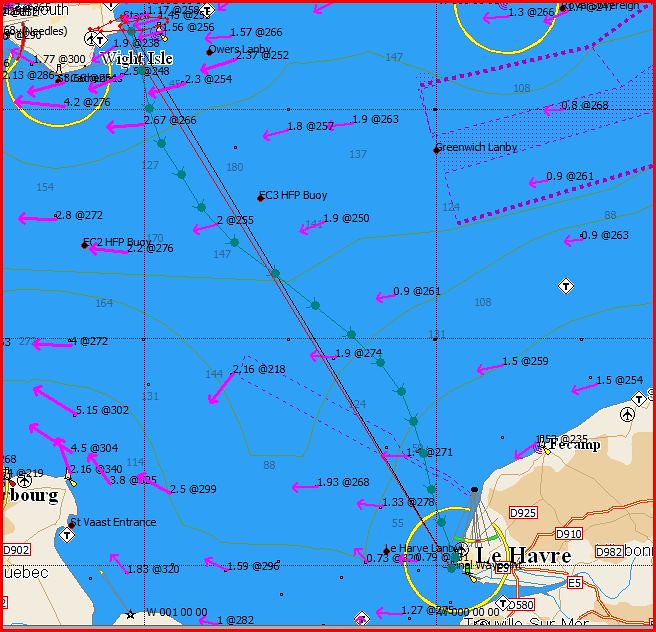
6970227649_774d3f1182_b.jpg


This is the COG for the date and time, then see below for the differences every hour for 24 hours and the CTS based on your chosen time. I did this quickly after a very fine Rioja so as they say, 'not to be used for navigation'!!

RESULTS ARE FROM DERIVED DATA AND AS SUCH ARE ONLY APPROXIMATE

Optimise Departure for 10 Apr 2012

Start : 50.41.70N 001.04.08W Range = 84.1 nm
Dest : 49.29.47N 000.03.03E Bearing = 149.2 °T Speed = 5 kt

Departure Time 0:00 Arrival Time = 17:21
CTS = 146°M Time Taken = 17:21 Distance through water = 86.8 nm

Departure Time 0:30 Arrival Time = 18:05
CTS = 146°M Time Taken = 17:35 Distance through water = 87.9 nm

Departure Time 1:00 Arrival Time = 18:15
CTS = 146°M Time Taken = 17:15 Distance through water = 86.3 nm

Departure Time 1:30 Arrival Time = 18:46
CTS = 148°M Time Taken = 17:16 Distance through water = 86.4 nm

Departure Time 2:00 Arrival Time = 19:00
CTS = 147°M Time Taken = 17:00 Distance through water = 85.0 nm

Departure Time 2:30 Arrival Time = 19:23
CTS = 149°M Time Taken = 16:53 Distance through water = 84.5 nm

Departure Time 3:00 Arrival Time = 19:44
CTS = 148°M Time Taken = 16:44 Distance through water = 83.7 nm

Departure Time 3:30 Arrival Time = 19:56
CTS = 150°M Time Taken = 16:26 Distance through water = 82.2 nm

Departure Time 4:00 Arrival Time = 20:26
CTS = 150°M Time Taken = 16:26 Distance through water = 82.2 nm

Departure Time 4:30 Arrival Time = 20:48
CTS = 151°M Time Taken = 16:18 Distance through water = 81.6 nm

Departure Time 5:00 Arrival Time = 21:20
CTS = 151°M Time Taken = 16:20 Distance through water = 81.7 nm

Departure Time 5:30 Arrival Time = 21:44
CTS = 151°M Time Taken = 16:14 Distance through water = 81.2 nm

Departure Time 6:00 Arrival Time = 22:16
CTS = 152°M Time Taken = 16:16 Distance through water = 81.4 nm

Departure Time 6:30 Arrival Time = 22:47
CTS = 151°M Time Taken = 16:17 Distance through water = 81.4 nm

Departure Time 7:00 Arrival Time = 23:18
CTS = 153°M Time Taken = 16:18 Distance through water = 81.5 nm

Departure Time 7:30 Arrival Time = 00:02 (11 Apr)
CTS = 152°M Time Taken = 16:32 Distance through water = 82.7 nm

Departure Time 8:00 Arrival Time = 00:28 (11 Apr)
CTS = 150°M Time Taken = 16:28 Distance through water = 82.3 nm

Departure Time 8:30 Arrival Time = 01:14 (11 Apr)
CTS = 150°M Time Taken = 16:44 Distance through water = 83.7 nm

Departure Time 9:00 Arrival Time = 01:42 (11 Apr)
CTS = 149°M Time Taken = 16:42 Distance through water = 83.5 nm

Departure Time 9:30 Arrival Time = 02:28 (11 Apr)
CTS = 149°M Time Taken = 16:58 Distance through water = 84.9 nm

Departure Time 10:00 Arrival Time = 02:55 (11 Apr)
CTS = 148°M Time Taken = 16:55 Distance through water = 84.6 nm

Departure Time 10:30 Arrival Time = 03:34 (11 Apr)
CTS = 148°M Time Taken = 17:04 Distance through water = 85.4 nm

Departure Time 11:00 Arrival Time = 04:23 (11 Apr)
CTS = 147°M Time Taken = 17:23 Distance through water = 87.0 nm

Departure Time 11:30 Arrival Time = 04:57 (11 Apr)
CTS = 147°M Time Taken = 17:27 Distance through water = 87.3 nm

Departure Time 12:00 Arrival Time = 05:31 (11 Apr)
CTS = 146°M Time Taken = 17:31 Distance through water = 87.6 nm

Departure Time 12:30 Arrival Time = 05:51 (11 Apr)
CTS = 146°M Time Taken = 17:21 Distance through water = 86.8 nm

Departure Time 13:00 Arrival Time = 06:35 (11 Apr)
CTS = 146°M Time Taken = 17:35 Distance through water = 87.9 nm

Departure Time 13:30 Arrival Time = 06:45 (11 Apr)
CTS = 146°M Time Taken = 17:15 Distance through water = 86.3 nm

Departure Time 14:00 Arrival Time = 07:16 (11 Apr)
CTS = 148°M Time Taken = 17:16 Distance through water = 86.4 nm

Departure Time 14:30 Arrival Time = 07:30 (11 Apr)
CTS = 147°M Time Taken = 17:00 Distance through water = 85.0 nm

Departure Time 15:00 Arrival Time = 07:53 (11 Apr)
CTS = 149°M Time Taken = 16:53 Distance through water = 84.5 nm

Departure Time 15:30 Arrival Time = 08:14 (11 Apr)
CTS = 148°M Time Taken = 16:44 Distance through water = 83.7 nm

Departure Time 16:00 Arrival Time = 08:26 (11 Apr)
CTS = 150°M Time Taken = 16:26 Distance through water = 82.2 nm

Departure Time 16:30 Arrival Time = 08:56 (11 Apr)
CTS = 150°M Time Taken = 16:26 Distance through water = 82.2 nm

Departure Time 17:00 Arrival Time = 09:18 (11 Apr)
CTS = 151°M Time Taken = 16:18 Distance through water = 81.6 nm

Departure Time 17:30 Arrival Time = 09:50 (11 Apr)
CTS = 151°M Time Taken = 16:20 Distance through water = 81.7 nm

Departure Time 18:00 Arrival Time = 10:14 (11 Apr)
CTS = 151°M Time Taken = 16:14 Distance through water = 81.2 nm

Departure Time 18:30 Arrival Time = 10:46 (11 Apr)
CTS = 152°M Time Taken = 16:16 Distance through water = 81.4 nm

Departure Time 19:00 Arrival Time = 11:17 (11 Apr)
CTS = 151°M Time Taken = 16:17 Distance through water = 81.4 nm

Departure Time 19:30 Arrival Time = 11:48 (11 Apr)
CTS = 153°M Time Taken = 16:18 Distance through water = 81.5 nm

Departure Time 20:00 Arrival Time = 12:25 (11 Apr)
CTS = 151°M Time Taken = 16:25 Distance through water = 82.1 nm

Departure Time 20:30 Arrival Time = 12:59 (11 Apr)
CTS = 150°M Time Taken = 16:29 Distance through water = 82.5 nm

Departure Time 21:00 Arrival Time = 13:43 (11 Apr)
CTS = 150°M Time Taken = 16:43 Distance through water = 83.6 nm

Departure Time 21:30 Arrival Time = 14:14 (11 Apr)
CTS = 149°M Time Taken = 16:44 Distance through water = 83.7 nm

Departure Time 22:00 Arrival Time = 14:59 (11 Apr)
CTS = 149°M Time Taken = 16:59 Distance through water = 85.0 nm

Departure Time 22:30 Arrival Time = 15:27 (11 Apr)
CTS = 148°M Time Taken = 16:57 Distance through water = 84.8 nm

Departure Time 23:00 Arrival Time = 16:21 (11 Apr)
CTS = 148°M Time Taken = 17:21 Distance through water = 86.8 nm


DOVER Tide Times
01:00 7.4
08:40 0.4
13:30 7.1
21:00 0.6

Note:- This chart's tidal diamonds are referred to the above port HW times


This is the calculated CTS:-

COURSE TO STEER 10 Apr 2012 @ 03:00

Start 50.41.70N, 001.04.08W Range = 84.1nm
Destination 49.29.47N, 000.03.03E Bearing = 149°T Speed = 5 kt

Time taken = 16:44
Course to Steer = 151°M
Distance through water = 83.71nm

(Manual plot cross check - end of tidal vectors = 50.40.79N, 001.05.26W)
----------------------------------------------------------------------------------------------------------------------------
RESULTS ARE FROM DERIVED DATA AND AS SUCH ARE ONLY APPROXIMATE
----------------------------------------------------------------------------------------------------------------------------

Dep slot = H.W. +2 for 30 mins

Tidal vectors used
Diamond A Direction 312° @0.6nm
Diamond H Direction 237° @1.6nm
Diamond J Direction 246° @1.7nm
Diamond R Direction 259° @1.1nm
Diamond K Direction 333° @0.1nm
Diamond U Direction 230° @0.1nm
Diamond U Direction 100° @1.6nm
Diamond U Direction 087° @2.8nm
Diamond x Direction 088° @2.5nm
Diamond S Direction 078° @2.1nm
Diamond S Direction 066° @1.3nm
Diamond S Direction 005° @0.4nm
Diamond S Direction 285° @1.1nm
Diamond U Direction 271° @1.4nm
Diamond U Direction 253° @1.6nm
Diamond Q Direction 262° @1.5nm
Diamond T Direction 243° @0.8nm
Diamond T Direction 231° @0.2nm

DOVER Tide Times
01:00 7.4
08:40 0.4
13:30 7.1
21:00 0.6

Note:- This chart's tidal diamonds are referred to the above port HW times
 
Thanks Robin, Thats very interesting. So over that 24hour period the passage ( through water) could be 88nm in 17:35 or 81.1nm in 16:14 hours. Quite significant though of course not th eonly factors.
Our 3am start doesnt look too bad taking 16:44. Very useful tool.
 
As has already been said, following the the rhumb line on the GPS is a mug's game. Other than when the the tide is slack, you will always be steering uptide and stemming the tide to some degree.

If your calculated CTS should happen to be dead to windward on the day and there's nothing else to choose between tacks, when it's slack, remember that you often sail better on a port tack and, when the tide is running, that lee bowing will help.
 

its because (in the N hemisphere) the wind tends to back a little in the gusts so on a port tack you sail a little freer if you keep to the same heading whereas if you are on a starboard tack the wind comes too close to the bow and you loose power.


Could be total
balls-1.jpg
 
Last edited:
Top