
Glow plug timer and solenoid click

crown22

Well-Known Member
Joined
19 Jul 2004
Messages
303
Location
Manchester
Visit site
Hello Everybody,
Starter motor bench tested, all wiring checked ,new engine starting battery.Occasionally when I operate the starter motor after letting the glow plug
light go out I get a click instead of the starter motor operating.Have read online that this is because an insufficient voltage or current is arriving at the solenoid.Up to now a second turn of the key causes the starter to operate.Have been studying the wiring diagram and there is a positive wire connecting the glow plug timer to the solenoid through a thirty amp fuse as well as the one from the key that I would expect.Could the operation of the glowplug timer be causing the "click" that I sometimes get when turning the key?Will try to upload a photo of the wiring diagram.
 
Without knowing the details of your battery and engine, I’d guess that the glow-plug current draw affecting starting is possible but not very likely.
First I'd check the battery, then the solenoid then the wiring between them all.
If you have a multimeter it would be simple to check the battery voltage at rest and the drop when glow-plug or starter are energised. You could then check the voltage drop across the solenoid’s starter terminals during starting.
 
Hello Everybody,
Starter motor bench tested, all wiring checked ,new engine starting battery.Occasionally when I operate the starter motor after letting the glow plug
light go out I get a click instead of the starter motor operating.Have read online that this is because an insufficient voltage or current is arriving at the solenoid.Up to now a second turn of the key causes the starter to operate.Have been studying the wiring diagram and there is a positive wire connecting the glow plug timer to the solenoid through a thirty amp fuse as well as the one from the key that I would expect.Could the operation of the glowplug timer be causing the "click" that I sometimes get when turning the key?Will try to upload a photo of the wiring diagram.

Wiring diagrams are in the workshop manual here http://www.motoren.cloudns.cx/pdfs/lombardini/WorkShopManual_Lombardini.pdf I assume you still have the Lombardini.

The positive wire to the glowplug relay via the 30 amp fuse is the main power supply from the battery to the switched contacts. The wire from the key switch is the supply to the relay coil which closes the relay when you first switch on.

I think the click you hear is probably the starter solenoid . It may be only partly operating, moving the pinion into engagement but failing to close its contacts or maybe insufficient power getting through a bad connection to crank the engine

Dont know the answer ....I have exactly the same problem with one of the cars at the moment ( Petrol so so glowplugs )

Please let me know if you find the cause of the trouble
 
Last edited:
A update guys.Battery voltage only drops from 12.7 to 12.4 when glow plugs are in operation.The engine needs a lot of cranking before firing when cold?
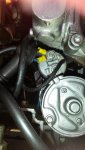
One of the blue wires and the red connection to the alternator are missing.The alternator only starts to charge after initially revving the engine to about 1400RPM.Maybe the missing red wire is designed to "excite" the alternator which instead has to be done by the initial revving?Picture attached.Main suspect now is heavy cable from alternator to battery?Thanks again20190621_123454.jpg
 
My previous posting should have said heavy cable from starter motor to battery and not alternator as I previously posted.Have previously
cleaned ignition switch terminals.Will be checking engine earth connections on next visit.Thanks again.
 
Try jumping the glow plug rail from the battery with a seperate lead to see if the plugs are actually heating. It might explain the excessive cranking.
 
A update guys.Battery voltage only drops from 12.7 to 12.4 when glow plugs are in operation.The engine needs a lot of cranking before firing when cold?
One of the blue wires and the red connection to the alternator are missing.The alternator only starts to charge after initially revving the engine to about 1400RPM.Maybe the missing red wire is designed to "excite" the alternator which instead has to be done by the initial revving?Picture attached.Main suspect now is heavy cable from alternator to battery?Thanks againView attachment 78597

If the battery only drops to 12.4v when glow plugs are operating it sounds as though there not working mine drops to around 10+ volts.
 
A update guys.Battery voltage only drops from 12.7 to 12.4 when glow plugs are in operation.The engine needs a lot of cranking before firing when cold?
One of the blue wires and the red connection to the alternator are missing.The alternator only starts to charge after initially revving the engine to about 1400RPM.Maybe the missing red wire is designed to "excite" the alternator which instead has to be done by the initial revving?Picture attached.Main suspect now is heavy cable from alternator to battery?Thanks again

My previous posting should have said heavy cable from starter motor to battery and not alternator as I previously posted.Have previously
cleaned ignition switch terminals.Will be checking engine earth connections on next visit.Thanks again.

If there is anything wrong with the heavy cable between the battery + and the starter motor solenoid ( eg dirty connections or bad crimps) your cranking speed will be affected. The same applies to a bad engine negative connection but if your cranking speed is low check both of these.

The wiring diagram shows two blue wires connected to the same starter solenoid terminal as the above. One is the positive supply to the key switch. If this was missing nothing would work. The other is the main power supply to the glow plug relay. If this is missing the glow plugs will not work.

In view of the difficulty starting I would check that there is a power supply reaching the glow plugs during the preheating period and also, in view of the relatively small drop in volts, check each of the glow-plugs. Disconnect the wiring from them and measure their individual resistances . They will be probably be about 1 or 2 ohms, maybe less when cold, if they are OK.

There should be a wire on the D+ terminal of the alternator ( maybe green) which comes, via a diode, from the "no-charge" warning light if this is disconnected or if the diode is blown there will be no initial excitation of the alternator and might be the reason for you seeing no charge until the engine is revved. (once it has started the alternator will be self exciting)
 
Thanks again guys.Forgot to mention that the engine starts without almost no cranking when warm.Checked the negative connections (earth) at both ends and found nothing wrong.Will probably buy new heavy cables as soon as I can find somebody near Manchester to make them for me.A great help your advice on the glowplugs also.I will check the resistance.Will be a bit disappointed if they have failed after only approx six years and only 420Hrs use.The glow plug warning light behaves as I would expect. i.e. goes out after fifteen seconds when cold and about five when warm.Will report back and thanks for the information.
 
I had a similar problem earlier this year. Suspected the starter motor and had it tested, but it was found to be OK. Then a friendly marine mechanic in the boatyard explained that my problem probably lay in the resistance of the start switch and it’s associated wiring having increased over the years due to corrosion. He recommended that I disconnect the wire from the start switch to the starter solenoid and install a 40Amp relay close to the starter solenoid, with reasonably thick wiring from both the starter motor positive post and to the solenoid. The wire from the start switch should then be connected to the actuating terminal of the relay. This meant that the start switch would be carrying a comparatively light current. After a trip to a motor factors for a 12V relay and an hour spent with bits of wire and crimps I was ready to put the mechanic’s recommendation to the test. “Dramatic improvement” would be an understatement. The engine spun over as though on steroids.
 
Top