Give a man enough rope

zoidberg

Well-Known Member
Joined
12 Nov 2016
Messages
6,949
Visit site
I've acquired some of this stuff....

51255998340_6ee03955a4_b.jpg


...which I now understand is polyester with a polyprop slippery sheath. It's rated at 681kg Min Break Load and is 'cheaper than chips', for the maker has miles of it.

It's about impossible to knot ( except when left to its own devices ) but it is easily eye-spliced. I've used some for effective lazy jacks. What other uses can you suggest?
 
Why can't you knot it Zoidberg? Does it just slip through itself like slippery dyneema?
I think it's used for pulling cables through ducting, how do they fasten the ends I wonder.
 
Waterski rope? Pull-the-paddleboard-behind-the-dinghy rope? Dinghy painter? (I bet it floats...)

Definitely danbuoy or heaving line to to MOB. Or the retrieval line on a recovery sling.

NB polyprop doesn't like UV, so lazyjacks might need monitoring. Just something I read; I don't know if you can expect months or years. But it's not as though total failure would be a total tragedy.
 
I used to have a reel of the same stuff but 10mm, we used it for anchor ropes for small fishing boats, it was also used to replace wire on the trailer winches, we could knot it to chain and shackles, but it was very slippy! i got told it was used by BT and the like for pulling cables through underground tubes, don't know how true this was, it was handy stuff.
 
I was given a reel of this years ago for use roping the track perimeter of Grass Track Circuits.

It is meant for pulling cables along pipes and ducts, hence the slippery coated outer sheath.

Very high strength.

I used HD crimps to make eyes in the end, but never needed anything very strong as it was good practice in the event of a crash for the posts to give way gradually, like a car crumple zone.

Good stuff, not to be left in the sun!
 
Why can't you knot it Zoidberg? Does it just slip through itself like slippery dyneema?
I think it's used for pulling cables through ducting, how do they fasten the ends I wonder.


One could suggest I'm a 'fumblefingers'. Another might suggest I can't retain in my hippocampus the complex procedure for a Bowline. Another again might simply observe 'He's a bit Pat 'n Mick'..... or all three.

But the truth is that it is even more slippery - by design and construction - than braided Dyneema.

A 'double-figure-of-eight' is practicable, if the loose end is tucked through the standing part a couple of times, but a tidy eye-splice using a Needle Splicer is just as quick - and stronger.

As for fastening t'ings onto the ends, I'm confident there will be special ( = expensive ) devices specifically for fibre optic cable, and I suspect there are 'Conical Terminations' similar to those by StaLok, but I haven't found those yet.

As mentioned, it's 'cheaper than chips' so I'd consider it a 'consumable' and not weep in my beer if it weakened and needed replacing now and then.

I wouldn't recommend using it for MOB throw ropes. It 'kinkles' vigorously at every chance.....
 
Last edited:
I have made loops in early dyneema with sleeve by using a zig-zag stitch on the sewing machine.
Slow progress (lots of stitches per mm) and width from half the rope to half the rope.

Very slender loops but no idea of strength.
 
With a polyprop cover it probably is no good for UV. Perhaps they used it for pulling wire through cable duct (slippery cover, non-stretch core)? There are cheap US variants, similar strength. I have a spool of those, limited uses. Mostly they use a specific type of polyester webbing in the US. It is the most strength/$ you can buy!

I would leave a sample in the sun for the summer before I started using it. You might get a nasty surprise.
 
Reminded me of rope given me a long time ago. The organisation I worked for had an aircraft set up for ocean search and rescue. Not a big plane about 8 seater presurised turbo prop. (G1000) Anyway they had 2 torpedo shaped pods mounted one on each side of the outside fuselage. One had a life raft the other had stores of water radio etc.
Between the two under the fuselage was 6mm polypropelene rope. Actually about 200 metres on a roll. The plan was to fly up wind of the victim and at right angles to the wind. First drop one pod then shortly after the other pod. So that hopefully the rope would stretch out and float down wind past the victim who could haul in both pods.
So the reason I got the rope was that after a training run the rope and pods were gathered by a boat and hauled aboard. (in a mess) It was not practical to roll the rope up again into the tight factory made roll. So throw the rope away. Having got the rope of course it was pretty much rubbish. But note it did float. Good ropes sink so rubbish for MOB heaving rope. ol'will just waffling again.
 
I thought all MOB heaving lines floated? They do in the US. You may want to rethink that. In fact, that is one of the few sailor uses for floating line.
yes quite so that was a generalisation. Good polyester rope you might find for sheets etc does sink. So no good for heaving line. Seems to me polypropelene or nylon does float. ol'will
 
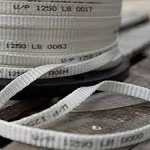
This is the most popular pulling line here. Polyester webbing, rather loose weave so not very abrasion resistant side-to-side. Available from 750-2500 pounds. Running length is marked. so you can tell how much you have pulled. About $0.06/foot for 1250-pound test. Clever ideas for on-boat use? I've put it on a Cuban yoyo and used it for kayak anchor rode.

1624064661809.jpeg
 
'EllsTeeth! Anchoring a kayak! Whateffer will those colonials come up with next?

I s'pose this'll spark off a long thread on the best anchor for kayaks....

:ROFLMAO:
 
Top