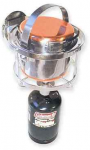
Gimballed cooking

gimballedstove

New Member
Joined
25 Oct 2020
Messages
3
Visit site
Good evening boaters,

I'm currently in the infant stages of a university mechanics project based on gimballed cooking equipment. Specifically I'm trying to decide whether to focus on stabilised equipment for standard hobs, or a gimballed kettle for making a brew on deck. I've got some limited sailing experience, but it would be great to hear from some more experienced cruisers. Any suggestions are greatly appreciated! I've also created an anonymous form here ----> Cooking at sea if you have a spare 90 seconds.

Thanks!
 
Good luck with your research.

Sometimes it’s a good idea to ask a few preliminary questions and get some answers before designing your survey so that it can have some more meaning.

In this case you are dealing with 99% of boats having a gimballed gas 2 burner hob with an oven underneath. Individual items like saucepans and kettles would add complexity. Portable gas appliances are not allowed inside boats because of the hazards of leaking gas and CO poisoning, and portable gas appliances on deck would simply blow out in the wind (unless you have a clever new design.

The real changes happening right now are people are moving more and more towards electric solutions as battery and solar technology gets better, and its cracking those problems that are interesting right now.
 
Sometimes it’s a good idea to ask a few preliminary questions and get some answers before designing your survey so that it can have some more meaning.

The existence of vessels other than fishing boats, yachts, and oddly specific Dutch barges, for instance ?

Pete
 
In this case you are dealing with 99% of boats having a gimballed gas 2 burner hob with an oven underneath. Individual items like saucepans and kettles would add complexity. Portable gas appliances are not allowed inside boats because of the hazards of leaking gas and CO poisoning, and portable gas appliances on deck would simply blow out in the wind (unless you have a clever new design.

The real changes happening right now are people are moving more and more towards electric solutions as battery and solar technology gets better, and its cracking those problems that are interesting right now.

Thanks! I've spent the most time on inland waterways and my only sailing experience is on a couple of liveaboard dutch barges (hence the slightly odd selection of vessels on the survey, although I've updated it now ?) so although I knew about gimballed stove setup's, I hadn't quite anticipated how common they are. It definitely looks like electric, especially renewable, is the way to go, with emerging battery tech as a focus. I'm really just trying to get a feel for what people are actually using, as an academic project gimballed cooking is a great fit, but I'd like it to be at least somewhat relevant to real users by the end.
 
Many boats have portable gas appliances but usually not gimbled, although some race boats have single gas cannister and ring gimballed. These are just the single burner portable camping types. Then there are many boats using portable gas burners not gimballed, but generally that is in flatter waters (Swedish archipelago) where you generally don't cook or heat water much whilst on the move. The biggest problem is when the gimballed stove hits it's end stops, a soft stop would be better, but also pan lids that are secure and good pot/kettle securing systems. I've done a few downwind passages where the boat can roll 30/40deg non stop and upwind in the channel with the gimballed stove on it's end stops quite often. Usually restricted by the gas pipe.
ATTACH]
 

Attachments

  • 1603694039248.png
    1603694039248.png
    121.5 KB · Views: 9
Not all boat stoves are gimballed. On the US and Canadian West Coast diesel heated ranges are very common, such as the Dickenson stoves. I had one on my last (sailing) boat. They are designed to run for months at a time. Hal Roth, a well-known circumnavigator this side of the globe, highly recommended them for long-distance cruising boats - none were ever gimballed. Pots and kettles are kept in place via clamps.
On our present boat we installed a new 3 hob range with oven. I purposefully did not install the gimbals and I use clamps instead. We rarely heel more than 20 degr. and for the times I cook on passage, deep pans are perfectly adequate, same goes for the kettle. Our level of cooking tends to be culinarily ambitious.
While some traditional boats can happily heel up to 50 degr., most modern ones do not. In my experience, gimballed stoves are rather rare on Dutch boats, for example, as are ones with ovens.
 
Last edited:
As said gimbled stoves are very common, with the above exceptions depending on the waters one sails in.

What would be great is a way of pouring hot water into a mug for a cup of tea/coffee in a F6 plus without covering the rest of the galley!

(Thoughts on damping the end stops is a good one as well, as is damping the swing itself; there is some good engineering there with mass damped system analysis and harmonics and all that.)
 
As said gimbled stoves are very common, with the above exceptions depending on the waters one sails in.

What would be great is a way of pouring hot water into a mug for a cup of tea/coffee in a F6 plus without covering the rest of the galley!

(Thoughts on damping the end stops is a good one as well, as is damping the swing itself; there is some good engineering there with mass damped system analysis and harmonics and all that.)
That’s a really good thought - it’s filling 2 or 4 mugs of hot coffee on a flat surface without them sliding (or if you use non-slip matting) falling over if you more than half fill them. It’s not so bad once filled as you can put lids on but that still takes two hands. Boiling a kettle on the gimballed stove is the easy bit.
 
It definitely looks like electric, especially renewable, is the way to go, with emerging battery tech as a focus. I'm really just trying to get a feel for what people are actually using,

I agree: I have just decided to take the bold (rash?) decision to specify all electric cooking on a new sailboat. Nearly all of my previous boats had gimballed gas hobs + ovens, but my own experience was that we hardly ever used the gimbals. Decent fiddles and saucepans not filled to the top have proved sufficient for my kind of sailing. Most modern yacht designs sail considerably flatter (i.e. more upright) than designs of a generation or two ago. Hence gimbals are arguably less of a necessity.

Getting rid of gimbals and using electricity has the added advantage of opening up the choice of domestic appliances, rather than being forced to buy expensive marine cookers - as well as dispensing with potentially hazardous fuel, plumbing and storage issues!
 
Last edited:
You may want to check out this project on the YouTube channel 'Sail Life':

(there are other episodes as the build progresses)

This provides a worked example (if a bit 'involved') of what RupertW and Arcady are referring to. The challenge here, from an industrial design perspective at least, being that 'off the shelf' options are apparently in short supply to convert electrical appliances to a gimbaled setup onboard.

That is assuming gimbals are required, of course, but for 'proper' cooking during offshore passages you probably do need a way of keeping everything inside the pan/tray, even with electric!
 
Why are you filling mugs on a flat surface underway instead of putting them in the sink like a normal person? ? ?

Pete
Because the sink always seems to be full - but good point. Maybe the proper question should be how I can have my post meal coffee before doing the washing up.
 
That’s a really good thought - it’s filling 2 or 4 mugs of hot coffee on a flat surface without them sliding (or if you use non-slip matting) falling over if you more than half fill them. It’s not so bad once filled as you can put lids on but that still takes two hands. Boiling a kettle on the gimballed stove is the easy bit.

Get yourself a tray that will sit above the other burner on your gimballed stove.
 
Oyster used to fit a unit about 10" wide to the side of the stove, bottom shelf for stuff, top was a tray a few inches deep that was for mugs etc. the whole thing gimballed with the stove. I suppose it would be seen as a waste of good cupboard space to those who don't value gimbals.
 
I can’t see us moving to electric on our 34 foot yacht in the near future. Neither can I see a burner in the cockpit being practical. On passage, we tend to use the hob mainly to heat the kettle; meals are usually cooked at anchor or on a mooring. We never use the hob when the boat is rolling or healed too much. I do see merit in dampening the effect of the gimbals as even relatively gentle rolling, particularly if it is uneven, can be dangerous.
 
Good evening boaters,

I'm currently in the infant stages of a university mechanics project based on gimballed cooking equipment. Specifically I'm trying to decide whether to focus on stabilised equipment for standard hobs, or a gimballed kettle for making a brew on deck. I've got some limited sailing experience, but it would be great to hear from some more experienced cruisers. Any suggestions are greatly appreciated! I've also created an anonymous form here ----> Cooking at sea if you have a spare 90 seconds.

Thanks!

So when you have finished the project, will you come back and give us a synopsis of your findings and ideas?
 
Top