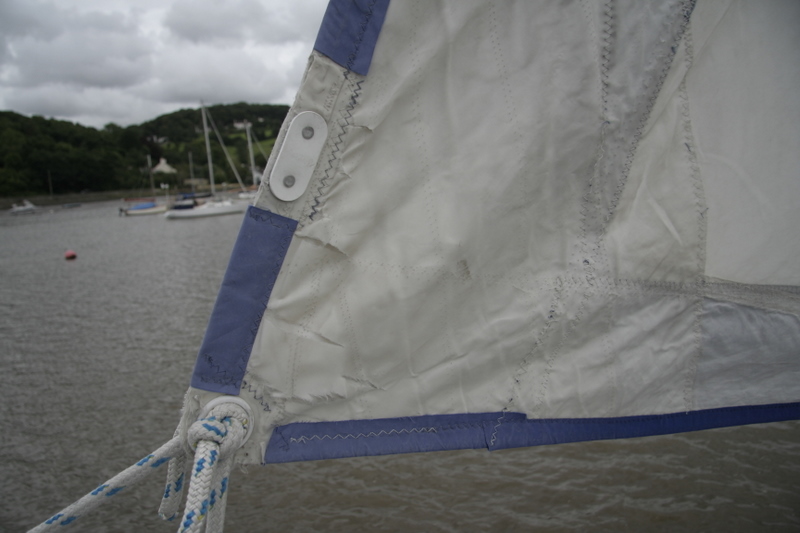
Genoa tears near clew.

CaptainBob

Well-Known Member
Joined
7 Nov 2007
Messages
1,477
Location
North Yorkshire
www.yacht-forum.co.uk
My genoa is showing some tears in the top layer of cloth at the clew. It's odd because on closer inspection, all of the sewing which was previously on this bit of the sail has been removed - maybe some repair work done in the past or something.

What's the best way to stop this progressing any further:
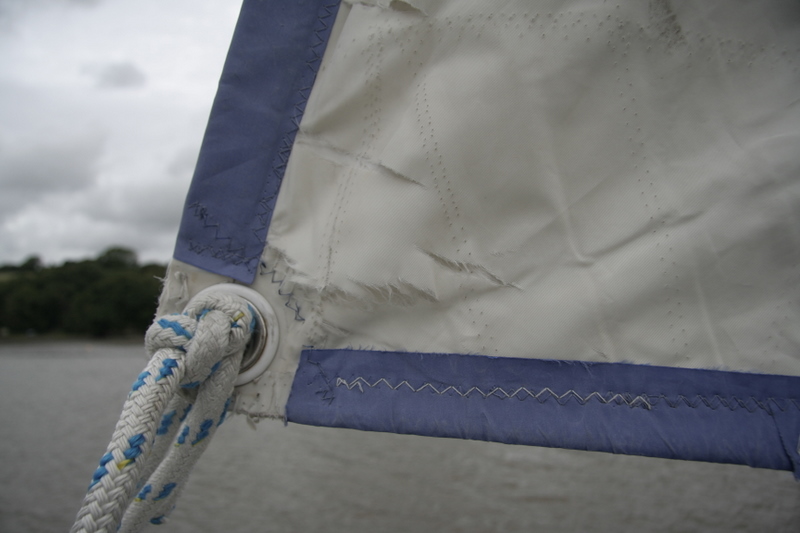
genoaclew.jpg
 
I strongly suspect that is UV damage over several years. I saw your other post re the long tear in your mainsail, and again, that sounds like UV damage to the threads/cloth.

I can't rememebr how old your sails are, but it does suggest breaking open the wallet for some new/secondhand ones perhaps?

I don't think I'd want to go too far with them in that condition.
 
I should have taken a wider angled shot I think. What you can't see is that the rips are in a small triangle of cloth which is just in the clew, laid over what I think is _good_ sail underneath. The rest of the sail seems fine.

My mainsail, yes all of the stitching between large areas of cloth is rotten, but the material itself seems absolutely fine. I'm going to re-stitch the lot as soon as I can get my hands on a decent sewing machine.
 
If you are sayiing that these small tears are in the corner reinforcing patch rather than the sail itself then it should be replaced. It is rotten, or at least degraded by UV, and cannot therefore be reinforcing the corner. Normally there are several patches one over the other of gradually increasing size.

With the pressed in cringle I would say it is a job for a sailmaker.

Maybe coble something together until it is time to have the blue strip replaced but you dont want to risk tearing the main sail panel.
 
I had the same kind of pattern of tears in my roller reefing mainsail (14 years old). The sailmaker confirmed rotten by uv damage. As a repair he glued new sailcloth over the whole length of the sail and stitchted it. I sailed with it for a year and it probably would have lasted for another 3 or 4 years if not more. Nevertheless i bought a new mainsail because there is no fun in being stranded with your family while on holiday because of a rotten sail.

When i hadn't planned any longer sailingtrips for a few years i would still have used my old sail.
 
I had similar problem with my masthead reefing genoa and had the local sailmaker reduce the foot by 18" to the peak reducing the sail area, then forming a new reinforced clew and fitting a new stainless cringle. This reshaped the sail so it became "blade "- like with a near vertical leach, such that the reduced area performs better in the stronger breezes and I like to think helps the boat point higher ; and reefing is still available. However I still need to get a newer 110% soon.
cheers

ianat182
 
That was probably caused by leaving a little triangle when furling the genoa instead of rolling until the sheets wrap round twice. Many people do this when they could simply add a few more turns of furling line.

However:

If it were mine, I would unpick the sewing of the UV strip for a couple of feet along the leach and the foot. I would then remove the torn patch and replace it with two new ones, the inner being in self-adhesive fabric. If the tears are on the sail itself (i.e. not on a patch) I would just add the two patches as above.

I would also do away with the swaged cringle and, instead, instal an external ring (ideally a 'D-ring'. This would be on three strips of webbing to spread the load.

The UV strip would then be resewn.

This is assuming that the rest of the sail is still in a reasonable condition.

Having said all that, if you cannot do the work yourself you would need to see if it is worthwhile after discussing it with a friendly sailmaker. If you do have access to an industrial sewing machine, it is pretty straightforward.
 
My genoa has suffered tears in similar location caused I think by being caught on obstacles as the clew is dragged around the mast when tacked. Yes it is quite likely UV deteriation of the outer layer of what will be 4 or 6 layers of cloth in the reinforced area.

You could ignore the problem. or glue and sew on a triangular patch over the area. You will have to hand sew this area unless you have a good sewing machine because of the number of layers of cloth. As already said the eyelet is difficult to remove and replace unless you have a new eyelet and correct mandel to set it. So cut the patch short of the eyelet.

Or as I said ignore it. Start planning for a new sail. good luck olewill
 
Could it be that at some time in the sails life it has been furled the wrong way round?
In other words rolled up on the furler anticlockwise.
This woud explain the UV damage.

Iain
 
I would listen to PuffTMD. Seen it lots in the Med and even more often with inmast mains, where the webbing flies off the clew in a gust. I ALWAYS roll the genny until there isn't any more spare sheet in the wheelhouse, and if I had inmast main, it would have a nice little "thong" made to cover it's vulnerable bits. Check the 'firmness' of the sailcloth nearer the luff, and if it's crisper, get the clew repaired, otherwise you may have to chew the amunition.
 
Thanks for all the replies.

Am I right in thinking that if I just ignore it and replace it when it gives out on me, the worst that could happen is a catastrophic failure of the sail - which I could just furl up and limp home under engine and main only?

Or is it actually dangerous in some way?

Or is it
 
That's a tough one to answer, my friend, especially without the benefit of a first-hand examination!

Are the rents restricted to the clew area or are there similar weak spots in other areas of the sail?

Are the tears / rents on a patch, on the sail proper, or on the old, white, UV strip?

The present blue UV strip was an addition to the sail; it is not original. The swaged cringle is pulling only on the 'old' part of the sail: the UV strip is not helping to spread the load. You can work around this problem by adding two strips of webbing, passing them through the existing cringle and sewing one along the foot and one along the leach. They only need to extend some 8-10 inches along both faces of the sail.

This is the least expensive solution and is something that you can do yourself, even by hand. It just requires a sharp needle, strong polyester thread and patience. A sailmaker's palm (or even a dressmaker's thimble, at a pinch) and a pair of pliers to pull the needle through would help.

Unless the rest of the sail or the stitching is rotten, this solution would go a ong way towards preventing catastrophic failure.
 
If you go to sea knowing something is likely to fail, you lose brownie points, as that attitude may eventually spread to other parts of the boat. You can rest assured that when it fails it will be spectacular and not when you're quietly pottering along with a scrumpy in your hand. The sheets may end up in the prop, so can you do it under main alone? is the main strong enough or has it deteriorated as well. Think about it.
 
Tell him, Bill, not me! /forums/images/graemlins/grin.gif

I go very carefully over the all the stitching each season, right after I wash the sails, and restitch any section that looks dodgy. Miss a small section and before you know it you have a zipper in your sail the second time that you get a good gust. /forums/images/graemlins/wink.gif
 
Top