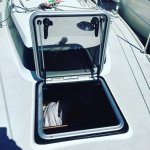
Genoa Sheets and For'd Hatch Hinges

johnsilver2

Active Member
Joined
25 Aug 2009
Messages
45
Location
Me Cheshire, boat Holyhead SC
Visit site
I have replaced the fore hatch on my Contessa 32 with the hinges for'd as per best practice from a safety perspective. The problem I have is the the Genoa sheet catch under the hinges.
I think the answer is to fit some form of a device to block the gap and allow the sheet to pass over.
Has anyone else had and solved this problem? Is there a proprietary solution or am I going to have to design and make my own?

Regards. Andrew
 
I have replaced the fore hatch on my Contessa 32 with the hinges for'd as per best practice from a safety perspective. The problem I have is the the Genoa sheet catch under the hinges.
I think the answer is to fit some form of a device to block the gap and allow the sheet to pass over.
Has anyone else had and solved this problem? Is there a proprietary solution or am I going to have to design and make my own?

Regards. Andrew

Think you will find many people do not agree with you that hinges forward is necessarily better. There is no requirement to have them this way as a quick walk round a marina will show. The thinking probably dates from the time when boats had hanked on sails which were stored in the forepeak which meant the hatch needed to be open, often in bad weather and on boats that tended to take water over the bows. if you sail in this way then there is some argument for having the opening at the rear to reduce the amount of water coming in. However if you have a furling headsail there is little justification for it. Just make sure the hatch is clamped down when sailing.
 
Yes I agree with the last post and this may well be my best option. Fortunately I used non setting sealant so removal and turning it around should be straightforward
It should be noted though that a coded vessel will have the hinges forward still. It is also better on a mooring or at anchor with for'd hinges especially if it starts raining at night!

Regards..........Andrew
 
It should be noted though that a coded vessel will have the hinges forward still. It is also better on a mooring or at anchor with for'd hinges especially if it starts raining at night!

Regards..........Andrew

Are you sure about that? I would have thought that in anything other than rain it is better to have the hinges aft.

I don't know anything about coding but all the boats we have ever chartered have had the hinges aft.

Richard
 
luke.jpg

If you have trouble with your hatch catching sheets, and turning it around solves that problem, just fix it. One benefit I get from installing my new hatch this way is much better ventilation when I need it, either if at anchor or underway.
 
Coding sometimes allow hinges aft as long as the hatch is marked "KEEP SHUT AT SEA". It's not always a trivial job to turn round hatches on new production boats.

I prefer hinges aft as it's usually better for ventilation ......
 
. . . I prefer hinges aft as it's usually better for ventilation ......

Indeed. Hinges forwards is a very British thing. There must have been an old duffer in some RORC / MCA meeting a long time ago who remembers someone regaling the clubhouse bar with a story he'd heard about a sailor who once had an old wooden fore-hatch ripped off it's hinges and this profound 'safety' necessity was born. It's not just ventilation that's better with hinges aft, but there's usually something for the hatch to 'lean against' when it opens that way.
 
Think you will find many people do not agree with you that hinges forward is necessarily better. There is no requirement to have them this way as a quick walk round a marina will show. The thinking probably dates from the time when boats had hanked on sails which were stored in the forepeak which meant the hatch needed to be open, often in bad weather and on boats that tended to take water over the bows. if you sail in this way then there is some argument for having the opening at the rear to reduce the amount of water coming in. However if you have a furling headsail there is little justification for it. Just make sure the hatch is clamped down when sailing.

I know it's an outside chance (hopefully), but personally I like to keep my forehatch "openable" at all times - for the simple reason I may need to get into the cabin and can't through the main hatch.
Two examples (extreme, I accept- but....):-
Fire at/in the galley by the main hatch.
A collapse and incapacitation of a crew member in the main hatch.
 
I only meant use the normal catches - although I know some boats are fitted with cross bars, but these are only useful to try and stop forced entry.
 
Top