Gelcoat polishing and repairs

Oaks81

Member
Joined
28 Apr 2020
Messages
27
Visit site
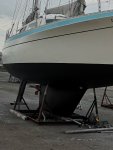
My boat has sustained some small damages and the top side has lost its shine. I'm planning to work on it in the coming weekends and I need your advice how to proceed.

I will use epoxy filler for small dents under the waterline and gelcoat putty for ones above the waterline. The rubber rub rail has some scratches and I'm not sure if it's possible to do anything about it other than replacing the whole thing.

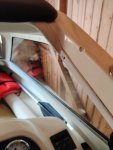
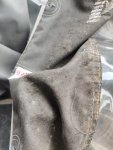
The boat cover has spots of mold and I'm planning to use sodium hypochlorite on it. I did a small patch test to verify that it won't bleach the color.

The boat is only 5 years old so I suppose there shouldn't be heavy oxidation yet. I think the gelcoat lost some of its shine due to excessive use of magic erasers. I learned my lesson and now its only oxalic acid and non-abrasive sponges and cloths. I have washed the boat with oxalic acid every fall, stored it in an unheated warehouse and waxed it before taking it into use.

Does it look like it needs sanding or should I just use cutting compounds and a buffer machine?

Oxalic acid did not entirely remove waterline stains. Is there anything else I can do about it? Is it important to get the stains off before sanding and buffing?
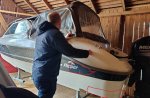
boat.jpg
 
If it is scored into the gelcoat it will need a gelcoat fill or you risk the chance of burning through the surrounding gelcoat to buff it out . just very minor depth scratches can be buffed out , It is hard to tell on your photos ,
Cutting compound and a good orbital polisher will bring it up a treat on your hull , you can choose a heavy cutting compound and then a finer compound after to bring the shine back then wax to protect use the different pad heads for the polishers , 3M are the best IMHO , I think I went white , on rougher compound and the yellow head on finer compound . (please check I m right )
Make sure your wax is removed before polishing , get the boat a good clean and remove residue, the heavy compound polishing will take the marks of the hull no problems
Many products out there and people will have their own favourites
I used Presta products
3M pads
Pure Carnuba wax
A variable speed polisher
Good micro fiber cloths to polish the wax
This is my 42 year old hull I brought back , I did go down the wet and dry before Buffing but no need for a 5 year old hull IMHO .
an.jpg
 
Thank you! So much good information.

Would it be safer to apply a small amount of the gelcoat putty in the scratches before buffing? I have only white gelcoat but I think the same product line might have a matching shade of blue.
 
I suppose it won't be a problem if I experiment filling the scratches with gelcoat. As long as the color matches.

I can always sand it to make it even.
 
Thank you! So much good information.

Would it be safer to apply a small amount of the gelcoat putty in the scratches before buffing? I have only white gelcoat but I think the same product line might have a matching shade of blue.
You will need to fill with gel coat filler and then get wet and dry and sand down , make sure it is very wet, start with 600 go up to around 1200 going through the stages of 600 , 800 , 1000 , this will then allow you to polish and should be as smooth as a babys bum
Try and get the filler as smooth as possible as well , will allow easier sanding
As for mold I have no experiences on this plenty of threads if you put it in the search facility some good sage advice
Some cracks and chips can be straight filled with the gelcoat but deeper dings I would fill with a filler , but you need to leave enough space for the gelcoat to sit in and be even with the rest of the boat gelccoat or you will rub back to the filler
 
I guess I won't need fiberglass mat as the dents are at most the size of a fingertip and the fibers below seem to be intact. Epoxy filler should be sufficient.

Great videos anyhow. This is very useful information. Thank you!
 
I Used this 1kg Pack White Topcoat to fill 3 long gouges on my hull. they varied from 150mm to 300mm about 2mm wide and about 1.5 mm deep, applied into the groove with a fine paint brush until very slightly proud of the surface. Your biggest problem will be to get the colour match, white seems to have more shades than any other colour. As said, wet and dry down to 1500 grit, coarse compound working up to a finishing glaze with a rotary polisher will give an almost invisible finish. Unfortunately the holes in the bow look a little to deep for topcoat.

Just looked at the videos above and video no. 3 is what I did,. If it is going on to a white hull, you can with patience try to tone it to the colour of your gel coat. Add the pigments very sparingly a drip at a time from a cocktail stick, then you can dab a bit onto the hull to check the match and wipe off if your not happy with it and add a bit more pigment. Then when happy add the hardener.
 
Last edited:
A small update.

I couldn't find gelcoat filler with the right shade, so I bought one jar of white and one of blue. I also found black pigment powder which is supposed to be good for coloring all kinds of resins. I won't mix any pigments into the underwater epoxy repairs.

I filled and sanded holes above the waterline. Unfortunately one of them has some discoloration at the edge of the repair and some small holes. I am assuming there was some trapped air which caused the voids. I will do more sanding and reapply some filler to these areas.
 
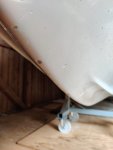
To my horror, I also discovered what looks like osmosis near the waterline. There are few pimples in a 30-40 cm wide area. As I mentioned in my first message, my boat is only few years old. It is from a very reputable manufacturer (as far as I know, Bella boats is the leading manufacturer in Nordic countries).

It might still be under warranty. I am just concerned that they will only fill the pimples and in a few years the boat will look like it has bad acne. I am sure that any repair they would do at this point is not going to cover my losses if I decide to sell boat.
 

Attachments

  • osmosis.png
    osmosis.png
    97.7 KB · Views: 32
With regard to gelcoat repair. Get the colour right. If the colour is wrong then no matter how good a repair you do, the shade difference will always hit you in the face as you walk to your boat. Try and get the manufacturers code and order that shade or mix your own by eye if you're good at that. You're still open to the weathering effects but you're at least somewhere near, not far away on a 5yr old boat I would guess.
 
I am now certain that the boat has osmotic damage. I found almost two dozen pimples on the bottom on the whole length of the hull.
 
I also ended up buying two random orbital polishers by accident. The store clerk did not know what a rotary machine is. I didn't have time to go back to the store so I had to finish the compounding with these tools.

I started with a hard foam pad and a high cut cream. Then I used a lamb's wool pad with a fine cut cream. Here is a pic after the high cut compounding.

IMG-20200524-WA0011.jpg
 
Actually, I'm starting to suspect that the machine I used is rotary after all (Biltema PM 150). The instruction booklet states that it is an eccentric polisher and the mechanism should avoid holograms. However, it has a backing plate which rotates in a circular fashion and it does not stop spinning when I apply pressure.

I did most of the work with the lowest speed, 600 rpm and only few trouble spots required 1000+ rpm
 
Top