Gel coat care + painting fibreglass

PeterGR

Active Member
Joined
29 May 2020
Messages
51
Visit site
Jaypers, soo many different methods and products for restoring/ painting gelcoat and fibreglass.
If someone could help and point me to a good source for clear yes/ no/ tried and tested instructions that would be amazing!

1. Restore faded coloured gelcoat on hull.
- wipe down clean
- perhaps 1000 grit wet/dry
- wipe down clean
- rub in a cutting compound
- wipe down clean
- rub in a polish or wax?
- wipe down clean
Can I do this all by hand? Seen plenty using a variable angle-grinder with polishing head. Could I use a suitable head on a drill instead?

2. Restore white gelcoat on hull (diff boat to above).
- same method as above?
Although I was heavily considering painting.
I understand gelcoating is expensive and a skilled application so maybe a DIY two-part epoxy roller + tipping?
Only if cutting and polishing method is a non-runner.

3. Re-do deck paint.
- sand, sand, sand, sand
- primer
- paint
Decks are knackered with a very poor previous paint job. Will sand as much as possible and do a few coats of toplac? And interdeck?
How many coats is the recommended?

4. Maintaining clean decks.
White is such a ridiculous colour to keep clean!
One of the boats deck areas etc are all white but get grubby quickly.
Something about just rubbing in a wax to help create a barrier?
It's lost its 'shine' so I assume that means it just collects dirt.

5. Teak Vs varnish.
Which is the main man to give the best finish to the wooden rails on the coach roof etc?

Spent all last week eating my ham leftover sambos and watching some great videos/ restoration series on YouTube - but everyone has a different way.
Ready to get stuck in to getting some of our club boats sorted.
Lots of elbow grease here ready to go, would prefer not to pay someone in just to do the work. In it to learn every day.
TIA
 
Just the sort of conundrum I'm faced with - so many methods & possibilities for making a mess. I'm sure that many of them are effective but wouldn't it be nice to find some certainty.
Looking forward to benefiting from the collective wisdom, thanks for presenting the issue so well.
T
 
The topsides are doable by hand, though tedious, on a small boat. A bigger one will soon have you looking at the Toolstation website (don't bother, Screwfix has a better selection) . A low speed polisher is what you'll need. A fast one risks burning the compound into the surface. Try not to take too much off the gelcoat, if you go through, you'll be painting it. If it's so bad that polishing isn't enough, it may need painting anyway. I did mine about 12 years ago. From a couple of metres away I can see that it's getting to be time to do it again, but from much further, even to my critical eye it still looks OK

A poor paintjob on the decks will have to come off pretty much completely, which is a royal pain if there's any nonslip texture. This, and it's cup-shaped brother helped, but didn't take away all the pain

I used a single pack white for the bits I don't walk on and a beige deck paint from here where I do. It works, but others swear by Sandtex or similar.
 
PeterGR you may find this PowerPoint presentation I gave on Gel Coat Renovation worth reading.
https://wiki.westerly-owners.co.uk/images/8/86/Gel_coat_renovation_19May2020.pdf

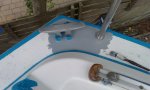
For your painted decks, you need to be make sure there are no areas of loose paint. Lightly sand the existing deck and feather in the edges to any patches without paint. Tape up all the edges and deck fittings over the deck with a high quality masking tape. Now apply a priming coat and finish with one or possibly two coats of Interdeck. See the photos showing the deck starting the repaint with masking tape in place and the finished deck.

For any gel coat on deck that has been compounded to a shine, this can be protected with a high quality marine polish, but do not use on any area where you may step as it will become very slippery with any moisture.

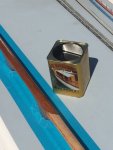
I have tried many different finishes on teak, including leaving it to weather. If you want a good quality finish, it takes time as a couple of coats of varnish will soon breakdown. Polyurethane varnishes have a hard surface but allows moisture to become trapped in the wood after any damage causing black staining in the teak and is difficult to patch. For my exterior varnish I use a traditional oil based varnish called Le Tonkinoise. Le Tonkinois. You will need to remove all previous finishes and then apply 8 coats of varnish for effective protection. It is a nice varnish to apply and flows well. I should mention it is a soft varnish, but can easily be patch repaired. To keep things looking good, you should apply a further couple of coats every other year. The 3rd photo shows the first coat of varnish being applied to my grab rails and the final photo shows the gra rails and toe rail varnished which add to the visual effect of the boat, compare it to the earlier photo where the teak has not been varnishedIMAG0990 1000pix.jpgIMAG1008 1000pix.jpgIMG_1547 990pix.jpgIMG_1872 cropped 2000pix.jpg.
 
PeterGR you may find this PowerPoint presentation I gave on Gel Coat Renovation worth reading.
https://wiki.westerly-owners.co.uk/images/8/86/Gel_coat_renovation_19May2020.pdf

For your painted decks, you need to be make sure there are no areas of loose paint. Lightly sand the existing deck and feather in the edges to any patches without paint. Tape up all the edges and deck fittings over the deck with a high quality masking tape. Now apply a priming coat and finish with one or possibly two coats of Interdeck. See the photos showing the deck starting the repaint with masking tape in place and the finished deck.

For any gel coat on deck that has been compounded to a shine, this can be protected with a high quality marine polish, but do not use on any area where you may step as it will become very slippery with any moisture.

I have tried many different finishes on teak, including leaving it to weather. If you want a good quality finish, it takes time as a couple of coats of varnish will soon breakdown. Polyurethane varnishes have a hard surface but allows moisture to become trapped in the wood after any damage causing black staining in the teak and is difficult to patch. For my exterior varnish I use a traditional oil based varnish called Le Tonkinoise. Le Tonkinois. You will need to remove all previous finishes and then apply 8 coats of varnish for effective protection. It is a nice varnish to apply and flows well. I should mention it is a soft varnish, but can easily be patch repaired. To keep things looking good, you should apply a further couple of coats every other year. The 3rd photo shows the first coat of varnish being applied to my grab rails and the final photo shows the gra rails and toe rail varnished which add to the visual effect of the boat, compare it to the earlier photo where the teak has not been varnishedView attachment 106028View attachment 106029View attachment 106037View attachment 106038.
That's brilliant.
Thanks v much for all that info.
Your boat looks great!
Hopefully I can get it looking this good!
 
5. Teak Vs varnish.
Which is the main man to give the best finish to the wooden rails on the coach roof etc?

If you don't want to spend hours every year painting your rails with goo, consider treating them twice a year with Boracol. It's quick and easy, no masking off needed. They'll just weather to a gentle silvery-grey and stay looking clean.
 
Top