
Gel/agm batteries

........I'd still tend to back a high quality flat plate wet such as Trojan or Rolls against any AGM for cycle life but that's based on general background experience.
I'm old fashioned and prejudiced and sailinglegend thinks I'm wrong!
No I don't - I just think Lifeline AGMs are better because they charge so much faster than flooded batteries - this means 30% less engine or genny run time - or 30% less solar needed for the same charging time.

I've tried for ages to find the Life Cycle statistics on the Trojan site but can't find them. Lifeline claim 1000 cycles at 50% DoD, 2500 at 25% DoD, also 550 @ 80% DoD, and 380 @ 100% DoD - not sure if I believe these last two claims.
 
A lot of good information here. I spent ages working out that I could discount gel and finally chose Trojan T105s over AGM. But that's just me, basing the choice on my lifestyle and equipment.

1) I don't mind monitoring battery electrolyte levels regularly
2) I spend around 7 months living on the boat each year
3) I only expect to be on mains power around 20% of the time (or less)
4) I have 80A alternator, Rutland 913, 65W solar (soon to be 130W) and Honda 20Eui

Going with AGM would have cost a lot more (not just battery cost). I'd need a big alternator to make use of the fast charge capability) and that would have involved all sort of other costs.

AGM came out ahead when modelling with the spreadsheet that's has been going around for ages. However, it was hopelessly out of date. When I updated it with current UK pricing data it clearly showed that T105s were cost effective.

Don't assume that all Trojan batteries are equal. I thought about some of their 12V marine deep cycle models and got tech. details from Trojan. It proved that the T105s were expected to give many more cycles than the 12V ones I'd looked at (& cost was similar).

I'm still pretty happy with my choice but admit that AGMs would allow me to re-charge much more rapidly initially. I have a spare 110A alternator and will probably fit that (assuming belt wear is OK) to give a small boost. However, the batteries are the limiting factor here. I have other tweaks in mind to help reduce re-charge times. To be honest, power reduction & extra solar are by far the cheapest option for me.

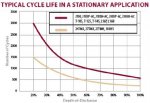
Just spotted request for Trojan DOD data and have attached a copy. Sorry about the quality, that's just what Trojan emailed. You can see that at 50% DOD T105s are expected to give 1200 cycles but the 12V models I'd looked at only give 600.
 

Attachments

  • TrojanDoD.jpg
    TrojanDoD.jpg
    23.3 KB · Views: 1
Last edited:
No I don't - I just think Lifeline AGMs are better because they charge so much faster than flooded batteries - this means 30% less engine or genny run time - or 30% less solar needed for the same charging time.

I've tried for ages to find the Life Cycle statistics on the Trojan site but can't find them. Lifeline claim 1000 cycles at 50% DoD, 2500 at 25% DoD, also 550 @ 80% DoD, and 380 @ 100% DoD - not sure if I believe these last two claims.

AGMs will charge faster up to a certain level if you have high current available - can't really see how that helps you with solar though.

No I haven't seen figures for Trojan. They also recommend restricting to 50% depth of discharge.

You know I think Lifeline's figures are ambitious :) I wouldn't expect any flat plate flooded battery to do better.
 
AGMs will charge faster up to a certain level if you have high current available - can't really see how that helps you with solar though............

It helps with ANY charging source because if you want to put in 100 Ah to a battery bank then with flooded batteries you would need to put in 125 Ah and with AGMs only 102 Ah - all because of their greater charge efficiency. Add to that their charge acceptance rates of about 1.5 X their capacity, i.e. 150 amps charging current into a 100 Ah Lifeline AGM battery @ 50% DoD, then you can see how having a high current source improves their efficiency even more.
 
It helps with ANY charging source because if you want to put in 100 Ah to a battery bank then with flooded batteries you would need to put in 125 Ah and with AGMs only 102 Ah - all because of their greater charge efficiency. Add to that their charge acceptance rates of about 1.5 X their capacity, i.e. 150 amps charging current into a 100 Ah Lifeline AGM battery @ 50% DoD, then you can see how having a high current source improves their efficiency even more.

I agree on the high charge rate acceptance but you won't have those currents available on solar.
I think that difference in charge efficiency is exaggerated though, there isn't that much in it.
 
Just spotted request for Trojan DOD data and have attached a copy. Sorry about the quality, that's just what Trojan emailed. You can see that at 50% DOD T105s are expected to give 1200 cycles but the 12V models I'd looked at only give 600.

Interesting graph. About 10% above Lifeline's claims isn't it for the T105. Quite ambitious.
That's a pretty hefty battery intended for industrial floor cleaners I think, no doubt the 12V ones are more lightly built.
 
I agree on the high charge rate acceptance but you won't have those currents available on solar.
I think that difference in charge efficiency is exaggerated though, there isn't that much in it.

I assumed the same thing when modelling my system. I pretty much discounted any battery inefficiencies with wind charging. Mine is lucky to provide part of the power used at any moment and therefore just slows down the discharge rather than actually charging. It can be pushing in 5-7A and but it is highly unusual for it to exceed consumption.

Solar is slightly different as power output occurs when consumption is low. However, even then my fridge averages about 1.5-2A draw and my solar peaks at around 4A. So he extra for charging is quite small (& difference between charging AGM or flooded is pretty small). I'll need to re-run calcs for the extra 65W of solar I'm going to fit as that should mostly go into the batteries.

I don't think battery type matters for my mains charger as it only has a max. output of 40A. Not talking about different charge voltages, just that it only puts out 40A and gets close to that with my flooded batteries. So I'd need to fit a larger charger to get any benefit from AGM. I use the Honda to run the charger at anchor.

That only leaves the alternator and this is certainly the area where I'd get greatest gain. However, usage pattern and installation cost don't merit this upgrade.

It's pretty complex with all parts of the system impacting others but Trojan T105s work for me. Can't say what I'd choose for other circumstances without doing more calculations (e.g. 250A alternator, 100A mains charger, 400W solar etc.).

So I gues that there's plenty of room for disagreement depending on usage and kit installed.
 
Interesting graph. About 10% above Lifeline's claims isn't it for the T105. Quite ambitious.
That's a pretty hefty battery intended for industrial floor cleaners I think, no doubt the 12V ones are more lightly built.

Yes, I was almost suckered into buying the Trojan marine deep cycle ones. However, the fact that they quoted CCA made me suspicious and so I asked for more techical data. In fact, there wasn't much difference in price between the Trojan "leisure" deep cycle batteries and the T105s. Why pay the same for something that certainly won't last as long? I guess that they make many more T105s and 12V models are specifically aimed at RVs, caravans, boats (so take a mark up in the price).

I guess most manufacturers don't publish technical data as widely as the flashy advertising blurb. Trojan tech. guys were great at sending anything I asked for specifically.
 
Last edited:
I agree on the high charge rate acceptance but you won't have those currents available on solar.
I think that difference in charge efficiency is exaggerated though, there isn't that much in it.
So we do have something to disagree about! A difference of about 25% in charge efficiency seems to me to be significant! You can observe this as AGMs don't get hot whereas flooded do. That's all to do with charge efficiency or internal resistance which means energy is wasted charging flooded and turned into heat.
 
So we do have something to disagree about! A difference of about 25% in charge efficiency seems to me to be significant! You can observe this as AGMs don't get hot whereas flooded do. That's all to do with charge efficiency or internal resistance which means energy is wasted charging flooded and turned into heat.

As rule of thumb figures I would use 110% input for AGM and 120% or a bit better for wet. Max 10% difference not 25%.
Up to 80-85% state of charge both are virtually 100%.
That's assuming you are calculating in Ah. I suppose if you calculate in Wh the AGM might show slightly more advantage but I'm not sure it would be significant. I'll think about that!
 
I can't argue about the technical side of things but we have 2 x 180 AH AGMs, designed for traction use (golf buggy sort of thing) as our domestic bank. They'll accept charge at whatever rate I can throw at them (90amp alternator, 150 watts solar, 40 amp smart charger) and have been sitting unloved and unregarded in the bottom of the boat since they were fitted 4 seasons ago. The main reason I go them was that were the largest capacity that would fit in the hole I had available; wet cells were a deal bigger and would also require frequent moving of stuff to get to them to keep them topped up. Bought them from the local battery dealer and I couldn't tell you the make but the price premium over wet cell was only about 10% - perhaps because there no mention of 'marine' or 'boat' on them?
 
I can't argue about the technical side of things but we have 2 x 180 AH AGMs, designed for traction use (golf buggy sort of thing) as our domestic bank. They'll accept charge at whatever rate I can throw at them (90amp alternator, 150 watts solar, 40 amp smart charger) and have been sitting unloved and unregarded in the bottom of the boat since they were fitted 4 seasons ago. The main reason I go them was that were the largest capacity that would fit in the hole I had available; wet cells were a deal bigger and would also require frequent moving of stuff to get to them to keep them topped up. Bought them from the local battery dealer and I couldn't tell you the make but the price premium over wet cell was only about 10% - perhaps because there no mention of 'marine' or 'boat' on them?

A bit late for me as I've already bought batteries. However, it might be of interest to others as it sounds as if these are reasonably priced (or price for flooded ones was over the top).

Do you have the manufacturer & model number to see if they are readily available & current price?

More detail on charging would be useful as well. Solar isn't very relevant as the charging current won't be very high. I'd expect flooded batteries to take pretty much all a 40A Smart charger would throw at the batteries (AGM or flooded).

That just leaves the alternator. Do you have information on actual output or time to charge from say 50% - 80% and then 90%?

I might be able to dig out some figures for my system. Unfortunately, my banks are 450Ah + 2x50Ah but charger, solar and alternator are fairly similar.
 
Top