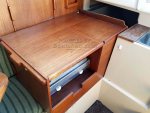
Gas plumbing for my slide-out galley/gimballed hob

chris-s

Well-Known Member
Joined
24 Apr 2019
Messages
816
Visit site
We have a Pegasus 700 for which I am building a slide-out galley unit with a gimballed hob which is what they were originally supplied with but ours has been lost over the years. A bit like what is in the attached photo.

Given the galley unit slides out about a meter, I obviously can't have rigid pipework from the gas locker to the back of the hob so I thought solid pipe from the bottle to a suitable point on the hull, then braided flexible hose to a fixture point on the galley unit followed by flexible hose from there to the hob.

Next tho, how do you avoid the flexible hose that connects to the hob from affecting the gimballing action too much?

Cheers!

Chris
 

Attachments

  • 255372_19eae763f708d4e6d07522be4010cc9e.jpg
    255372_19eae763f708d4e6d07522be4010cc9e.jpg
    147.1 KB · Views: 1
Have the hose long enough that it's not so stiff as to affect the gimbal. There are different schools of thought about braided and unbraided hose in that braided hose is more difficult (impossible?) to inspect.
 
We had a trapper Ts240 with a slide out galley and gimballed stove.

We just had a simple rubber tube from the stove to a hose tail on a stop tap just aft and to the boat hull side of the galley when pulled into the forward position. Solid copper pipe from the gas bottle in the gas locker to stop tap. The pipe was facing backwards so that the loop extended out as the galley was pilled forward.

Personally I would not go any where near any boat with a braided hose as they are impossible to monitor for wear and have been known to fail in use with alarming results.

Our set up was passed by a "gas safe scheme " waterways engineer.
 
I would not fit braided hose either. Solid from the gas locker to the back of the stove with a tap. Then a long loop of soft hose. Lets say your stove inlet is on the right and your supply also comes in on the right, there should be enough room to loop all the way to the left of the space and back, giving enough slack to slide forward and allow it to swing. More or less what TSB said above. Soft, un-reinforced hose is standard in domestic installation here for low pressure and date stamped for limit to change by. Just change it a bit more often.
 
Thanks for the replies. I hadn’t thought about the inspection issue over the braided hose, a very valid point!
 
Strange prejudice against armoured hose. In the motorhome and caravan world opinions are exactly the opposite, although they do not have to cope with gimbals. Our gimbals are not used a lot as we mostly keep the stove fixed with a bolt but we have used armoured hose throughout the life of the boat, 35 years.
 
Strange prejudice against armoured hose. In the motorhome and caravan world opinions are exactly the opposite, although they do not have to cope with gimbals. Our gimbals are not used a lot as we mostly keep the stove fixed with a bolt but we have used armoured hose throughout the life of the boat, 35 years.

Quite agree. My car has braided hoses in the braking system. Never heard anything but good about them. Yes, I know, different application but still relevant I think.
 
Most applications are with the standard red rubberised hose available at Motor Home / Caravan dealers ...

Even fixed as I have in my boat - have sections of red hose ... one is to the gas bottle and other is from the solid copper pipe that runs along the hull to connect cooker.
 
Some old post may gather dust but illustrate the risk of braided hose failure.

http://www.ybw.com/forums/showthread.php?444326-armoured-or-not-quickie

In summary there are further solutions if abrasion may still be a problem . This can be mitigated with either a spiral wire protector around a standard orange tube or the application of a bubble leak detector in your system. I prefered the KISS routine which is to eliminate points of chafe and replace the rubber on a regular interval. I have continued this practice on our current boat removing the armoured hose of unknown date (probably 15 years old!) and replacing with a short length of rubber hose behind the gimballed cooker. I don't have a bubble detector.
 
Some old post may gather dust but illustrate the risk of braided hose failure.

http://www.ybw.com/forums/showthread.php?444326-armoured-or-not-quickie

In summary there are further solutions if abrasion may still be a problem . This can be mitigated with either a spiral wire protector around a standard orange tube or the application of a bubble leak detector in your system. I prefered the KISS routine which is to eliminate points of chafe and replace the rubber on a regular interval. I have continued this practice on our current boat removing the armoured hose of unknown date (probably 15 years old!) and replacing with a short length of rubber hose behind the gimballed cooker. I don't have a bubble detector.


My contribution is there, post 10.

I have an armoured hose still because it was the only one the guy could fit at the time. Will be replacing it soon with the orange stuff.
 
My contribution is there, post 10.

I have an armoured hose still because it was the only one the guy could fit at the time. Will be replacing it soon with the orange stuff.

The "orange stuff" is reinforced high pressure hose, although obviously there is no objection to it being use for low pressures
Except.
The black low pressure hose may be just a tad more flexible and therefore a better choice for a gimballed cooker. It is also easier to get onto the Fulham nozzles than the high pressure hose. ( There are in fact slightly different nozzles for the high pressure hose. )

Lp, "Fulham", nozzle
1-4in-bsp-t-x-10-mm-o-d-hose-nozzle-bsp-taper-male-to-fulham-nozzle-taper-thread_min_6246_L_1.jpg


Hp nozzle:
1-4in-bsp-t-m-x-8-35-mm-o-d-high-pressure-nozzle_min_8870_L_1.jpg
 
Regardless of the hose (which is a minor risk, no matter what type is fitted) .. the major risk is of the stove being stowed (either intentionally, or accidentally) with a burner still lit there should be a safety cutout so that the gas cannot be turned on unless the cooker is fully extended.

There are many normal kitchen stoves that have a fold down, glass cover. All have a cutout to extinguish the gas supply when closed.
 
Id put an on?off tap in an easily accesable position so you can turn it on/off easily. and not behind or over the stove for obvious reasons.. The regulations specify a maxuim lenght for Flexible pipework. seam to remember it being arround a metre.

Steveeasy
 
Id put an on?off tap in an easily accesable position so you can turn it on/off easily. and not behind or over the stove for obvious reasons.. The regulations specify a maxuim lenght for Flexible pipework. seam to remember it being arround a metre.

Steveeasy

It is common practise to fit a local shut off valve but not actually required by any "regulations" that I know of if only one gas appliance is installed.
I have do one, which I use if I have forgotten to shut off the bottle isolator before getting into bed. It's not what you would call easily accessible though!

The max length of hose normally accepted by the BSS is 1 metre but "all hose" systems are recognised.
 
On our boat, I have an electrically operated valve near the bottle, and a manual cutoff in the galley. We close the manual cutoff if leaving the boat and at night, and the electric valve has a switch with an annoyng flashing in the galley. it only gets turned on when the cooker is actually in use.

A electric valve with a switch that was activated only when the cooker was fully extended might be an idea.
 
Daft question:

Gas hose, armoured or not, has a life of about 5 years. Flexible brake pipes on cars are replaced when needed, often after 10+ years of life in a hostile environment, being blasted by dirty water and gravel regularly. What's the difference? Is it just that brakes are relatively fail safe, while the consequences of a gas leak are very likely to be fairly unpleasant?
 
Daft question:

Gas hose, armoured or not, has a life of about 5 years. Flexible brake pipes on cars are replaced when needed, often after 10+ years of life in a hostile environment, being blasted by dirty water and gravel regularly. What's the difference? Is it just that brakes are relatively fail safe, while the consequences of a gas leak are very likely to be fairly unpleasant?

From what I understand it the loss of the plasticizer in the tube due to the LPG flow that reduced the flexibility of the tube and thus the propensity to stiffen and crack due to the loss of the plasticizer.
 
Top