Gas oven hose for BSS

Teddy

Well-Known Member
Joined
12 Aug 2001
Messages
171
Location
Thames non tidal
Visit site
I need to replace my existing coiled copper pipe fitted to my oven with a flexible rubber hose in order to allow easy (or safer) inpection for BSS.
I know it must be less than 1M, but does it have to be metal covered or will a piece of BS3212 (type2) be ok? If the latter, can the connection to the cut off end to the copper pipe be made with jubilee clips?
 
Its all here:
http://www.boatsafetyscheme.org/media/164540/bss guide chap7.pdf

Rubber hose ok but must have the right BS mark on it and it must be pre-made so no jubilee clips.

Pre Assembled hoses are only required for the HP system (ie gas cylinder to regulator).

Cut lengths of hose is acceptable for the LP system but must be fitted on to suitable nozzles and secured by crimp or worm drive clips. ( personally I prefer "mini hose clips" )
12-14mm-mini-screw-clamp-zinc-plated.jpg


BSS section 7.9.5/R applies
 
Last edited:
Thanks for the replies. I am a bit confused over the "suitable nozzles" quoted in 7.9.5/R.

If I removed the copper pipe and left say 50mm of pipe at the oven end and the supply end, would this not be sufficient to connect the rubber hose?

I was also a bit bothered about the heat at the rear of the oven having an adverse effect on the longevity of the pipe, hence the thought that it should be protected by a metal covering. It will be very difficult to replace the oven without potential contact with the rear panel.
 
Thanks for the replies. I am a bit confused over the "suitable nozzles" quoted in 7.9.5/R.

If I removed the copper pipe and left say 50mm of pipe at the oven end and the supply end, would this not be sufficient to connect the rubber hose?

I was also a bit bothered about the heat at the rear of the oven having an adverse effect on the longevity of the pipe, hence the thought that it should be protected by a metal covering. It will be very difficult to replace the oven without potential contact with the rear panel.

I've had the same 'problem' - the pipe inlet is at the back of the cooker and it gets warm. The simplest and most cost effective solution was to fit a standard armoured flexible gas hose with brass pipe at either end to fit the cooker and directly to the tap at the other.
No messing about with other joint or clips - which only introduce other point of possible leakage and so on.
It's not a good idea to fiddle about with fittings not designed to do that particular job - certainly with gas fittings.

(I've just been on another forum where somebody was faffing about to save old olives - cost pence if you can get them. It'll only end in tears - or worse. That's precisely why there are regulations......)
 
Thanks for the replies. I am a bit confused over the "suitable nozzles" quoted in 7.9.5/R.

If I removed the copper pipe and left say 50mm of pipe at the oven end and the supply end, would this not be sufficient to connect the rubber hose?

I was also a bit bothered about the heat at the rear of the oven having an adverse effect on the longevity of the pipe, hence the thought that it should be protected by a metal covering. It will be very difficult to replace the oven without potential contact with the rear panel.

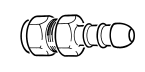
A "Fulham nozzle" is the correct fitting for low pressure hose.
8990.png


Often local suppliers only stock the high pressure hose for which there are slightly different nozzles.
8869.gif


It is possible to get the HP hose onto a Fulham nozzle but it's slightly difficult because it does not stretch as easily as LP hose.

What the BSS is saying is that fitting the hose directly to the copper pipe is not acceptable. Presumably it would fail a BSS inspection.

You can use armoured hose if you wish/ think it is more suitable. These come with ready made ends of various types.

BES is a good source of all the bits and pieces you might need https://www.bes.co.uk

but also refer to Southampton Calor Centre's website http://www.socal.co.uk/

and your local caravan supplies place
 
Last edited:
The very latest information we have not yet had time to put into the gas section on our website is the accepatabilty of a new hose for cooker connections

Pre-made proprietary hose assemblies conforming to BS EN 14800 may be used to connect free-standing cookers to LPG supply pipework. Such hoses must have the standard number marked on the hose assembly or ferrule.

If the mark can be seen, it can be considered as meeting Check Item 7.9.1R

Hope it helps with your search for a replacement hose.
Rob
 
The very latest information we have not yet had time to put into the gas section on our website is the accepatabilty of a new hose for cooker connections

Pre-made proprietary hose assemblies conforming to BS EN 14800 may be used to connect free-standing cookers to LPG supply pipework. Such hoses must have the standard number marked on the hose assembly or ferrule.

If the mark can be seen, it can be considered as meeting Check Item 7.9.1R

Hope it helps with your search for a replacement hose.
Rob

I'm impressed - such attention to duty on a weekend!
Perhaps I should review my view of the BSS process. Perhaps...
 
The very latest information we have not yet had time to put into the gas section on our website is the accepatabilty of a new hose for cooker connections

Pre-made proprietary hose assemblies conforming to BS EN 14800 may be used to connect free-standing cookers to LPG supply pipework. Such hoses must have the standard number marked on the hose assembly or ferrule.

If the mark can be seen, it can be considered as meeting Check Item 7.9.1R

Hope it helps with your search for a replacement hose.
Rob

"May be"
so i assume jubilee clips may be also used
 
"May be"
so i assume jubilee clips may be also used

On LP hoses yes.

Read 7.9.5/R referred to in #3

7.9.5/R REQUIREMENT
Are all LPG hose connections accessible for inspection, of the
correct type, secure and in good condition?
Check the accessibility of all hose connections.
Check types of all LPG hose connections.
Check the type, condition, and completeness of all hose connections.
Pull using light manual force to check security of all hose connections.

All LPG hose connections:
■ must be accessible for inspection; and,
■ must be part of pre-assembled lengths of hose of proprietary
manufacture (high- and low-pressure applications); or use suitable
nozzles secured by crimped or worm-drive clips (low-pressure
applications only); and,
■ must not be made using hose clamps fixed by spring tension; and,
■ must be free of any missing components, cracks, burrs or rough
edges or signs of other damage or deterioration; and,
■ must not be so narrow as to cut into the hose; and,
■ where made with crimped or worm-drive clamps, the clamps must be
suitably sized, that is, not so oversized that the band forms an
elliptical shape, or so undersized that inadequate compression is
achieved; and,
■ be appropriately tight, that is, not so loose that the connection can be
pulled forward or back under light manual force nor so tight that the
hose is excessively pinched.
 
And not forgetting check item 7.11.1
Appliances connected by hose must be provided with an individual shut-off valve at the connection point to the LPG supply pipework

> Note – for an installation with a single appliance connected by a hose the cylinder valve may be classed as the appliance isolation valve.
> Note – ease of access takes precedence over the requirement for the valve to be located at the connection to the LPG supply pipework.
> Note – hob/oven arrangements may be deemed one appliance for the purposes of this check.
.
 
Top