Gas compression connector problem

mattonthesea

Well-Known Member
Joined
28 Nov 2009
Messages
1,519
Location
Bristol
ayearatsea.co.uk
There I was, celebrating with a cup of tea, happy that I'd got all the essential jobs done, and many of the 'nice to have done' ones too, ready for departure on Tues, when I smell gas! With combination of bubble check, manometer tubing and taking the hose off I narrow it down to the compression to hose tail connector on cooker which must have been knocked when I moved cooker temporarily. Easy to replace (fairly old and looking it) I thought.

Problem is that I can't get the olive off. It will twist but not come down the pipe. Has anyone any clever ways of getting it off without damaging the pipe? I did wonder if it's a metric on a imperial pipe - Neptune cooker if that helps but I can't find any info on web - and it's jammed?

Thanks in advance
 
There I was, celebrating with a cup of tea, happy that I'd got all the essential jobs done, and many of the 'nice to have done' ones too, ready for departure on Tues, when I smell gas! With combination of bubble check, manometer tubing and taking the hose off I narrow it down to the compression to hose tail connector on cooker which must have been knocked when I moved cooker temporarily. Easy to replace (fairly old and looking it) I thought.

Problem is that I can't get the olive off. It will twist but not come down the pipe. Has anyone any clever ways of getting it off without damaging the pipe? I did wonder if it's a metric on a imperial pipe - Neptune cooker if that helps but I can't find any info on web - and it's jammed?

Thanks in advance

olives are a "once use", designed to nip the pipe,which is why you cant remove it
 
+ the brass ones don't really clamp on the pipes. I always throw the OEM brass olives away whenever I buy compression fittings and replace them with copper ones. An alternative is to smear the olive with Fernox LSX (from your puller's merchant), leave to gell a bit then tighten up. I did that on all my original gas connections and the great thing about it is that when you undo one to replace, say, the flexi hose to the cooker, you can clean it off y rubbing with your fingers.
 
You could try putting a saw cut across the olive nearly down to the pipe and then try to lever the olive apart with a screwdriver. If the pipe gets damaged it will need cutting back. Copper olives should be used on copper gas pipes. I normally make the joint up nearly fully tight, undo the joint and smear a small amount of 'gas approved' jointing compound around the olive and then make the joint up.
 
There I was, celebrating with a cup of tea, happy that I'd got all the essential jobs done, and many of the 'nice to have done' ones too, ready for departure on Tues, when I smell gas! With combination of bubble check, manometer tubing and taking the hose off I narrow it down to the compression to hose tail connector on cooker which must have been knocked when I moved cooker temporarily. Easy to replace (fairly old and looking it) I thought.

Problem is that I can't get the olive off. It will twist but not come down the pipe. Has anyone any clever ways of getting it off without damaging the pipe? I did wonder if it's a metric on a imperial pipe - Neptune cooker if that helps but I can't find any info on web - and it's jammed?

Thanks in advance

If it is loose but will not pull off it sounds as though it has been over-tightened and has crushed the pipe.

Ideally the pipe should be replaced or cut back. I guess neither are options. You may have to resort to sealing the joint with jointing compound, unsatisfactory though that may be.

If you can cut it off or devise a method of pulling it off using the nut which presumably is still on the pipe you can measure the pipe diameter with a vernier caliper.
 
I've carefully cut olives off with a hacksaw cut diagonally. Make sure not to damage the tail though.
The advice on the calor website is that no jointing paste is necessary.
 
...Problem is that I can't get the olive off. It will twist but not come down the pipe. Has anyone any clever ways of getting it off without damaging the pipe?...

If the olive is so hard to remove it's probably damaged the end of the pipe and you won't get a seal with a new olive. Cut off behind the olive and start again, you'll only lose 10-15mm of pipe.
 
One of the many uses of a rotary tool and Dremel™ (brand) fibre cutting wheel. Cut lengthwise into the olive, almost to the pipe (but don't touch it), then split it with a twist of a flathead screwdriver.

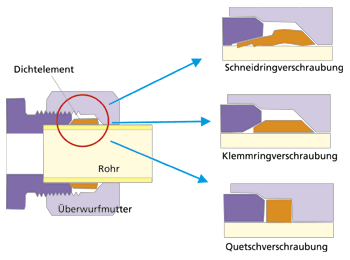
Note that there are several different (but similar looking) types of these fittings. The cutting ring type (top one in the illustration below) will cut into the pipe, cannot be removed without splitting it and when re-using the pipe you must not re-use the groove it left - ideally cut off a bit of the pipe or at least move the ring further inwards. These are typically used in German gas systems, including those on Bavaria yachts.

1001.gif
 
If the olive is so hard to remove it's probably damaged the end of the pipe and you won't get a seal with a new olive. Cut off behind the olive and start again, you'll only lose 10-15mm of pipe.

If the olive is free to rotate on the pipe, it will come off if you cut in front of it?
A lot of these problems are due to mixing metric and imperial parts.
 
Thanks all

I checked and a new 8mm copper olive would fit on the pipe so I cut off the old one and reconnected with the new. All fine except that my detective work is not as good as I thought it was. There was still a leak; turned out to be the other compression joint as well (the one that goes through the work surface). The surface was just thick enough for the compression nut to not quite get to full tightness on the olive. When I did some work on the sink I must have knocked the pipework that must have just been holding gas tight.

Sorted that and all is fine ;)
 
Thanks all

I checked and a new 8mm copper olive would fit on the pipe so I cut off the old one and reconnected with the new. All fine except that my detective work is not as good as I thought it was. There was still a leak; turned out to be the other compression joint as well (the one that goes through the work surface). The surface was just thick enough for the compression nut to not quite get to full tightness on the olive. When I did some work on the sink I must have knocked the pipework that must have just been holding gas tight.

Sorted that and all is fine ;)

If you have to take a pipe through a bulkhead or work-surface with a bulkhead fitting you can avoid introducing two potential leakage points by boring out the central land in the bulkhead fitting so that the pipe can pass right through it without being cut. The compression joints then only serve as supports for the pipe. In fact you need only use one, even cutting the other off it it makes installation easier.
 
Top