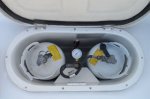
Gas bottle storage

These are the requirements in Australia.

Which requirements does a cylinder compartment or locker on a boat have to fulfil?

  • No more than two 15kg gas cylinders are allowed inside the LP Gas compartment
  • The compartment should face away any openings
  • The bottom edge of the door opening has to be no less than 100 mm above the compartment floor
  • Surrounded by water the compartment has to be water and corrosion resistant
  • Always secure the cylinder in the compartment
  • The compartment has to be sealed to prevent gas vapour from entering the boat
  • The compartment has to be easily accessible and permit easy removal without the use from any tool. A key to secure the compartment is permitted.
  • A drain above the water line has to be included to excess water easily
  • The compartment should not face the direction of the travel
  • Don’t store anything else than the cylinders or associated cylinder equipment in the compartment. Certainly not store any electrical equipment, batteries or ignition sources into the compartment. Except a non-sparking shut-off device. A sticker on the compartment has to inform about that.

    https://gasequipment.com.au/6-essential-questions-to-answer-before-installing-lp-gas-on-a-boat/
 
Last edited:
Any Gas work to remodernise a boat or a new installtion where gas will be used no matter if on boats or houses , will fall under the Gas saftey umberella and must be fitted by a qualified gas fitter , this was due to the number of deaths on Narrow Boats many years ago , it is not just CO2 but CO and the Gas itself that will cause death ,
older installations are not covered as they have been installed before legislation but this will be activated once you change , replace, modify your system , as stated watch your insurance, if you blow up because you did the work I suspect you will have issues , were as if you blow up but show them a certificate the Gas fitter is liable and you showed due dillengence .

Can you tell me what legislation requires this? I believe it's a requirement for houseboats and inland waterways craft, but not for sea-going yachts.
 
Fitted a complete new locker on my 1989 Colvic Watson, the gas bottle must be secure and also the locker drainage at the bottom to outside the boat.

View attachment 78921View attachment 78920

Side opening gas lockers are specifically forbidden by ABYC in the US. They must be top opening. The gasket will leak, and if it does not, when you open the door the gas comes out. Same for lockers inside the cockpit.

Just sayin'.

propane%u00252Blocker.jpg
 
Side opening gas lockers are specifically forbidden by ABYC in the US. They must be top opening. The gasket will leak, and if it does not, when you open the door the gas comes out. Same for lockers inside the cockpit.

Just sayin'.

ABYC standards are voluntary guidance though, rather than legal requirements. My Bavaria has a side-opening gas locker in the (self draining) cockpit; these boats are sold in the US.

View attachment 78931
 
ABYC standards are voluntary guidance though, rather than legal requirements. My Bavaria has a side-opening gas locker in the (self draining) cockpit; these boats are sold in the US.

View attachment 78931

Yes, smart guidance, generally based on accident history. Just because they are sold that way does not mean it is a good idea. Boats shows are full of bad ideas. However, CE standards allow for open transoms as being "on deck," so long as there is a sufficient companionway sill. I believe your Bavaria is open transom (not just self-draining). I'm pretty sure the Colvic Watson is NOT open transom.

It also has no gasket and no drain. It is only a gas locker in the sense that it is separated from the cabin. Also, remember (you know this but not all of the readers do) that drains that open below the water line do NOT drain propane--they are sealed by the water.
 
Any Gas work to remodernise a boat or a new installtion where gas will be used no matter if on boats or houses , will fall under the Gas saftey umberella and must be fitted by a qualified gas fitter

Nope. Gas Safety (Installation and Use) Regs 1998 as amended specifically exclude seagoing vessels via regulation 2(5).

No doubt charter yachts are then covered by coding, and I'm sure the MCA (possibly via class societies, P&I clubs, and all that jazz) has something to say about merchant shipping. And of course the inland waterways have the well-known Boat Safety Scheme, the technical side of which tends to be taken as useful guidance by those of us at sea too. But if you're going to assert that private pleasure yachts require certified gas fitters by law then you're going to have to point to the actual legislation that says so.

Pete
 
Nope. Gas Safety (Installation and Use) Regs 1998 as amended specifically exclude seagoing vessels via regulation 2(5).

Yes, that was the legislation I had in mind. People are very confused by all the incorrect information bandied about on gas systems.
 
Nope. Gas Safety (Installation and Use) Regs 1998 as amended specifically exclude seagoing vessels via regulation 2(5).

No doubt charter yachts are then covered by coding, and I'm sure the MCA (possibly via class societies, P&I clubs, and all that jazz) has something to say about merchant shipping. And of course the inland waterways have the well-known Boat Safety Scheme, the technical side of which tends to be taken as useful guidance by those of us at sea too. But if you're going to assert that private pleasure yachts require certified gas fitters by law then you're going to have to point to the actual legislation that says so.

Pete


Yes indeed but there is a clause in that argument
Regulation 2(5)–(6): Seagoing ships and hovercraft are fully excludedfrom the scope of GSIUR. Boats, vehicles and caravans may be excluded, depending on the circumstances (see paragraphs 66–72)

Boats67 GSIUR applies to certain boats not requiring a load-line certificate, as specified in regulation 2(5)(c). These include:(a) boats (both permanently moored and those capable of navigation) whichare hired out in the course of a business, eg boats used for holidayaccommodation;(b) any boat (including those privately owned/occupied) used solely or primarily for domestic or residential purposes, such as houseboats and those used for cruising but in which the owner/user lives for most ofthe time;(c) boats made available to the public in the course of a business carriedout from the vessel, eg floating restaurants and public houses

Now I not a lawyer so this is only how I interpret it in one case they say there exempt , if using part time for lesiure but as a live aboard then there not , so the definition is a live a board

But Really does it matter what the Regulations say , good God if you need an expert for your house why not use one for your boat
your life at risk and those that come sailing with you and those that moor next to you , some people think that the risk is all theres but there is always inoccents as well that can get caught up in your relaxed I dont give a dam no regualtions on my boat attitude
IMHO ofc :encouragement:
So spare me the lectures
http://www.hse.gov.uk/pubns/priced/l56.pdf
 
So spare me the lectures

In fairness, you were the one lecturing, when you claimed incorrectly that "Any Gas work to remodernise a boat or a new installtion where gas will be used no matter if on boats or houses , will fall under the Gas saftey umberella and must be fitted by a qualified gas fitter" - which isn't true.

The RYA's guidance is that "For other private pleasure craft, where the BSS does not apply, there is still no general legal requirement in UK waters to have the gas installation fitted, repaired or inspected by a qualified engineer (unless there is someone living or working on board or local regulations may apply)."
https://www.rya.org.uk/knowledge-advice/safe-boating/look-after-yourself/Pages/gas.aspx
 
In fairness, you were the one lecturing, when you claimed incorrectly that "Any Gas work to remodernise a boat or a new installtion where gas will be used no matter if on boats or houses , will fall under the Gas saftey umberella and must be fitted by a qualified gas fitter" - which isn't true.

The RYA's guidance is that "For other private pleasure craft, where the BSS does not apply, there is still no general legal requirement in UK waters to have the gas installation fitted, repaired or inspected by a qualified engineer (unless there is someone living or working on board or local regulations may apply)."
https://www.rya.org.uk/knowledge-advice/safe-boating/look-after-yourself/Pages/gas.aspx

I think that the HSE excutive outranks the RYA on this, pretty plain in black and white as I posted , the argument is liveaboard and navigation and the term ship does not represent a boat and espically the load line which boats do not have , like I said no lawyer me or insurance borker , but if they can get away with paying out they will and if you cause a death by your shoddy gas works on your boat and you let it out rented toa freind or a live aboard I would expect the CP to have a look at charges , but yet again Im no lawyer
Are you, do you want to take the risk , not me Im A sensible boat owner
 
I think that the HSE excutive outranks the RYA on this, pretty plain in black and white as I posted , the argument is liveaboard and navigation and the term ship does not represent a boat and espically the load line which boats do not have , like I said no lawyer me or insurance borker , but if they can get away with paying out they will and if you cause a death by your shoddy gas works on your boat and you let it out rented toa freind or a live aboard I would expect the CP to have a look at charges , but yet again Im no lawyer
Are you, do you want to take the risk , not me Im A sensible boat owner

You now seem to be admitting that it isn't necessary to have any work on most boats' gas systems done by a Gas Safe engineer, which is correct. LPG on boats is perfectly safe if common-sense precautions are taken. If I want to replace some LPG piping, or fit a new regulator, I'll do it myself, it's quite straightforward and well within the abilities of most practical boat owners.
 
You now seem to be admitting that it isn't necessary to have any work on most boats' gas systems done by a Gas Safe engineer, which is correct. LPG on boats is perfectly safe if common-sense precautions are taken. If I want to replace some LPG piping, or fit a new regulator, I'll do it myself, it's quite straightforward and well within the abilities of most practical boat owners.


You asked me for the information
I gave it to you
I aslo interpted it as best I could
you then argue that the RYA know better
I corrected you
The dialouge in the HSe Booklet is Vague but clealry states without objection the rules to be followed , which I have displayed this would superseed anything I have said in prevoius quotes (this is obvious to me) and others
I have already said that the term Live aboard is the point that Gas Engineer would need to be called as I see it , I aslo stated that as good practice it is best to get a qaulifed gas fitter to look at any major work getting carried out
At no point did I say you cannot do this yourself, but that you should get it inspected my a qualified fitter , the Law clealry states when that Gas fitter should be required . again which superseeds my first qoute :encouragement:
You are like a person that cannot be wrong and need to constanly argue for the last point when if you took the time to read as you have requested from me then there would be no need for this game of tennis ,
But I have had the pleasure of those that cannot admit something , makes me chuckle , I wonder do you look in the mirror and argue with yourself :p
 
Last edited:
When I bought my present boat, she came with a "Gas Safe" certificate, duly signed by the certificated numpty who had "improved" the installation for the previous owner. It was a shockingly poor job, with for example, a bubble tester in a position where it was impossible for it to be seen. He obviously realised this, as he hadn't bothered to put the fluid into it.
 
Side opening gas lockers are specifically forbidden by ABYC in the US. They must be top opening. The gasket will leak, and if it does not, when you open the door the gas comes out. Same for lockers inside the cockpit.

Just sayin'.

View attachment 78930

Err you lost me, the sealed gas locker is in the open cockpit and also has a 20 mm dia drain to outside the boat 'above the waterline', also I have a gas detector before the gas bottle which together with the gas bottle valve is OFF when not in use, so where is the gas coming from when you open the door ????
 
The way I see it is that if you are a practical boat owner who can work on all systems on the boat, do installations to a high standard, then a gas installation is no different. How to do it and what components should be used is easily researched on the internet.
With our gas bottle mounted on the stern rail and a single continues copper pipe installed through the boat to the cooker, it really isnt rocket science.
 
If it was so bad, you should have reported the certified numpty to their certifying organisation.
When I bought my present boat, she came with a "Gas Safe" certificate, duly signed by the certificated numpty who had "improved" the installation for the previous owner. It was a shockingly poor job, with for example, a bubble tester in a position where it was impossible for it to be seen. He obviously realised this, as he hadn't bothered to put the fluid into it.
 
If it was so bad, you should have reported the certified numpty to their certifying organisation.

The previous owner certainly should have done. I couldn't see the point. The certificated numpty didn't do the work for me. I am perfectly capable of connecting up some bits of copper pipe and fittings in a safe and tidy manner, so re-did it myself.
 
Top