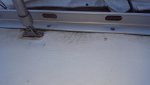
Gaps in the hull to deck joint

Yannis

New Member
Joined
30 Nov 2020
Messages
14
Visit site
Hello. I am thinking of buying a second hand boat. It is Jeanneau Sun Odyssey 34.2 (2001). I noticed that it has some gaps between the toe rail and the deck. Does anyone has an experience of such gaps?
 

Attachments
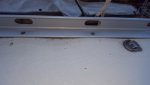
  • 20230128_144209.jpg
    20230128_144209.jpg
    740.2 KB · Views: 249
  • 20230128_144203.jpg
    20230128_144203.jpg
    674.5 KB · Views: 242
Last edited:
Not uncommon. The important seal is between the GRP deck and hull. Might be sensible to mask it off and squirt some sealant into the gap to prevent dirt from building up in there. Ask your surveyor for advice.
 
Not uncommon. The important seal is between the GRP deck and hull. Might be sensible to mask it off and squirt some sealant into the gap to prevent dirt from building up in there. Ask your surveyor for advice.
A good bargaining point for reducing the sale price.
If you do buy the boat, clean under the toerail before squirting in sealant. A powerwasher or a piece of string and some soap and water should do it.
 
The Jeanneau 34.2 is not a 2021 model - these were built from 1996 to 2002. After this date the replacement model was the Jeanneau 35, then the 36i, then 349, and all these had injection moulded decks. I think the 34.2 had "conventional" balsa cored decks. I would not put sealant in: after a few years it will get blackened and look worse, and be very difficult to get out of the fine diamond moulded deck surface to renew. There will be sealant/adhesive holding down the alloy toerail as well as the big self-tapping screws.
 
The Jeanneau 34.2 is not a 2021 model - these were built from 1996 to 2002. After this date the replacement model was the Jeanneau 35, then the 36i, then 349, and all these had injection moulded decks. I think the 34.2 had "conventional" balsa cored decks. I would not put sealant in: after a few years it will get blackened and look worse, and be very difficult to get out of the fine diamond moulded deck surface to renew. There will be sealant/adhesive holding down the alloy toerail as well as the big self-tapping screws.

Thanks for your answer. I have made a mistake in the year. It is 2001. Yes deck is balsa cored.
 
To me, that problem looks like a quality issue. The toerail is straight but the deck has gone droopy between the fixings for the toerail. It could be that the grp is too thin. I wouldn't expect the balsa core to go all the way under the toerail so the droopy bit must be solid glass. It looks like not enough glass was laid up in the mould when the deck was built. It would be a walk away issue for me. Find a better built boat.
 
Looking at the photos it looks as though the toerail is straight, but the deck surface is not: only pulled up hard to the toerail where the screws are. As this boat has a slotted toerail it could be that the screws are actually machine screws with nuts underneath, but all later models just used big self-tappers and had no slots in the toerail to stop users putting things like spinnaker sheet blocks attached to the slots. I worry about the extra fittings into the deck more than the dips. One of the fittings (bimini frame?) is into the scupper drain hole area, another (anchor point for something) is into the deck itself, with no sign that the fittings are even bedded down on sealant.
 
My 1986 Gib'Sea has draining slots under the toe rail, a real pain when they fill with leaves, they are clearly defined. That looks quite different.
 
Yes, the deck dips between the screws, but the one recess where the frame attachment has been screwed is on one of the scupper drain slot moulding recesses. They do block very easily and are a pain to clear out fully. I wonder if the deck moulding was still not quite cured hard when it was fitted to the hull?

As an aside when a supposedly quality yacht building boatyard replaced one of my Jeanneau toerails, as part of a series of botches, as a finishing touch they put extra Sikaflex in to fill up the "gaps" in the small scupper mouldings, so the deck there then had no drain scuppers. They sort of fixed it all eventually, though some of the damage is still visible many years later. After the MD came to look in response to my complaint what should have been a simple job they sent grownups. It took weeks to undo the damage they'd done in other areas. I should have stood over the apprentices they sent - at least I hope they were apprentices on their first week.
 
............. I worry about the extra fittings into the deck more than the dips. One of the fittings (bimini frame?) is into the scupper drain hole area, another (anchor point for something) is into the deck itself, with no sign that the fittings are even bedded down on sealant.

It's a good point, that small well is probably the worst place to put a new fitting even if bedded properly, which looks doubtful.
 
Looking at the photos it looks as though the toerail is straight, but the deck surface is not: only pulled up hard to the toerail where the screws are. As this boat has a slotted toerail it could be that the screws are actually machine screws with nuts underneath, but all later models just used big self-tappers and had no slots in the toerail to stop users putting things like spinnaker sheet blocks attached to the slots. I worry about the extra fittings into the deck more than the dips. One of the fittings (bimini frame?) is into the scupper drain hole area, another (anchor point for something) is into the deck itself, with no sign that the fittings are even bedded down on sealant.
Thanks!!
yes it is the bimini frame.
 
Yes, the deck dips between the screws, but the one recess where the frame attachment has been screwed is on one of the scupper drain slot moulding recesses. They do block very easily and are a pain to clear out fully. I wonder if the deck moulding was still not quite cured hard when it was fitted to the hull?

As an aside when a supposedly quality yacht building boatyard replaced one of my Jeanneau toerails, as part of a series of botches, as a finishing touch they put extra Sikaflex in to fill up the "gaps" in the small scupper mouldings, so the deck there then had no drain scuppers. They sort of fixed it all eventually, though some of the damage is still visible many years later. After the MD came to look in response to my complaint what should have been a simple job they sent grownups. It took weeks to undo the damage they'd done in other areas. I should have stood over the apprentices they sent - at least I hope they were apprentices on their first week.
Thanks. Good that you managed to fix it.
 
That could be a bad core , I would get someone with tramex or sovereign meter to check moisture level of the deck all over and get them to sound the deck with a hammer before going any further, I know quite bit about bad cores as I’m currently replacing the fore deck core from the inside and it’s not a nice job
 
If the deck to hull joint is compromised you should see sign of water damage inside, or moisture, if it is in a cockpit locker.
One guess to what could be cause of the wavy deck, is that excessive force on the rail has lifted it and the deck, but then I would expect to see deformation of the rail, too.
Another guess is that the screws that held the deck to the hull, while the glue was curing, are deliberately spaced in between screws of the rail, and if for some reason the glue had started to cure before they screwed this section, the excess glue would not squeeze out as supposed and block up the deck. The case of the first, it is bad, the second is cosmetic.
 
I
If the deck to hull joint is compromised you should see sign of water damage inside, or moisture, if it is in a cockpit locker.
One guess to what could be cause of the wavy deck, is that excessive force on the rail has lifted it and the deck, but then I would expect to see deformation of the rail, too.
Another guess is that the screws that held the deck to the hull, while the glue was curing, are deliberately spaced in between screws of the rail, and if for some reason the glue had started to cure before they screwed this section, the excess glue would not squeeze out as supposed and block up the deck. The case of the first, it is bad, the second is cosmetic.
I don't think that would be an issue if the deck laminate was thick enough. This is a structural part of the boat. If this part of the boat isn't built substantially I would walk away. Unlike some boat that glass the deck and hull joint so the boat effectively becomes monocoque, this boat is using glue and screws. You would hope that the glass at the junction was strong enough to not deform between the screws. This is not a cosmetic issue it's about hull strength, integrity and water tightness
 
I

I don't think that would be an issue if the deck laminate was thick enough. This is a structural part of the boat. If this part of the boat isn't built substantially I would walk away. Unlike some boat that glass the deck and hull joint so the boat effectively becomes monocoque, this boat is using glue and screws. You would hope that the glass at the junction was strong enough to not deform between the screws. This is not a cosmetic issue it's about hull strength, integrity and water tightness
Well, it has managed 22 years without falling apart and would guess that it has been like that from new. Amazing how one can draw such a definitive view of structural integrity from just one photo if a small section of the deck. Who needs a surveyor?
 
Top